Iran has added Lebanon and Hezbollah to its red lines in ongoing negotiations with the United States, establishing that future Israeli military operations in the country will trigger direct Iranian retaliation—a significant expansion of Tehran’s conditions for a peace deal.
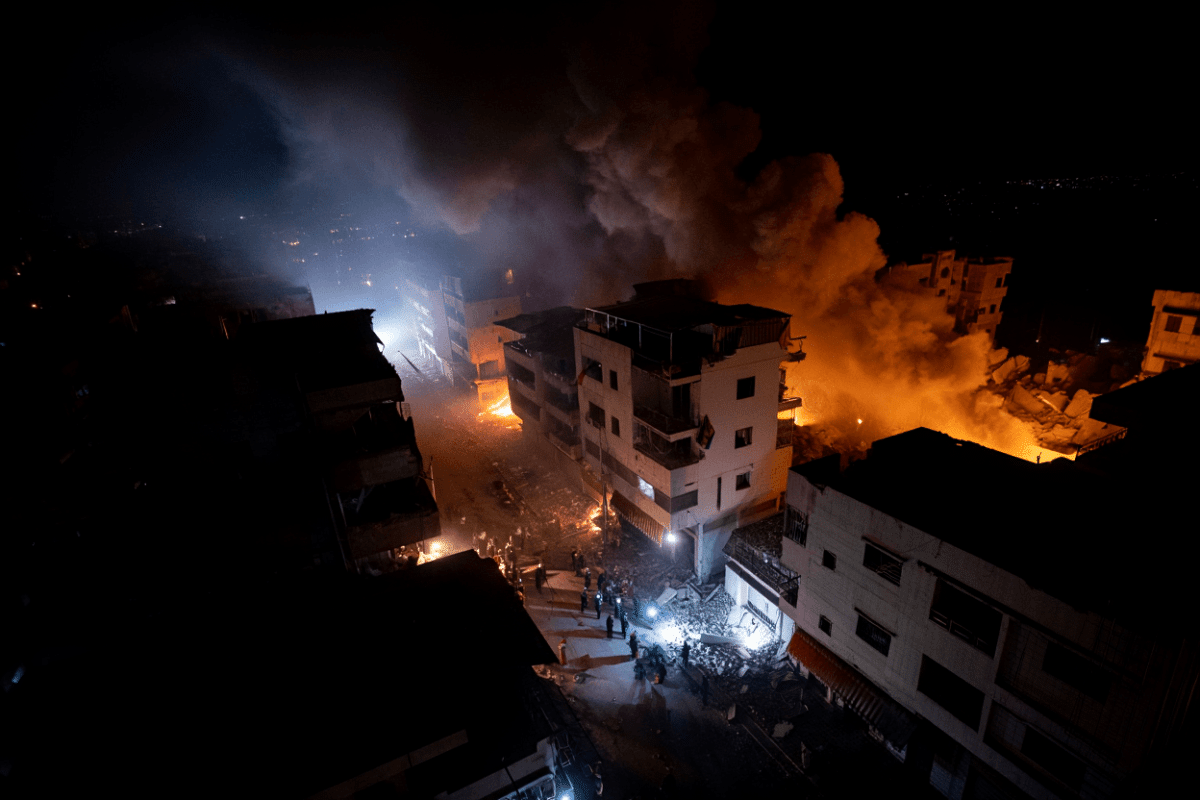
On June 8, 2026, Iran launched a barrage of missiles at Israel in response to Israeli strikes on Beirut’s southern suburbs, according to Iran International. The strike marked the first time Iran directly retaliated for an attack on a country other than Iran itself, signaling a fundamental shift in its deterrence strategy.
Iran’s Revolutionary Guards declared an end to the immediate operation but warned that further Israeli strikes in Lebanon would be met with “harsher” attacks, according to multiple reports. This established Lebanon as a hard boundary that Iran is now willing to enforce militarily—a departure from its previous posture of using proxy forces like Hezbollah to project regional power.
From Proxies to Direct Defense
Iran’s original red lines in negotiations, laid out in April 2026, focused on nuclear issues, control of the Strait of Hormuz, and sanctions relief, according to the Wall Street Journal and Times of Israel. The addition of Lebanon represents a strategic recalibration.
According to Iran International, Iranian officials and media outlets framed the missile strike as “the official declaration of a strategic doctrine” in which Iran would defend its regional allies directly rather than rely solely on proxy networks. Parliament Speaker Mohammad Bagher Ghalibaf, who heads Iran’s negotiating team with Washington, argued that Iran had “overturned the equation of a ceasefire on paper and its repeated violation on the battlefield,” according to the outlet.
Analysts say Iran is attempting to preserve what it calls a “unity of fronts” strategy—keeping its network of regional allies intact. “Iran’s fear is that if it looks like it cannot protect Hezbollah, its most important proxy, then its regional proxies will be undermined one after the other,” said Nadim Houry, executive director of the Arab Reform Initiative, according to Al Jazeera.
A Condition for Peace
Iran has now made a ceasefire in Lebanon a condition for any broader peace agreement with the United States. Reuters reported in June 2026 that “Iran has insisted on a halt to Israeli attacks in Lebanon as a condition of any deal to end the war.” CBS News similarly reported that Iran’s government stated it would not accept a deal without addressing the Lebanon conflict.
This approach complicates negotiations because the United States and Israel have sought to separate the Israeli military campaign in Lebanon from the wider US-Israel war on Iran. However, Iran has consistently rejected this separation, according to Al Jazeera reporting. “Tehran’s message is: Together in war, together in peace,” said Negar Mortazavi, senior fellow at the Center for International Policy, in an Al Jazeera interview.
The escalation has raised critical questions about whether a durable peace is achievable. According to Al Jazeera, experts warn that if Washington cannot prevent Israeli actions Tehran considers unacceptable, Iran may conclude the US is incapable of delivering the comprehensive ceasefire it demands. One analyst quoted by Al Jazeera noted that “this is a new ‘red line’, but it is a flexible ‘red line'”—suggesting Iran wants ambiguity to deter escalation while preserving diplomatic space.
At least 3,613 people have been killed and more than one million displaced in Lebanon since fighting resumed in March 2026, according to Lebanon’s Health Ministry figures cited by Al Jazeera. Israel has occupied nearly one-fifth of the country, and despite a US-mediated ceasefire that began in April, Israeli operations have continued, including strikes on the Lebanese capital.
The timing of Iran’s missile strike—following an Israeli raid on Beirut despite US assurances that such attacks would not occur—underscores Tehran’s determination to enforce its new boundary. Whether this red line will hold or trigger further escalation depends heavily on whether the Trump administration can restrain Israeli military operations in Lebanon, analysts say.
Sources
- Iran International — Iranian officials’ statements on Lebanon as a new red line and strategic doctrine shift; details of the June 8 missile strike and Iranian media analysis
- Al Jazeera — Expert analysis on Iran’s shift from proxy-based deterrence to direct state action; details on Israeli strikes and ceasefire dynamics; casualty figures from Lebanon’s Health Ministry
- Reuters — Iran’s insistence on Lebanon ceasefire as a condition for any US-Iran deal
- CBS News — Iran’s stated condition linking Lebanon ceasefire to broader peace agreement
- Wall Street Journal — Original Iranian red lines in April 2026 negotiations (nuclear program, Strait of Hormuz)
- Times of Israel — US and Iranian red lines from failed April 2026 talks in Islamabad