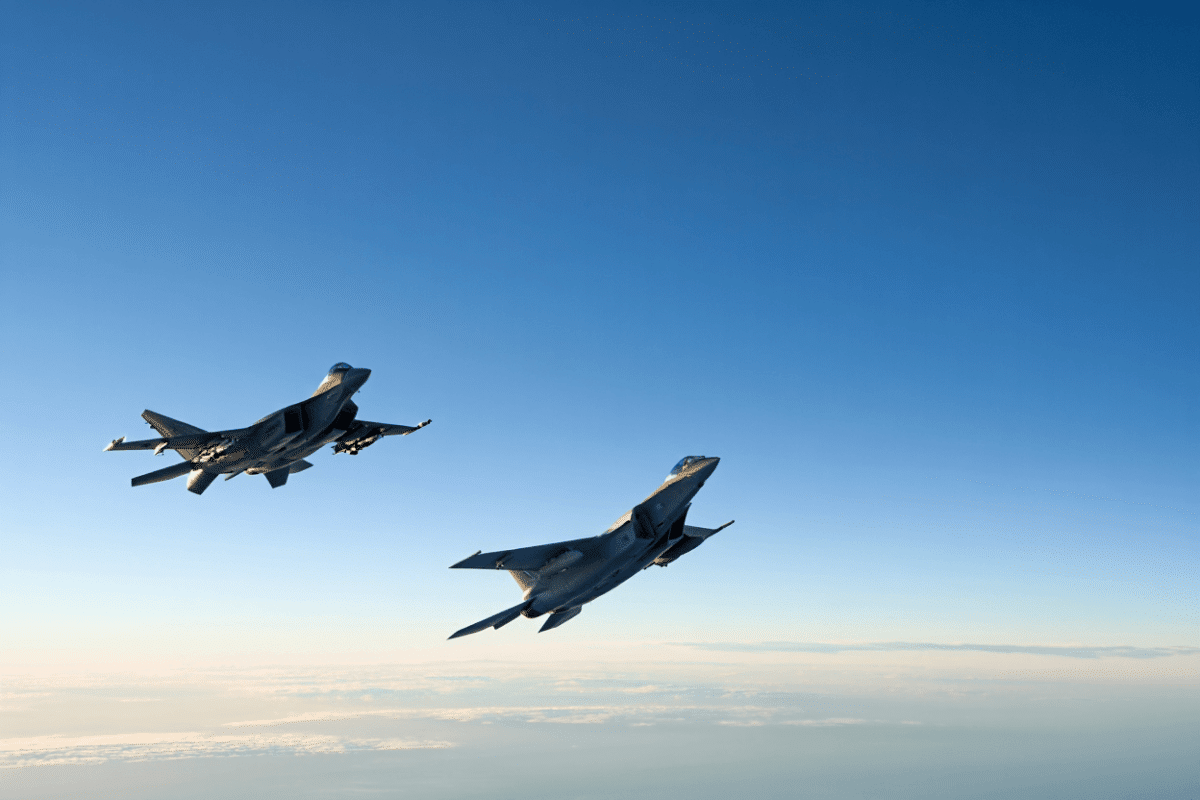
The Pentagon is considering long-term multiyear procurement contracts for the F-35 Lightning II and F-15EX Eagle II that could reduce aircraft costs by 5-15% per unit, according to lawmakers and defense industry analysis. The proposal would shift from annual purchasing to 5-year fixed contracts, allowing defense contractors to optimize production and reduce overhead expenses while securing stable demand for both platforms through the 2030s.
🔥 Quick Facts
- F-35 unit cost: $80-$120 million depending on variant and configuration (F-35A averages $95M actual flyaway cost)
- F-15EX unit cost: $90-$99 million per aircraft, with potential 5-15% reduction through multiyear contracts
- Pentagon FY2027 budget requests 85 F-35s and 24 F-15EXs, continuing major procurement acceleration
- Total life-cycle cost remains $2.1 trillion for F-35 program through 2088, with sustainment accounting for 75% of expenses
- Multiyear buy proposal pending NDAA approval to take effect in FY2027 defense budget cycle
Why Cost Reduction Matters in Fighter Jet Procurement
Fighter aircraft acquisition represents the largest segment of U.S. defense spending. Military aircraft account for more than $553 billion of the $1.058 trillion annual defense budget, making production efficiency critical to national security planning.
Current annual purchasing forces both Lockheed Martin (F-35 manufacturer) and Boeing (F-15EX manufacturer) to maintain separate production lines for each year’s order. This fragmented approach increases per-unit costs through repeated setup labor, inventory management, and supplier coordination. A multiyear contract would allow both contractors to establish continuous production schedules, negotiate better supplier rates, and reduce administrative overhead—savings that transfer directly to the Pentagon’s budget.
How Multiyear Contracts Deliver Cost Savings
The 5-15% cost reduction estimate comes from historical precedent. In previous multiyear buys for military aircraft, fixed production runs allowed contractors to achieve improvements in three key areas:
1. Production Efficiency: Continuous manufacturing eliminates costly production line restarts between fiscal years. Boeing and Lockheed Martin can retain trained workforce teams, maintain fixed-pace assembly lines, and reduce per-hour labor costs through consistent output.
2. Supply Chain Negotiations: Guaranteed 5-year demand allows subcontractors to adjust inventory planning and negotiate volume discounts. RTX Corporation (avionics and defense systems supplier) and other Tier-1 vendors can reduce safety stock, improving cost structures across the supply base.
3. Engineering and Overhead: Design modifications and quality improvements are amortized across larger production batches. Annual contracts force each batch through separate engineering reviews; multiyear contracts allow rolling improvements without restarting the full design-validation cycle.
Current F-35 and F-15EX Unit Costs Compared
| Metric | F-35A (Lockheed Martin) | F-15EX (Boeing) |
| Flyaway Unit Cost (Actual) | $80–$95M | $90–$99M |
| Total Unit Cost (w/ Support) | $110.3M | ~$115M (estimated) |
| Annual Sustainment/Jet | $6.6M (target: $4.1M) | TBA (estimated $7M–$8M) |
| FY2027 Procurement Request | 38 aircraft | 24 aircraft |
| Estimated Savings (Multiyear) | $3.8–$7.2M per aircraft | $4.5–$8.9M per aircraft |
At the lower end of the savings range, a 5-year multiyear buy of 150 F-35s (typical USAF annual purchase) would generate $570M–$1.08B in total savings, equivalent to procuring 6–12 additional aircraft with existing budget authority.
“Multiyear contracts provide stability to the defense industrial base and allow for more predictable production schedules. The contractor can plan workforce requirements with confidence, negotiate better terms with suppliers, and invest in manufacturing efficiency that directly benefits the government.”
— Analysis based on Congressional Research Service testimony on defense acquisition economics, 2026
Legislative Push and NDAA Proposals
U.S. Senator Thom Budd (R-NC) has sponsored multiple bills in the National Defense Authorization Act (NDAA) to expedite multiyear procurement authority for both aircraft programs. The proposal would authorize the Pentagon to enter firm, fixed-price contracts beginning in FY2027, with options to extend through FY2031.
Key legislative elements include mandatory annual reporting to Congress on cost-reduction achievements, performance metrics tied to meeting production schedules, and price adjustment clauses protecting the government if inflation exceeds 3% annually. The proposal also requires both contractors to reinvest a portion of realized cost savings into advanced manufacturing technology and workforce training.
Defense policy experts note this approach mirrors successful multiyear buys for KC-46 aerial refueling tankers and C-130J transport aircraft, though those programs faced different cost-growth pressures than modern fighter acquisitions.
Industry Response and Implementation Timeline
Lockheed Martin and Boeing have both signaled readiness to accept multiyear contracts, with production capacity already ramping to meet increased Pentagon demand. F-35 production is projected to reach full operational capacity by Q2 2027, with 150+ aircraft annually achievable under current facility expansion. F-15EX production targets 2 aircraft monthly by mid-2027, requiring sustained orders to justify facility investment.
Pentagon procurement officials have indicated contract finalization would occur by Q3 2026 if NDAA legislation passes current committees, enabling FY2027 budget execution under multiyear terms. Initial procurement orders under the new framework would cover aircraft production slots 151–300 (F-35) and aircraft 96–120 (F-15EX) within the respective programs.
What Cost Reductions Mean for Air Force Modernization
Realized savings from the 5-15% cost reduction could be reallocated to three critical initiatives: next-generation fighter development (the F-47 stealth fighter receiving $5 billion in FY2027 budget authority), pilot retention programs addressing critical shortages, and base infrastructure modernization required to operate larger fleets of advanced aircraft.
Sustainment costs remain the largest long-term expense for both platforms. The F-35 program’s $1.58 trillion life-cycle estimate (up from $1.1 trillion in prior estimates) reflects growing sustainment requirements across a fleet projected to exceed 2,400 aircraft by 2044. Every 1% reduction in sustainment costs translates to $15.8 billion in program savings over the aircraft’s operational life.
What Happens Next in the Budget Cycle?
The multiyear buy proposal faces three remaining approval gates: House Armed Services Committee markup (expected by June 15, 2026), Senate Armed Services Committee approval (expected by June 22, 2026), and final NDAA passage (projected by July 31, 2026). Assuming approval, the Pentagon would have 90 days to negotiate final contract terms with both contractors before FY2027 budget implementation.
If multiyear authority is denied, the Pentagon will revert to annual purchasing for both platforms, eliminating the 5-15% cost-reduction opportunity and maintaining fragmented production schedules through the remainder of the decade. Defense analysts estimate this outcome would cost an additional $8–$12 billion across both programs by 2031.
Sources
- Breaking Defense — Senate bill proposals for multiyear F-35/F-15EX procurement contracts (May 2026)
- Air Force Magazine — FY2027 budget request for fighter aircraft procurement and sustainment costs
- Simple Flying — F-35 unit cost analysis and historical pricing trends (January 2026)
- Congressional Research Service — FY2026 defense budget analysis and weapon system acquisition costs
- Business Insider — Life-cycle cost analysis of F-35 and F-15EX programs (April 2026)
- Migflug Aviation — F-35 sustainment cost crisis and budget implications (May 2026)