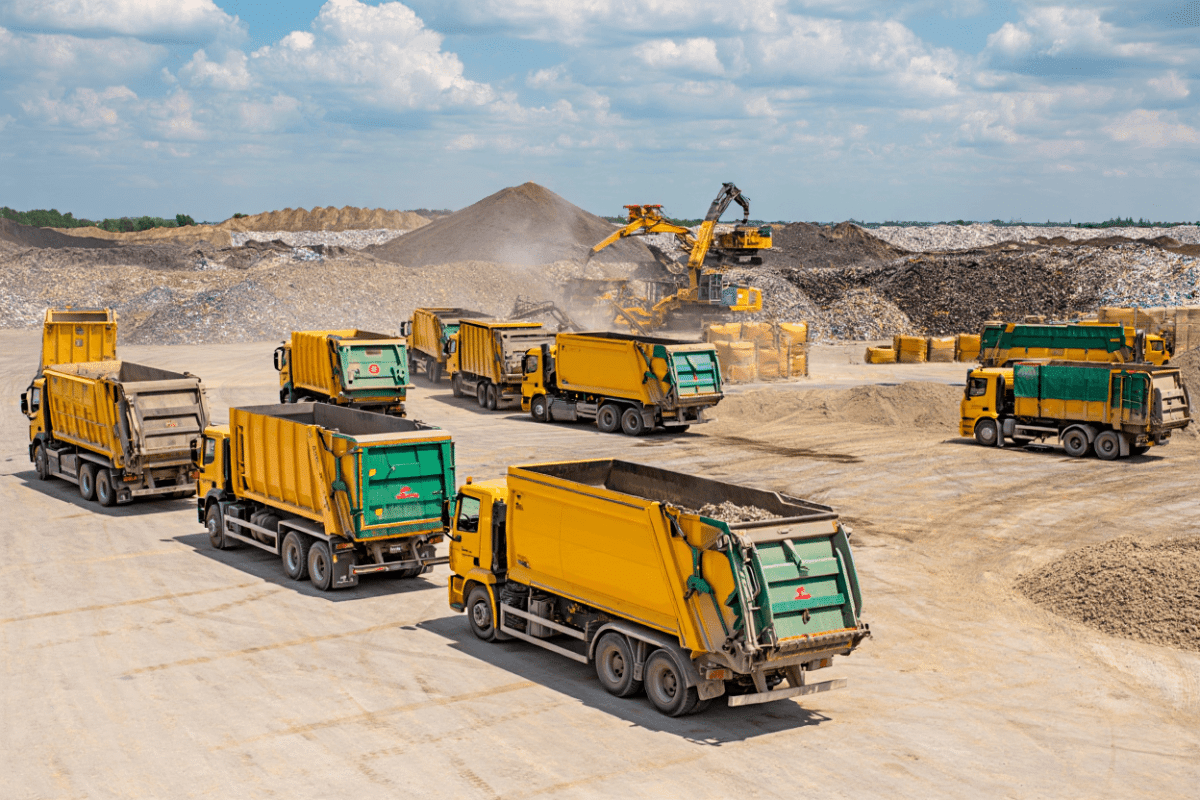
The United States waste management market reached $123.43 billion in 2026, marking a milestone moment for the industry as Q1 pricing surges reshape service costs across collection, disposal, and recycling divisions. Market Data Forecast confirms this valuation, with projections indicating growth to $162.53 billion by 2034—driven by urbanization, regulatory mandates, and sustainability pressures. The pricing acceleration reflects tipping fee increases nationwide, with landfill operators raising rates between 50-53% in key regions, signaling structural cost pressures that will ripple through supply chains and consumer expenses.
🔥 Quick Facts
- US Waste Management Market: $123.43 billion valuation in 2026
- Projected growth: 31.8% by 2034 to $162.53 billion
- Orange County landfill rates jumped 53% effective July 1, 2026 (from $43.89 to $67 per ton)
- Q1 2026 WM revenue: $6.23 billion, up 3.5% year-over-year
- Industry drivers: E-waste growth, urban density, recycling mandates
Market Scale and Strategic Significance
The $123.43 billion figure represents waste management’s evolution from a fragmented regional service into an essential infrastructure asset. This encompasses municipal solid waste, hazardous materials, recycling operations, and emerging segments like waste-to-energy and E-waste processing. The sector’s scale rivals major industrial segments—comparable to aerospace manufacturing or pharmaceutical wholesale—yet operates with far less public visibility. For context, North America’s waste market alone (including Canada and Mexico) was valued at $210.31 billion in 2025, making the US portion approximately 58-60% of regional capacity.
Growth is underpinned by three structural forces: population growth in Sun Belt states (Florida, Texas, Arizona), stricter Environmental Protection Agency (EPA) regulations targeting landfill methane and recycling rates, and corporate ESG commitments mandating waste diversion. Major facilities in high-demand markets now operate near capacity, forcing operators to either expand infrastructure or redirect waste hundreds of miles—both costly propositions that translate to price increases.
Q1 Pricing Surge: Regional Intensity and Operational Drivers
The 2026 Q1 pricing acceleration reflects a perfect storm of cost pressures. Business sectors responding to market shifts similar to waste management face labor inflation, fuel costs, and capital expenditure needs. Specific evidence:
Landfill tipping fees—what municipalities and private haulers pay per ton—surged dramatically. Orange County, California raised rates from $43.89 to $67 per ton (a 52.8% increase) effective July 2026. Baltimore hiked rates from $60 to $127.50 per ton (plus a $7.50 disposal fee), representing a 112.5% jump. York County, Pennsylvania set rates at $85 per ton for 2026. These are not isolated incidents—they reflect industry-wide capacity constraints and aging infrastructure renewal cycles.
Waste Management Inc. (WM), the sector’s largest player, reported Q1 2026 revenue of $6.23 billion, a 3.5% increase from the prior year. More telling: free cash flow nearly doubled to $920 million as automation technologies reduced labor dependency in recycling operations. However, the company also disclosed that single-stream recycling commodity prices declined 27% in Q1—offset only by 18% improvement in recycling profitability through operational efficiency. This insider detail signals that volume pricing—not commodity recovery—now drives margins.
Market Composition and Competitive Positioning
The $123.43 billion market breaks down across several segments:
| Waste Segment | Market Share % | Key Driver |
| Collection & Disposal | 52-55% | Residential & commercial trash pickup |
| Recycling Processing | 18-22% | Single-stream separation & material sales |
| Hazardous/Special Waste | 12-15% | Medical, industrial, e-waste disposal |
| Waste-to-Energy & Other | 10-12% | Landfill gas capture, renewable energy |
The Big Three operators—Waste Management Inc. (WM), Republic Services, and Waste Connections—control approximately 40-45% of the sector by revenue. These firms have pursued aggressive M&A strategies, with major public waste companies spending $3.3 billion on acquisitions in 2025. WM alone allocated $395 million to M&A, while Republic Services deployed $1.1 billion. This consolidation reflects the economics: smaller regional operators face prohibitively expensive capital requirements to comply with new EPA landfill standards and invest in automation.
“The waste management industry’s pricing power stems from its essential nature and infrastructure barriers. As landfills reach capacity and regulations tighten, operators have latitude to pass costs to customers. We expect price increases of 3-5% annually through 2028.”
— Industry Analysis, Market Data Forecast & Grand View Research
Forward Outlook: Constraints, Opportunities, and Market Implications
The 2026-2034 growth projection to $162.53 billion (a 31.8% CAGR of ~3.4% annually) faces both tailwinds and headwinds. Urbanization in Southwest and Southeast metros will drive volume growth. Extended Producer Responsibility (EPR) laws in California and other states shift waste costs upstream to manufacturers, creating new service categories. E-waste recycling—projected to grow at 15.6% annually as regulatory mandates expand—represents a high-margin segment.
Conversely, commodity price volatility in recycled materials (aluminum, cardboard, steel) creates earnings uncertainty. Labor shortages in collection and sorting operations continue to pressure margins. Capital intensity remains acute—building a modern landfill or transfer station requires $100M+ in infrastructure. These factors explain why consolidation will likely accelerate, with forecast M&A activity of $3-4 billion annually through 2028.
What Market Dynamics Await Waste Management in 2027 and Beyond?
Will Q2-Q4 2026 pricing stabilize after early-year surges, or will regional rate increases compound further? The answer hinges on landfill utilization rates, fuel prices, and labor cost inflation. If the US experiences economic slowdown, waste generation could decline, reducing collection volumes and moderating price pressure. If growth accelerates, capacity constraints will intensify, justifying additional rate hikes. Investors and waste generators should monitor quarterly earnings reports from WM, Republic Services, and Waste Connections for guidance on sustaining pricing momentum in an increasingly consolidated environment.
Sources
- Market Data Forecast – US Waste Management Market valuation ($123.43B in 2026, $162.53B by 2034)
- Waste Management Inc. Q1 2026 Earnings Report – Revenue $6.23B (+3.5% YoY), free cash flow $920M, recycling economics
- Resource Recycling Magazine – WM Q1 volume trends and commodity price data
- Orange County Waste & Recycling – Landfill rate increase documentation (53% surge)
- Waste Dive – M&A activity 2025 ($3.3B spent by public operators)
- Grand View Research – Global waste market framework and CAGR projections