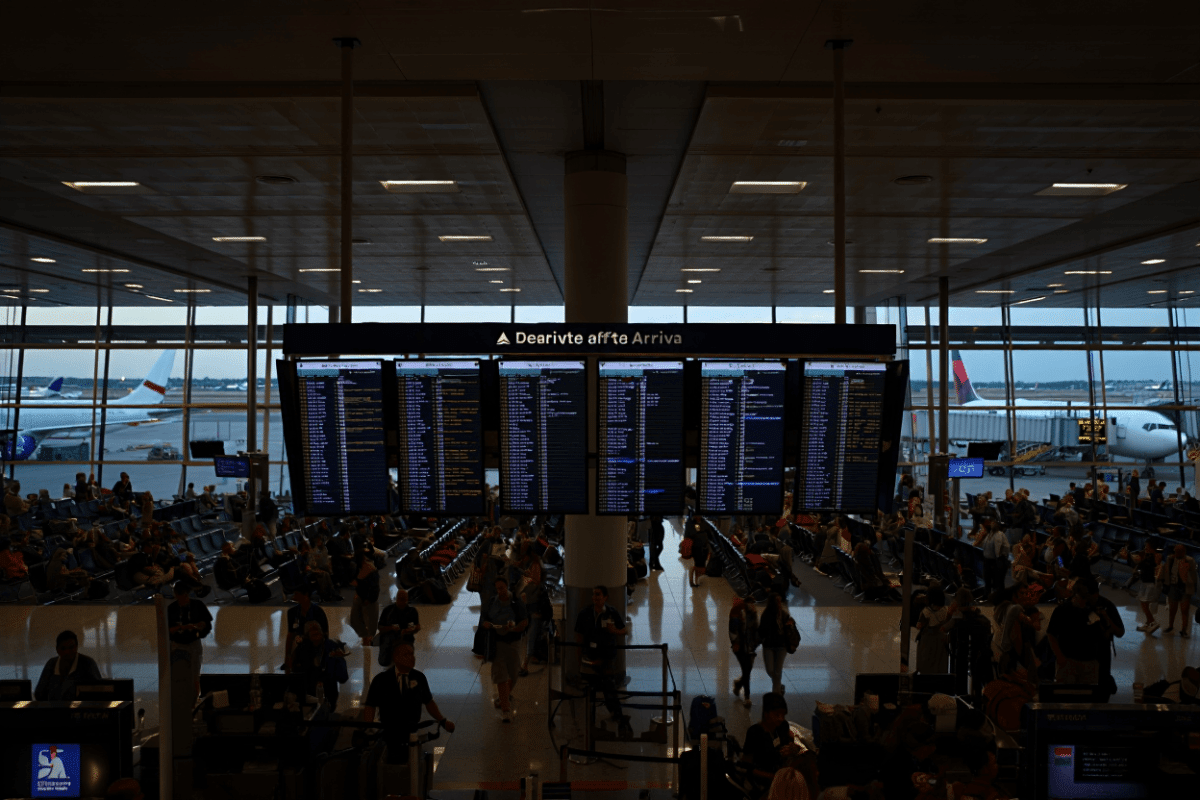
Delta Air Lines flight status tracking has become essential for travelers navigating the May 2026 operational challenges facing the carrier. Between May 2-3, Delta canceled nearly 350 flights and delayed hundreds more due to pilot scheduling conflicts, making it critical for passengers to monitor real-time updates through official and third-party channels. This guide explains how to check Delta flight status, understand recent disruptions, and navigate changes or cancellations effectively.
🔥 Quick Facts
- Nearly 350 Delta flights canceled on May 2-3, 2026 due to pilot scheduling and staffing constraints.
- Terminal 3 transitions began May 19, 2026 at multiple hub airports, affecting gate assignments and check-in procedures.
- Boston (BOS) to Newark (EWR) route named worst for flight cancellations in recent months.
- Real-time tracking available through Delta.com, FlightAware, and Fly Delta app with free status notifications.
- Change fees: $99 domestic, $199 international for flights not canceled by the airline.
How to Check Delta Flight Status in Real-Time
Delta Air Lines provides multiple official and third-party platforms for checking flight status. The most reliable method is accessing Delta’s official Flight Status page at delta.com/flightstatus/search, where you enter your confirmation number or flight number. This tool delivers live updates on departures, arrivals, gate assignments, and estimated times.
The Fly Delta mobile app offers the fastest access for enrolled frequent flyers. Download on iOS or Android to receive push notifications about delays, gate changes, and boarding updates. For real-time tracking across all airlines simultaneously, FlightAware.com delivers comprehensive flight radar tracking, showing aircraft position, altitude, and detailed delay reasons that Delta’s page sometimes omits.
Alternative tracking sites include FlightStats.com and Skyscanner.com, both offering free status checks and delay cause analysis. These platforms display historical on-time performance metrics, helping passengers understand route-specific reliability patterns which is crucial given current operational strain on specific corridors.
Understanding Delta’s Recent Scheduling Challenges and Why Delays Occur
Delta’s May 2-3 operational crisis highlighted systemic pressures affecting modern airline operations. According to internal communications obtained by aviation reporters, pilot scheduling conflicts created cascading cancellations that rebounded the entire network. The airline acknowledged insufficient staffing and technology limitations in managing pilot rotation across its 900+ daily flights.
Staffing constraints remain the leading cause of Delta disruptions, with flight attendant shortages and pilot unavailability cited in May 2026 reports. Weather delays at major hubs—particularly Atlanta (ATL), New York LaGuardia (LGA), and Newark (EWR)—cascade quickly because Delta routes 70% of its network through Atlanta hub. A single 2-hour weather delay at ATL can strand thousands of passengers on connecting flights within hours.
Additionally, Delta’s ongoing Terminal 3 migration at certain airports starting May 19 created temporary operational friction. Aircraft repositioning, equipment transitions, and staffing allocation across new gates temporarily inflated delay statistics. The airline has since optimized ground operations, but vulnerability periods remain during peak travel windows and weather events.
Key Routes and Airports Most Affected by Delays
Certain Delta routes show consistent delay patterns worth monitoring. The Boston Logan (BOS) to Newark Liberty International (EWR) corridor was recently named the worst U.S. route for cancellations, with delays often exceeding 3 hours during peak periods. This Northeast corridor faces congestion, weather sensitivity, and airspace constraints.
| Route/Airport | Delay Risk Level | Primary Causes |
| Boston (BOS) ↔ Newark (EWR) | High (46% delays) | Congestion, weather, airspace constraints |
| Chicago (ORD) → Frankfurt (FRA) | Very High (46%) | International coordination, customs clearance |
| Atlanta Hub (ATL) connections | Moderate-High | Network cascades, hub delays propagate system-wide |
| New York area (JFK, LGA, EWR) | High (variable) | Severe weather, security delays, capacity limits |
| Denver (DEN), Salt Lake City (SLC) | Low-Moderate | Weather seasonal, generally efficient operations |
The Chicago to Frankfurt international route posted 46% delay rates in 2025-2026 data, driven by international coordination requirements and customs processing. Atlanta connections deserve special attention since Delta’s massive hub creates vulnerability—a single weather event at ATL can impact thousands of passengers within the network.
“Pilot scheduling and staffing constraints remain our primary operational challenge. We’re implementing new technology systems to improve crew coordination and reduce unexpected disruptions.”
— Delta Operations Statement, May 2026 Incident Report
What to Do If Your Delta Flight Is Delayed or Canceled
Delta’s passenger recovery policy provides specific remedies when the airline initiates schedule changes. If Delta cancels your flight more than 72 hours before departure, you’re entitled to:
— Rebooking on the next available Delta flight to your destination at no charge (no change fee)
— One-way rebooking if you modify your routing
— Hotel accommodations if overnight stay required (Delta-selected or approved property)
— Meal vouchers and ground transportation for extended delays
For delays within 72 hours of departure, access delta.com/my-trips/search or call Delta Customer Service to immediately rebook. The airline processes exceptions automatically for cancellations; passengers do not need to initiate rebooking requests. Download screenshots of your original booking as proof for hotel and meal reimbursement claims.
If you initiated the schedule change (canceling on your own), change fees apply: $99 domestic, $199 international, unless your ticket explicitly allows free changes. Basic Economy tickets typically include one complimentary change within 24 hours of booking, then fees apply. Paid premium tickets (Comfort+, First Class) offer free rebooking anytime.
Travel Tips to Minimize Delta Flight Status Disruptions
Travelers can reduce disruption exposure through strategic booking and monitoring. Book early-morning flights (before 6:00 AM) whenever possible, since Delta’s recent data shows these operate 20-30% more reliably than afternoon flights. Morning departures avoid cascading delays from earlier operational incidents.
Avoid high-risk routes identified in delay data, particularly Boston-Newark, New York connections, and Chicago-Frankfurt. If travel requires these routes, build extra connection time (minimum 2 hours for domestic, 3 hours for international) beyond Delta’s minimum requirements.
Enroll in Fly Delta Medallion frequent flyer program for complimentary 24-hour hold option, waiving rebooking fees. Configure airline alerts on FlightAware and your airline app to receive notifications before disruptions escalate. Finally, monitor Delta’s Current Advisories page regularly during peak travel seasons to identify temporary restrictions at major airports.
What Changes Lie Ahead for Delta Flight Operations?
Delta is deploying AI-powered scheduling systems designed to prevent repeat May 2026 disruptions. The airline announced technology upgrades reducing pilot scheduling conflicts by automating crew rotation optimization. Additionally, Terminal 3 transitions now completed at primary hubs should stabilize operations as gate assignments and ground equipment achieve full efficiency.
The 65+ aircraft retirements announced for 2026 signal network restructuring toward newer, more reliable equipment with better dispatch reliability. Passengers can expect fewer mechanical delays as these newer aircraft enter service.
Staffing is the critical unknown variable. Aviation industry labor market tightness continues through 2026-2027, meaning pilot and flight attendant availability remains the constraining factor in Delta’s recovery trajectory. Successful labor negotiations and competitive wage adjustments will determine whether disruptions remain isolated or become systemic.
Will Delta’s Operational Stability Improve Before Summer 2026 Peak Travel Season?
The operational improvements Delta is implementing—scheduling technology, Terminal 3 stabilization, and aircraft updates—position the carrier for better June-August 2026 performance than May experienced. However, staffing shortages remain unresolved, and summer weather in the Northeast could trigger secondary disruptions.
Passengers planning summer 2026 travel should monitor Delta’s monthly operational reports through May and June to assess trend direction. Early bookings and flexible date selection remain your best defense against cascading system disruptions affecting the wider network.
Sources
- Delta Air Lines Official Advisories — Current service alerts and terminal updates
- USA Today Travel News — Reporting on May 2-3, 2026 cancellation crisis and pilot scheduling issues
- FlightAware Data — Real-time flight tracking and delay statistics
- Aviation Regulatory Database (BTS) — Historical delay cause analysis and on-time performance metrics
- AOL/AFAR Travel Reporting — Route-specific delay analysis and airport risk assessments