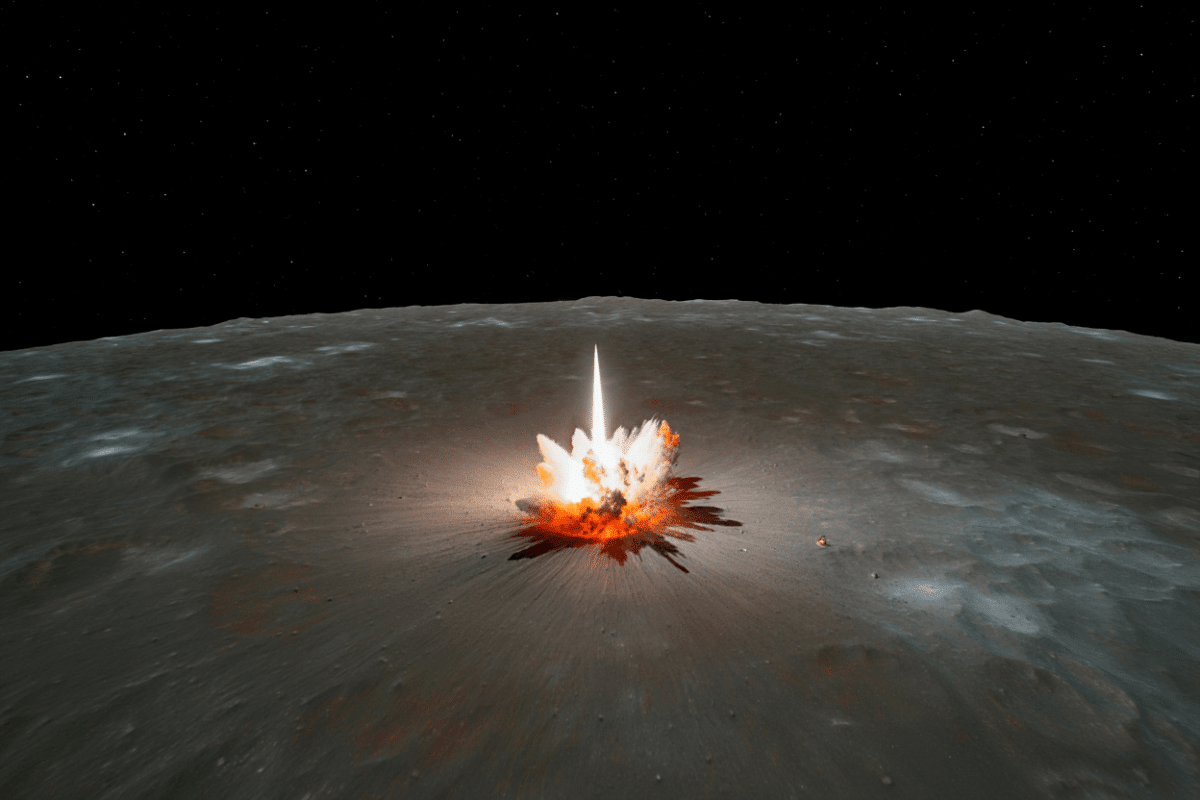
A Falcon 9 upper stage from a January 2025 lunar delivery mission will strike the Moon on August 5, 2026, at approximately 6:44 AM UTC (2:44 AM ET). The discarded rocket component, designated 2025-010D, will impact near Einstein Crater at roughly 5,400 miles per hour—nearly seven times the speed of sound. This unintentional collision highlights a growing challenge in spaceflight: managing spent rocket stages destined for lunar orbit.
🔥 Quick Facts
- Impact Date: August 5, 2026, at 06:44 UTC
- Rocket Stage: Falcon 9 upper stage from January 15, 2025 launch
- Impact Velocity: 5,400 mph (8,700 km/h)
- Original Mission: Blue Ghost Mission 1 and Hakuto-R M2 lunar landers
- Debris Designation: 2025-010D, approximately 45 feet long
The Origin of Orbital Debris in the Earth-Moon System
The Falcon 9 upper stage that will strike the Moon launched on January 15, 2025, from Kennedy Space Center in Florida. Its payload consisted of two significant lunar missions: Blue Ghost Mission 1 (a commercial lunar lander operated by Firefly Aerospace) and Hakuto-R M2 “Resilience” (Japan’s ispace lunar lander). Both landers successfully separated and began their journeys to the Moon, but the spent upper stage remained in a chaotic translunar orbit.
After deploying its payload, the stage was never retrieved or deorbited to a safer trajectory. Over months, gravitational perturbations from both Earth and the Moon gradually altered its orbit, pulling it inexorably toward lunar impact. This outcome reflects a growing gap in spaceflight practices: while launch providers reliably deliver payloads to their destinations, end-of-life disposal for rocket stages is not yet standardized, particularly for translunar missions.
Impact Details and Crater Formation Physics
According to orbital mechanics calculations from Dr. Donald Gray of the San Francisco State University, the impact will occur near Einstein Crater, which sits between the Moon’s near and far sides. The collision will release kinetic energy equivalent to approximately 10 tons of TNT due to the extreme velocity involved.
At 5,400 mph, the 45-foot aluminum structure will compress lunar regolith (moon soil) and rock instantaneously. The resulting ejecta will blast outward in all directions, excavating a fresh crater estimated between 300 and 500 feet in diameter, depending on the angle of impact and the composition of the target area. While the impact flash will likely not be visible from Earth due to the impact occurring on the Moon’s daylit side around sunrise at that location, NASA’s Lunar Impact Monitoring Program and ground-based observatories equipped with infrared sensors may detect the thermal signature.
This will be the first human-caused debris impact on the Moon to be tracked and documented in real time, as part of ongoing efforts to understand how orbital objects affect the lunar environment.
The Growing Problem of Space Debris at the Moon
The 2025-010D impact represents one of at least 600 Falcon 9 missions launched to date, with dozens of upper stages now in various Earth and trans-lunar orbits. Most are in stable Earth orbits or have already re-entered the atmosphere. However, as highlighted in SpaceX’s advancing rocket development, increased commercial lunar activity will generate more debris. The EscaPADE spacecraft mission (launched in November 2025) utilized a Falcon 9 that was deliberately placed in a stable lunar orbit to avoid this problem—a rare example of proactive debris management.
| Category | Details |
| Debris Object ID | 2025-010D |
| Rocket Type | SpaceX Falcon 9 upper stage |
| Launch Date | January 15, 2025 (01:11 AM EST) |
| Payload Delivered | Blue Ghost 1 & Hakuto-R M2 landers |
| Impact Velocity | 5,400 mph (8,700 km/h, Mach 7) |
| Impact Time | August 5, 2026, 06:44 UTC (UTC+0) |
| Impact Location | Einstein Crater region, Moon |
| Estimated Crater Diameter | 300–500 feet (90–150 meters) |
NASA’s Meteoroid Environment Office monitors lunar impacts using telescopes at sites including McDonald Observatory in Texas. The agency maintains that such impacts pose no threat to human activities on Earth. However, the implications for the Artemis program—which aims to establish sustained human presence on the Moon by the late 2020s—are significant. Future lunar bases and surface operations will require detailed maps of impact craters and debris fields for site selection and operational planning.
“The accidental crash points to a troubling future for space travel. As more commercial missions target the Moon, operators must adopt responsible practices for end-of-life disposal of rocket stages.”
— Institute for Applied Orbital Mechanics and Space Policy, Northeastern University
What This Event Means for SpaceX, Lunar Commerce, and International Policy
Unlike accidental impacts from asteroids or comets—which have shaped the Moon for 4.5 billion years—this collision is man-made and entirely preventable. SpaceX continues to maintain orbital operations worldwide, but this incident underscores the need for industry-wide standards. The space community has already developed guidelines through the Inter-Agency Space Debris Coordination Committee (IADC), which recommends that spent rocket stages be either deorbited into Earth’s atmosphere within 25 years or placed in stable graveyard orbits.
The 2025-010D impact will not affect Earth or any active satellites, and no crewed missions are near the impact zone. However, it serves as a proof-of-concept for tracking and predicting debris impacts—a capability that will become critical as commercial lunar stations and human outposts become operational. Going forward, launch operators may face regulatory requirements to either retrieve spent stages or actively manage their orbital decay.
Will We See the Impact, and How Are Scientists Preparing?
The direct visual observation of the impact from Earth will be challenging because Einstein Crater sits near the terminator line (the boundary between day and night on the Moon) at the moment of impact. However, infrared sensors on orbiting spacecraft like NASA’s Lunar Reconnaissance Orbiter (LRO) may detect the thermal flash, and amateur astronomers worldwide with equipment sensitive to the far-infrared spectrum have been invited by NASA to participate in simultaneous observations. The impact's brightness and duration will provide scientists with data about the moon’s subsurface composition and impact ejecta dynamics.
The Lunar Impact Monitoring Program, which has documented thousands of meteoroid impacts on the Moon, expects to add this event to its catalog. Unlike natural impacts that occur randomly, this collision provides a unique opportunity to study a ground-truth impact event with known parameters: mass, velocity, composition, and exact timing.
Could This Happen Again, and What Are the Lessons?
The $5.4 billion annual space industry—encompassing launch providers, commercial space stations, and exploration agencies—must grapple with the reality that orbital pollution is accumulating. Low Earth orbit now contains over 35,000 tracked objects larger than 10 centimeters, according to NASA’s Orbital Debris Program Office. The Moon, previously pristine except for natural impacts and six Apollo-era missions, is becoming a destination for commercial activity, making debris management increasingly urgent.
SpaceX has not commented directly on the 2025-010D debris trajectory, but the company's engineering team is aware of the situation. Future Falcon 9 missions to lunar destinations could implement targeted deorbit burns—controlled engine firings that ensure spent stages either impact the Moon safely away from planned human sites, or burn up in Earth's atmosphere.
What Happens the Day After? The August 6, 2026 Crater Survey
NASA and commercial lunar operators have already begun planning post-impact observations. The Lunar Reconnaissance Orbiter, in its 14th year of operation by August 2026, will be instructed to image the fresh impact site within hours. Comparing before-and-after orbital imagery will allow scientists to measure the crater diameter, ejecta blanket extent, and subsurface stratigraphy exposed by the impact. These data will inform our understanding of the Moon's near-surface structure—knowledge essential for planning future drilling operations and sample collection missions.
Sources
- Project Pluto (S2A Systems) – Orbital mechanics calculations and debris trajectory tracking
- Live Science – Expert analysis of impact velocity and crater formation
- Sky at Night Magazine (BBC) – Observer reports and astronomical details
- NASA Meteoroid Environment Office – Lunar impact monitoring standards and data collection
- USAToday / Space News – Mission background and orbital debris context
- SpaceFlight Now / NextSpaceFlight – Launch vehicle and payload mission details
- Northeastern University Institute – Policy implications and space debris analysis