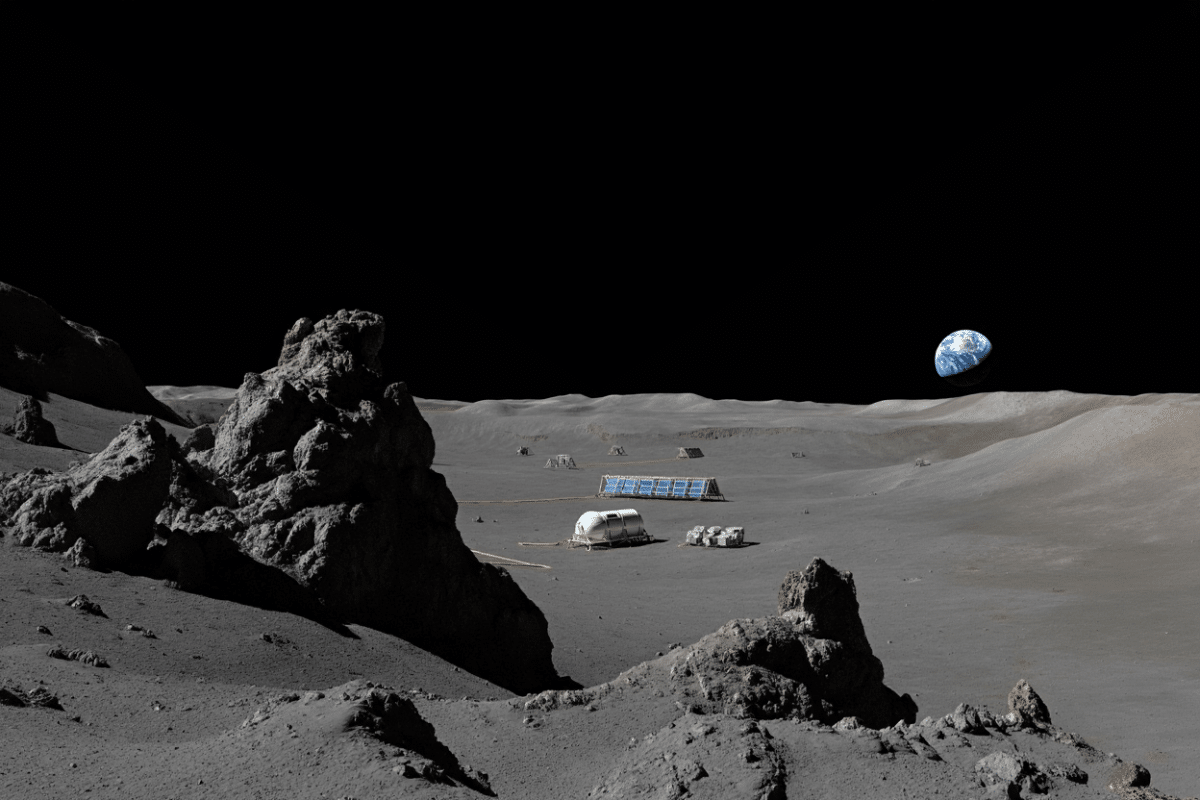
NASA unveiled its comprehensive Moon Base strategy on May 20, 2026, detailing a phased approach to establishing sustained human presence on the lunar surface. The space agency has committed $20 billion over the next seven years to construct the facility across dozens of missions, representing a fundamental shift from planned orbital infrastructure toward surface-based habitation and operations.
Key Facts
- $20 billion investment over seven years for lunar base construction
- Artemis III (mid-2027) will test integrated systems and lunar descent operations
- First sustained landing targeted for early 2028 via Artemis mission
- Location: Moon’s south pole region near permanently shadowed areas with water ice deposits
- Phased construction replaces cancelled Lunar Gateway orbital station program
Strategic Shift: From Orbit to Surface
NASA Administrator Jared Isaacman announced the revised Artemis architecture in March 2026, fundamentally repositioning lunar exploration priorities. The agency initially planned a distributed system combining the Lunar Gateway—an orbital outpost near the moon—with surface operations. However, engineering analysis revealed that concentrating resources on surface infrastructure would accelerate permanent human presence more efficiently. This strategic reorientation aligns with national space policy objectives to establish enduring lunar operations as a stepping stone toward Mars exploration.
The Moon Base initiative replaces the Lunar Gateway program, which was paused indefinitely in March 2026. This decision redirects substantial funding toward constructing pressurized habitat modules, power generation systems, and life support infrastructure on the lunar surface itself. The approach demonstrates lessons learned from International Space Station operations, where distributed, incrementally deployed systems proved more flexible than monolithic infrastructure.
Artemis Mission Timeline and Technical Milestones
NASA continues targeting early 2028 for the first crewed lunar surface landing, a schedule unchanged since mid-2025. The progression begins with Artemis III, scheduled for mid-2027, which will conduct critical systems testing including Human Landing System (HLS) operations and orbital assembly demonstrations. This mission acts as a full-dress rehearsal, validating entry, descent, and abort procedures in actual lunar environment conditions.
Artemis V, scheduled for no earlier than late 2028, initiates the sustained landing phase. From this point, NASA intends yearly crewed missions to sequentially build base infrastructure. Each mission deploys specific components—initial habitats, power reactors, life support systems, and scientific equipment—allowing modular base expansion across multiple fiscal appropriations and technology development cycles.
| Mission | Timeline | Primary Objective |
| Artemis III | Mid-2027 | Systems demonstration; HLS testing; surface checkout |
| Artemis IV-V | 2028 | Initial habitat deployment; power system installation |
| Artemis V+ | Annually through 2030s | Incremental base expansion; permanent staffing capability |
| Target Configuration | 2033 | Full 28-day sustained surface operations |
The south pole region selection reflects sophisticated site analysis conducted by lunar science teams. This area offers proximity to permanently shadowed craters containing water ice deposits—critical for in-situ resource utilization and advanced space operations. Water can be converted into rocket propellant and breathable oxygen, reducing resupply missions from Earth and enabling longer-duration scientific exploration.
Infrastructure Architecture and Construction Methodology
The base construction follows a phased deployment strategy optimized for cargo capacity and crew safety. NASA released technical documentation in March 2026 outlining component specifications. Initial phases prioritize basic pressurized modules capable of supporting crews for extended stays, with early iterations supporting 28-day mission durations.
Power generation systems represent a critical technology challenge. NASA is developing kilopower nuclear reactors—compact, dependable systems that function in lunar darkness and shadowed regions where solar panels become ineffective during multi-week night cycles. These reactors, generating 10 kilowatts or more, enable operations beyond the lunar day-night cycle limitations that constrained earlier exploration concepts.
Life support infrastructure builds upon ISS heritage systems, including water recovery systems, oxygen generation, and carbon dioxide removal. Advanced in-situ resource utilization (ISRU) technologies—still under development—will eventually extract water and produce propellant locally, but initial base phases rely on Earth-supplied consumables delivered via cargo landers.
Budget Allocation and Program Economics
The $20 billion seven-year investment represents approximately 2.8 billion annually—roughly 11% of NASA’s total budget—dedicated to lunar base development. This allocation includes spacecraft development, spacesuit advancement, habitat construction, launch services, and technology demonstrations. Some analyses suggest total costs could reach $30 billion over the full decade when accounting for extended operational phases beyond the initial construction timeline.
Funding sources include existing Artemis budget allocations, reallocations from the cancelled Lunar Gateway program, and new congressional appropriations aligned with national space policy priorities. The total represents one of the most significant sustained investments in space exploration infrastructure since the Apollo program era, though spread across a longer timeline with reduced annual expenditures.
Scientific and Strategic Implications
The Moon Base serves multiple objectives beyond flagpole-planting symbolism. Lunar science researchers will conduct geology studies, mineralogy analysis, and water ice characterization essential for understanding lunar formation and resource availability. The facility enables long-duration analog research for Mars missions—testing life support redundancy, crew psychology, and equipment reliability under sustained extraterrestrial conditions.
Commercial partnerships with aerospace companies reduce government costs through competitive procurement. SpaceX, Blue Origin, and other contractors provide launch services and cargo delivery through established programs, while NASA retains responsibility for habitat development and mission architecture.
What Does Permanent Lunar Presence Mean for Space Exploration?
The shift toward sustained lunar operations signals fundamental transformation in exploration philosophy. Rather than brief visits, NASA envisions rotating crews maintaining continuous presence for scientific investigations impossible during short missions. This approach accelerates technology maturation for deep space missions, including future lunar orbit stations and Mars expeditions requiring weeks or months of autonomous operations.
Competitors—particularly China, which announced its own lunar base plans—observe America’s renewed commitment. The Artemis program demonstrates sustained technological leadership and capability to organize massive infrastructure projects. Success validates long-term investment in space exploration as both scientifically productive and strategically important for technological advancement, workforce development, and international competitiveness.
Sources
- NASA (May 2026) – Moon Base Strategy Announcement
- NASA (March 2026) – National Space Policy Implementation Initiatives
- Spaceflight Now (March 2026) – Analysis of $20 billion lunar base investment plan
- Space News (April 2026) – Technical systems requirements for Moon Base operations
- The Conversation (March 2026) – Infrastructure and long-term lunar presence development