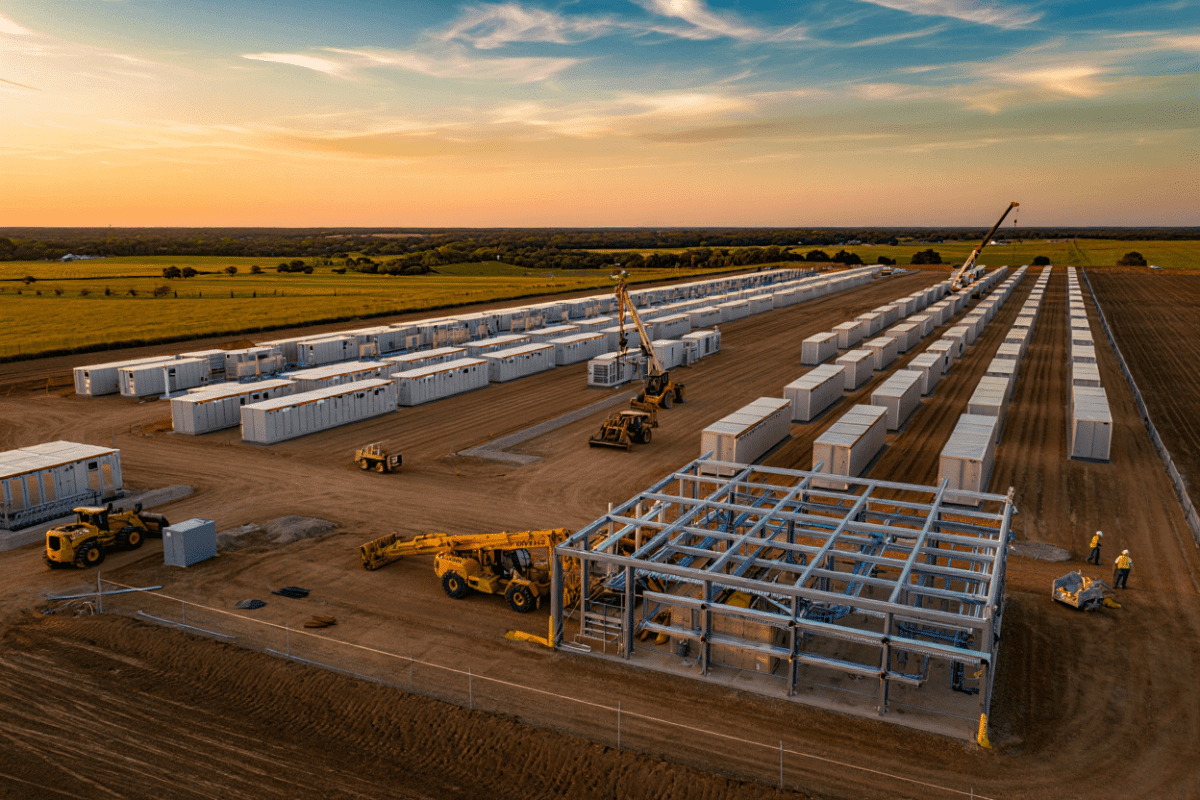
CPS Energy and OCI Energy officially broke ground on the Alamo City Battery Energy Storage System (BESS) on May 19, 2026, marking the transition from development to construction for one of the region’s largest standalone battery storage projects. The $120 million facility will deliver 120 megawatts (MW) of power with 480 megawatt-hours (MWh) of storage capacity, sufficient to power approximately 30,000 homes for up to four hours during peak demand periods.
🔥 Quick Facts
- 120 MW/480 MWh battery storage capacity serving San Antonio region
- $120 million investment developed and financed by OCI Energy
- Expected commercial operation in 2027 as part of CPS Energy’s Vision 2027 plan
- Powers approximately 30,000 homes for up to four hours during peak demand
- Located in southeastern Bexar County, Texas, connected to ERCOT grid
The Strategic Role of Battery Storage in Texas Grid Management
Battery Energy Storage Systems (BESS) have become critical infrastructure for managing Texas’s evolving power grid. The Electric Reliability Council of Texas (ERCOT) oversees the nation’s largest competitive wholesale electricity market, where demand continues to accelerate. Texas now hosts 12.9 gigawatts of utility-scale battery storage—representing 53% of the 24 gigawatts expected to be added nationally in 2026. This dominance reflects the state’s rapid growth in data centers, manufacturing, and population requiring dependable electricity during peak demand windows.
The Alamo City BESS addresses a specific challenge: shifting how and when electricity flows through the grid. During periods of highest demand—typically late afternoon and early evening—the facility can discharge stored energy rapidly, reducing pressure on aging transmission infrastructure and preventing brownouts. CPS Energy, serving approximately 970,000 electric customers across San Antonio and seven adjoining counties, estimates the project will enable more efficient and economical power delivery when the system experiences its greatest strain.
Project Architecture and Advanced Technology Partnership
The groundbreaking ceremony on May 19 brought together multiple sector leaders. OCI Energy—a developer with a track record delivering Texas’s earliest large-scale solar installations since 2012—developed and financed the project. LG Energy Solution Vertech, the U.S. division of a global battery manufacturer with nearly two decades of energy storage expertise, supplies the lithium-ion battery technology. Elgin Power Solutions, a 45-year-old power systems manufacturer, serves as the Engineering, Procurement, and Construction (EPC) contractor. ING Capital provides construction financing expertise.
This collaborative structure reflects industry maturation: battery storage requires vertically integrated solutions combining battery manufacturing, power electronics integration, substation installation, and grid interconnection expertise. LG Energy Solution Vertech’s bundled approach—delivering complete systems with long-term warranties and software support—represents evolution beyond component procurement.
Operational Model and Grid Integration
| Project Parameter | Specification |
| Capacity (Power) | 120 MW |
| Energy (Duration) | 480 MWh (4-hour discharge) |
| Homes Served | ~30,000 households at peak output |
| Investment | $120 million |
| Location | Southeastern Bexar County, Texas |
| Expected Operational Date | 2027 |
| Ownership Structure | OCI Energy owns; CPS Energy operates |
| Grid Operator | ERCOT (Electric Reliability Council of Texas) |
A critical distinction: OCI Energy retains ownership under a long-term storage capacity agreement with CPS Energy, who gains operational control. This arrangement benefits both parties—OCI monetizes its development and asset management expertise while CPS Energy secures flexible grid resources without capital expenditure. The battery can inject power during peak afternoon hours or absorb excess power during low-demand periods, effectively smoothing the grid’s voltage and frequency fluctuations.
“Energy storage is a critical component of how we prepare for the future. Projects like Alamo City BESS give us the flexibility to meet growing demand, integrate more diverse energy resources, and ensure our community has reliable power when it matters most.”
— Rudy D. Garza, President and CEO, CPS Energy
Alignment with CPS Energy’s Vision 2027 and Broader Texas Energy Trends
Alamo City BESS enters service at a pivotal moment in Texas power supply evolution. CPS Energy’s Vision 2027 plan targets aggressive renewable capacity expansion and battery storage integration. The utility has already brought 50 MW of battery storage online (completed in October 2025) and is pursuing an additional 500 MW through an RFP issued in December 2025. Combined, these projects position CPS Energy toward over 1,000 MW of battery storage capacity by 2027—a transformation that enables higher renewable penetration without sacrificing grid stability.
The broader ERCOT context underscores urgency. Texas’s peak demand forecast for summer 2026 ranges between 90,500 MW and 92,500 MW, approaching all-time records. Yet ERCOT’s reliability outlook remains stable due to battery storage gains. Where battery storage represented a small fraction of grid resources five years ago, it now powers approximately 10% of Texas at times. This shift directly reduces reliance on natural gas peaking plants and enables smoother renewable integration.
What This Project Signals About San Antonio’s Energy Future
The Alamo City BESS represents San Antonio’s commitment to managed energy transition. Unlike capacity additions that take a decade to develop, battery projects proceed from proposal to operation in three to four years. Construction financing from ING—a global financial institution with decades of renewable infrastructure experience—signals that institutional capital now prioritizes energy storage. Lenders recognize that battery projects generate revenue through multiple mechanisms: peak capacity payments, energy arbitrage (buying low, selling high), and ancillary services supporting grid stability.
For San Antonio specifically, the facility addresses local grid congestion. Southeastern Bexar County transmission corridors experienced strain during past summer peak events. The battery’s ability to inject power locally reduces transmission losses and defers costlier substation upgrades. Economically, this translates to stable electricity rates for the region’s 970,000 electric customers—whose combined bills already rank among the lowest of the 20 largest U.S. cities.
What Outstanding Questions Remain for Battery Storage Deployment in Texas?
While Alamo City BESS represents significant progress, several challenges persist regionally. How will battery storage interact with an increasingly variable grid as solar penetration exceeds 20% of peak generation capacity? Current forecasts assume four-hour discharge duration optimal for afternoon peaks, but winter demand patterns differ. Will longer-duration storage (8-12 hour systems) become cost-competitive? Additionally, ERCOT’s interconnection queue contains 400 pending large-load requests totaling 239,000 MW—primarily data centers. If even half connect, demand will exceed current forecasts, requiring accelerated battery deployment beyond Vision 2027 targets.
Sources
- CPS Energy Newsroom – Official groundbreaking announcement and project specifications (May 19, 2026)
- PR Newswire – OCI Energy partnership details and stakeholder quotes (May 19, 2026)
- ERCOT Annual Report 2025 – Texas battery storage context and grid demand forecasts
- Texas Public Power Association – CPS Energy Vision 2027 renewable capacity goals
- Advanced Energy United – ERCOT battery storage penetration data and grid reliability trends