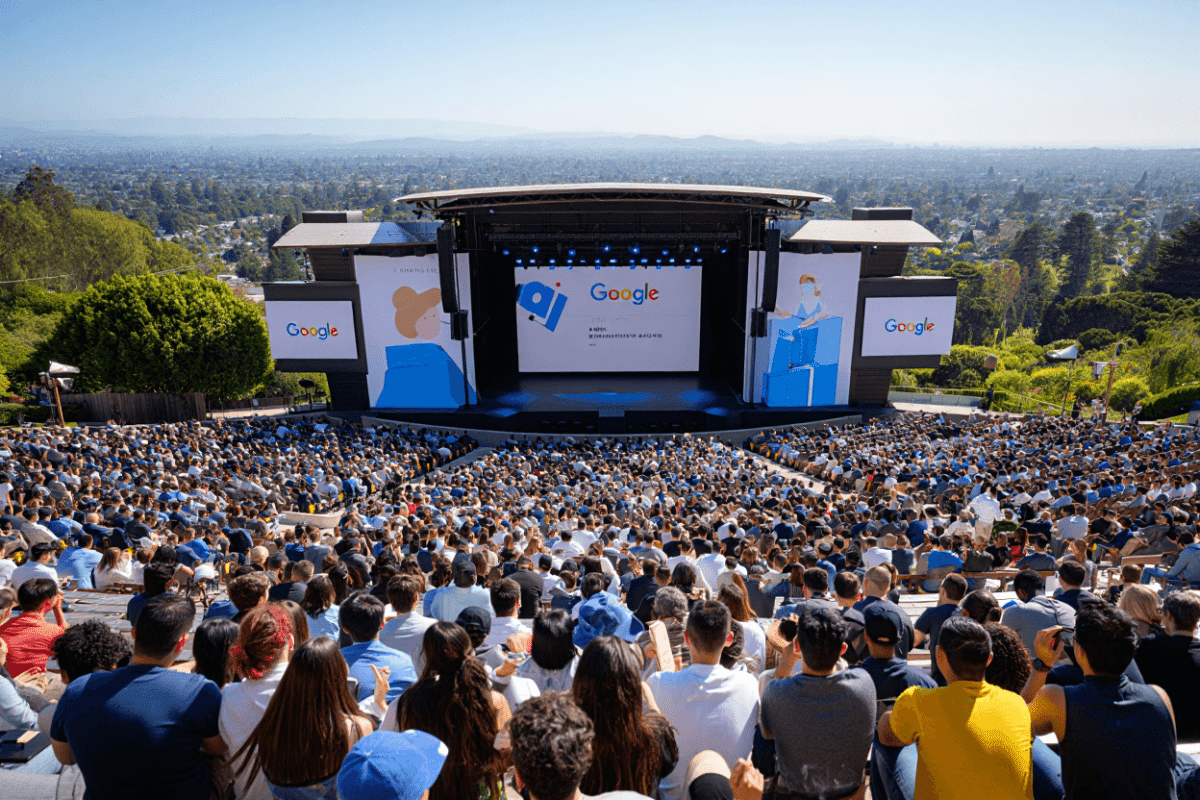
Alphabet Inc. stock advanced to near all-time highs on May 19, 2026, as investors gathered momentum ahead of the company’s Google I/O conference keynote set to kick off at 10:00 AM PT from the Shoreline Amphitheatre in Mountain View, California. With GOOG trading around $399.30, the stock has surged approximately 140% over the past 12 months, making today’s announcements a critical test of whether Google’s dominant position in artificial intelligence can translate into sustained earnings growth and new revenue streams.
🔥 Quick Facts
- GOOG stock up 140% over the past year, with analysts now targeting $427.89 average price target across 63 Buy ratings
- Google Cloud revenue reached $20 billion in Q1 2026, growing 63% year-over-year and outpacing AWS (28%) and Azure (30%)
- Cloud backlog surged to $462 billion, nearly doubling quarter-over-quarter, with 50% expected recognition within 24 months
- Gemini 3.5 Flash unveiled earlier this week, delivering 4x faster output speed than Gemini 3.1 and optimized for complex workflows
From AI Skeptic to Full-Stack Dominance: Alphabet’s 18-Month Transformation
Just 18 months ago, Wall Street questioned whether Alphabet had squandered its technical lead to OpenAI and other emerging rivals. Today, that narrative has reversed entirely. Alphabet now controls nearly every layer of the artificial intelligence stack—from custom silicon and cloud infrastructure to foundational models, consumer applications, and enterprise software. This vertical integration has become the central bull thesis driving analyst upgrades. At Google Cloud Next 2026 (held in April), the company disclosed that number of billion-dollar-plus deals signed in 2025 surpassed the previous three years combined, while existing customers increased spending by over 30% versus initial commitments. This wasn’t incremental growth; it signaled a wholesale shift in how enterprises view Google as a critical AI infrastructure partner. Gen AI product revenue grew approximately 800% year-over-year in Q1 2026, demonstrating that monetization strategies are already bearing fruit.
The Cloud Engine That Powers the Bull Case: What Today’s Announcements Must Validate
Google Cloud is now the centerpiece of analyst estimates for Alphabet‘s future. Mizuho Securities analyst Lloyd Walmsley lifted his price target to $460 after projecting 70% Google Cloud revenue growth in 2026 and 59% growth in 2027—substantially ahead of Street consensus expectations of 58% and 47% respectively. In his note, Walmsley stated that Alphabet has shifted “from AI Loser to AI Winner and deserves a premium.” His valuation now reflects 30x his 2027 GAAP earnings-per-share estimate, above the company’s historical three-year average multiple. Loop Capital Markets proved even more aggressive, moving its target to $490 (from $355), while Oppenheimer lifted to $445 (from $425). The spread between the highest target ($515) and lowest ($334.22) reflects lingering disagreement about how rapidly Alphabet can scale AI revenue and manage emerging risks in search monetization. Today’s I/O keynote—scheduled to run as a tight, action-packed 105-minute presentation led by CEO Sundar Pichai—must address this uncertainty with concrete product roadmaps and financial guidance that justifies the latest round of seven-figure price targets.
Key Areas Investors Are Watching: Gemini Models, Agents, and AI Search Monetization
Wall Street attention will focus on six critical dimensions of Alphabet‘s AI strategy. First, whether Google announces Gemini 4, a full generational leap beyond Gemini 3.1 Pro (released in February 2026). Citi Research noted that Google‘s typical launch cadence of three-to-four months makes a Gemini 3.5 update more likely, yet Mizuho emphasized that a Gemini 4 debut would push Google back to the bleeding edge of the frontier—critical optics for maintaining investor confidence against OpenAI and Anthropic. Second, Project Astra, Google‘s universal AI assistant, is expected to receive deeper integration across Gmail, Calendar, Maps, and native tool use capabilities that position Gemini as an operating layer rather than a conversation tool. Third, the emergence of “agentic” AI workflows—where Gemini understands user intent and executes multi-step tasks independently—is being positioned as the next major milestone in AI commercialization. Fourth, agentic commerce represents a potential game-changer: Google has been expanding its Universal Commerce Protocol with partners including Meta, Microsoft, Stripe, Klarna, and Affirm, enabling Gemini to move from answering shopping queries to completing transactions independently. Fifth, the TPU externalization strategy remains critical: Google disclosed that external TPU (Tensor Processing Unit) sales to third-party customers begin in H2 2026, with analyst Gene Munster noting the AI chip market runs at roughly $500 billion annually—even modest share gains could materially impact Alphabet‘s revenue profile. Sixth, AI Mode monetization in Search carries risk: Mizuho flagged that 93% of AI Mode searches end without an external click, with organic click-through rates declining 15% on AI Overview queries—a structural headwind that investors want management to address with concrete ad product innovation.
Analyst Consensus and Price Targets: What the Market Is Pricing In
| Analyst / Firm | Price Target | Rating | Key Catalyst |
| Mizuho Securities (Walmsley) | $460 | Buy | 70% Cloud growth in 2026 |
| Loop Capital | $490 | Buy | TPU externalization, Cloud expansion |
| Oppenheimer | $445 | Outperform | AI agent adoption, Cloud acceleration |
| Bank of America (Post) | $430 | Buy | AI subscriptions, agent capabilities |
| Citi Research | $447 | Buy | Gemini updates, monetization clarity |
| Consensus Average | $427.89 | 57 Buy / 6 Hold / 0 Sell | Full-stack AI execution |
63 analysts tracked by S&P Global now cover Alphabet with 57 Buy ratings, 6 Hold, and zero Sell recommendations—an alignment rarely seen on a company with a $4.8 trillion market cap. The consensus price target of $427.89 implies 7% upside from Friday’s close, with the high-end target of $515 suggesting 29% upside potential if management executes flawlessly on cloud growth and artificial intelligence monetization. This optimism is predicated on the assumption that Google can sustain 70%+ cloud revenue growth through 2026 and begin capturing meaningful revenue from TPU external sales without cannibalizing its broader AI infrastructure margins. As Lo Toney, founding managing partner of Plexo Capital and early Anthropic investor, noted: “Google is probably the best-positioned company to monetize AI at scale because it controls almost every layer of the stack. We’ve never really seen a company that has that complete vertical integration from top to bottom to be able to support AI.”
“There is a benefit to owning the full stack in terms of the speed that you can innovate. When you’re building on your own custom silicon, for example, that’s an advantage of speed. When you have access to power, you can get data centers up more quickly. That’s a speed advantage, which is important.”
— Gene Munster, Managing Partner, Deepwater Asset Management
What Success Looks Like Today: Concrete Roadmaps Over Vague Promises
The February 2026 Google Discover Core Update has raised expectations for depth, originality, and expertise signals in how technology stories are covered and consumed. Alphabet faces a similar credibility test with investors today. Rather than unveil incremental feature updates, Wall Street is expecting Sundar Pichai and his team to articulate concrete answers on four dimensions: a clear Gemini roadmap explaining the path to a next-generation model; specific metrics proving that agentic workflows are driving enterprise adoption and revenue; transparent commentary on search monetization strategy as AI Mode reduces external click-through rates; and preliminary guidance on external TPU sales channels, pricing architecture, and revenue recognition methodology. Management commentary around Anthropic‘s relationship—particularly the reported $200 billion cloud commitment—will also be scrutinized, as Oracle‘s recent experience demonstrates how concentrated customer relationships can trigger valuation volatility if perceived as unsustainable. Alphabet‘s pitch is fundamentally different: even if enterprises prefer Claude over Gemini, Google benefits from infrastructure demand. But that argument only holds if investor confidence in the underlying platform remains solid. Today’s keynote is where that argument gets tested in real time.
The Broader Market Context: Why Timing Matters for Alphabet Stock Today
The Google I/O 2026 keynote arrives at a moment when U.S. Treasury yields have climbed to multi-year highs, with the 30-year yield exceeding 5.18%—the highest level in nearly 19 years. This backdrop creates tension for high-growth technology stocks like Alphabet: while operating leverage and cloud acceleration justify premium valuations, rising discount rates compress the net present value of future earnings streams. Mizuho‘s $460 price target assumes the market sustains 30x forward earnings multiples for two years—a bet that Alphabet‘s growth profile justifies premium valuation expansion even as macro rates rise. Conversely, concerns about search monetization and TPU market adoption timelines explain why the low-end analyst target sits at $334.22, implying that meaningful downside protection exists if management fails to deliver on cloud growth or artificial intelligence monetization. For retail investors, the message is clear: GOOG‘s near-term direction will depend less on macro headwinds and more on management’s ability to prove that Alphabet has indeed become the most valuable artificial intelligence infrastructure company on the planet. Today’s 105-minute keynote is where that case either strengthens or unravels.
What Happens Next: Two Days of Deep Dives, Sessions, and Technical Announcements
Google I/O 2026 spans May 19-20, with the main Google keynote at 10:00 AM PT followed by the developer keynote at 1:30 PM PT on day one. Sessions will cover AI agents and workflows, Android 17 capabilities, Chrome innovations, Firebase updates, TPU software stack scaling, and Gemma open-source model family improvements. Special “Dialogues” sessions will feature Demis Hassabis (founder of DeepMind) discussing “AI and the Frontiers of Science,” plus sessions on quantum computing and the future of the developer craft. Wall Street analysts will parse every announcement for signals about revenue trajectory, competitive positioning, and execution risk. Stock movement during and immediately after the keynote will reflect how the market assesses management‘s ability to sustain the 140% rally and justify $460+ price targets based on concrete evidence rather than sentiment.
Sources
- CNBC – Google I/O primer on Alphabet’s full-stack AI advantage and Wall Street expectations
- Watcher Guru – Detailed analyst price target analysis and consensus data as of May 19, 2026
- Google I/O 2026 Official Website – Conference schedule, keynote times (PT), and session announcements
- Market Beat / Robinhood – Real-time GOOG stock price data for May 19, 2026
- Yahoo Finance / Seeking Alpha – Alphabet Q1 2026 earnings metrics and cloud revenue growth data
- Financial Charts / Morningstar – Historical stock performance and 12-month price appreciation