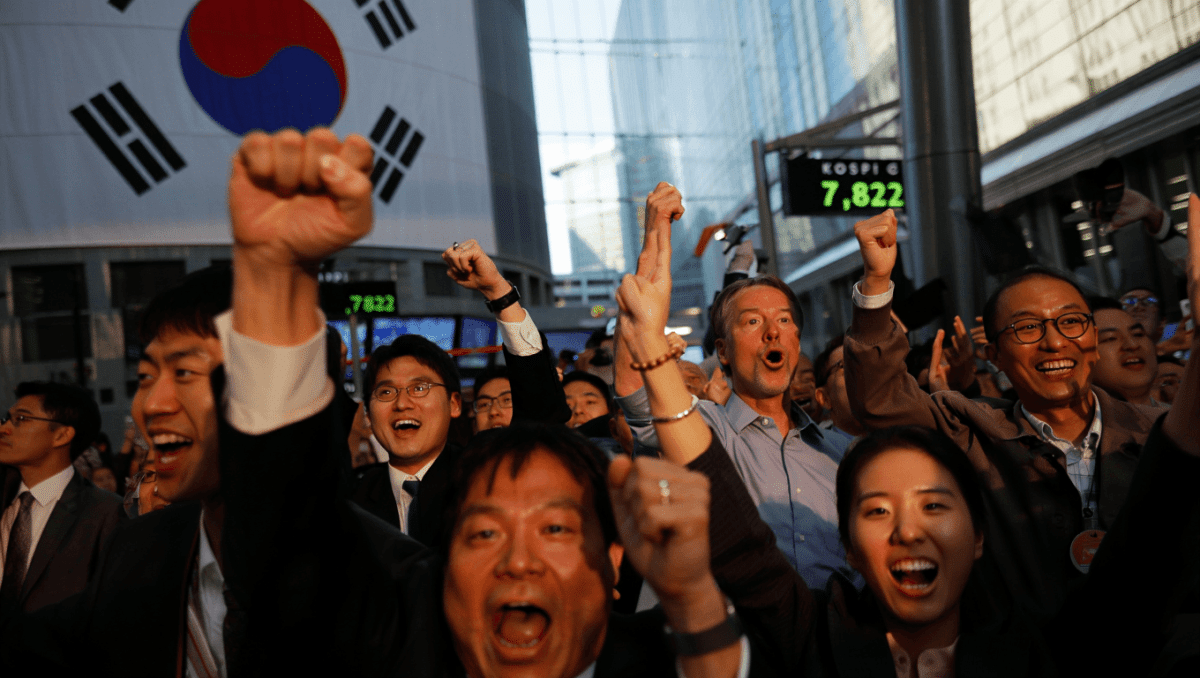
South Korean stocks hit a historic milestone as the KOSPI surged 324 points to close at 7,822 on May 11, 2026. The 4.32% gain marks a stunning new all-time record, driven by an explosive rally in semiconductor giants Samsung and SK Hynix. Can Asia’s hottest market reach 8,000 points next?
🔥 Quick Facts
- Record Close: KOSPI ended at 7,822.24, smashing the previous peak and gaining 324.24 points in one session.
- Intraday Peak: The index briefly crossed 7,899.32 during trading before settling at the record close.
- 2026 Gains: South Korea’s market is up 75% year-to-date, outpacing the Nikkei and Nasdaq combined.
- AI Memory Boom: Semiconductor exports jumped 139% year-over-year to $78.5 billion in Q1 2026 alone.
The AI Chip Shortage Fueling a Historic Rally
Artificial intelligence demand has created an unprecedented global shortage of memory semiconductors. Samsung Electronics and SK Hynix, which together dominate 60% of the world’s memory chip supply, are reaping enormous profits. Samsung’s chip division alone posted 53.7 trillion won in earnings, compared with just 1.1 trillion won a year earlier, a staggering 49-fold increase.
SK Hynix isn’t far behind. The company just posted a record 5-fold jump in quarterly profits from AI-driven demand. High-bandwidth memory, essential for AI servers, faces severe shortages. This supply crunch has sent memory chip prices soaring, boosting both companies’ profit margins to levels not seen in years.
Samsung and SK Hynix Lead the Charge
Samsung Electronics closed the day up 6.33%, while SK Hynix surged 11.51%. These two chipmakers represent the heart of the KOSPI’s explosive move. SK Hynix even hit a record 1.6 million won per share, reflecting pure market euphoria over its AI dominance.
The broader KOSPI semiconductor sector posted a net income growth of 293% year-over-year. Yet market capitalization has only risen 135%, meaning chip stocks are still trading at bargain valuations despite the record run. Foreign investment banks haven’t ignored this anomaly, leading to aggressive target hikes.
Next Stop: The 8,000-Point Barrier
| Target Level | Bank Forecast | Timeline |
| 8,000 | Next milestone, widely expected | Weeks to months |
| 9,000 | Goldman Sachs (raised May 8) | Mid-2026 |
| 10,000 | JPMorgan bull-case scenario | Year-end 2026 |
| 12,000 | Hyundai Motor Securities | By year-end 2026 |
Goldman Sachs initially set a 9,000 target, then raised it from an 8,000 base case just days ago. JPMorgan went even bolder, lifting its bull-case target to 10,000 points from 9,000, suggesting another 28% upside remains. Hyundai Motor Securities took the most aggressive stance, projecting 12,000 points within 12 months.
“The KOSPI’s jump is due to the recovery of capital market confidence in South Korea, which had been undervalued. This reflects strong structural earnings growth in semiconductors.”
— Democratic Party leader, commenting on government support policies
Earnings Revaluation on Steroids
Semiconductor profit growth stands at 220% for 2026, a number that would shock most investors outside Asia. Yet the KOSPI’s forward price-to-earnings ratio sits at just 7.5x, indicating the market still views the index as undervalued. Compare this to the U.S. market’s 20x+ forward P/E, and South Korea looks like a bargain bin.
The rally also benefits from year-to-date returns of 75%, making South Korea by far the world’s best-performing major market. Retail investors, long excluded from the gains, have begun to join institutions. Foreign investors are pouring capital into KOSPI stocks, attracted by both valuations and the structural AI boom.
Will This Momentum Last, or is Caution Warranted?
While the rally is undeniably powerful, risks exist. U.S.-Iran tensions briefly spooked markets during the May 11 session, though chip strength overshadowed geopolitical concerns. Memory chip prices, while elevated, could face compression if artificial intelligence demand slows or if rival NAND and DRAM producers ramp output.
Still, analysts point to structural tailwinds that justify the move. AI data center buildouts are only in early innings. Samsung and SK Hynix have raised full-year guidance, signaling confidence in sustained demand. Morgan Stanley lifted its KOSPI target to 6,500 from 5,200. The question may no longer be if the KOSPI hits 8,000, but when, and how far beyond?