Deere & Company reported $1.773 billion in net income for the second quarter ending May 3, 2026, or $6.55 per diluted share. While the industrial giant held its full-year profit guidance at $4.5 billion to $5.0 billion, the results mask diverging performance across its business units: Construction & Forestry is surging with infrastructure demand driving 20% sales growth expectations, while Production & Precision Agriculture—Deere’s largest segment—experienced a 14% revenue decline amid a prolonged farm economy downturn.
🔥 Quick Facts
- Q2 FY2026 net income: $1.773 billion, marking the company’s sustained profitability despite agricultural headwinds
- Equipment operations margin: 16.9%, boosted by a $272 million IEEPA tariff refund that added nearly 2.5 percentage points
- Full-year guidance unchanged: $4.5B–$5.0B, reaffirmed despite divergent segment outcomes
- Construction and Forestry sales forecast raised to ~20% growth with 10–12% segment margins, offsetting agricultural weakness
- Direct tariff headwind for FY2026: ~$1.2 billion, representing approximately 3 percentage points of margin pressure
Agricultural Segment Faces Prolonged Downturn, Construction Strength Tells Two-Speed Story
Deere’s Q2 results reveal a company navigating sharply divergent market dynamics. The Production & Precision Agriculture segment, which comprises approximately 60% of equipment operations, posted a 14% revenue decline as large farm equipment demand remained depressed. The company explicitly forecasts the U.S. and Canadian large agriculture market to contract 15–20% in fiscal 2026, marking a continuation of the farm economy stress that defined 2025.
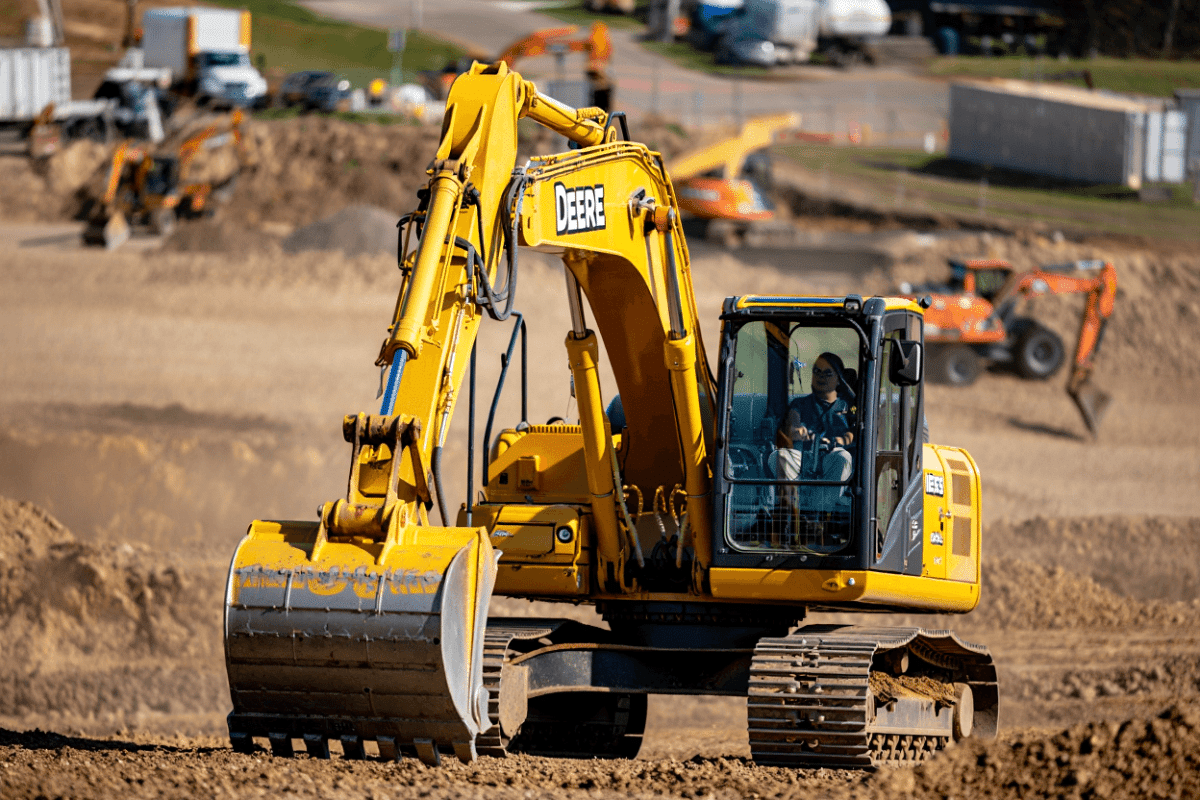
Conversely, Construction & Forestry (CF) is experiencing robust demand. The segment posted net sales growth of 29% in Q2, driven by infrastructure investments, road construction, and forestry applications. This dichotomy explains why management chose to raise the CF full-year sales guidance to approximately 20% growth despite large agriculture remaining at cycle lows. The company now expects Construction & Forestry margins of 10–12%, a meaningful improvement trajectory that provides revenue diversification in a challenging macro environment.
Tariff Refunds Mask Structural Margin Pressure; $1.2B Exposure Remains
A critical analytical lens for interpreting Q2 profitability is the treatment of tariffs. The $272 million Inflation Reduction Act (IEEPA) tariff refund provided a material boost to equipment operations margins, adding nearly 2.5 percentage points to quarter results. Importantly, management highlighted that direct tariff exposure remains substantial: approximately $1.2 billion on a full-year basis, translating to a 3-point margin headwind that persists regardless of incidental refunds.
This structural dynamic means that normalized equipment margins—excluding the tariff refund—would have been approximately 14.4% rather than 16.9%. Investors focusing on underlying operational performance should be mindful of this distinction when projecting future quarters. The company remains exposed to both tariff escalation and the timeline for future relief provisions, which could meaningfully impact profitability if trade policies shift.
Segment Performance and Market Positioning: Comparative Analysis
The following table summarizes Deere’s three primary operating segments and their strategic positioning heading into the second half of fiscal 2026:
| Segment | Q2 Revenue Trend | FY2026 Guidance | Key Driver |
| Production & Precision Agriculture | -14% YoY | Large ag market -15% to -20% | Farm commodity prices, equipment financing |
| Construction & Forestry | +29% YoY | Sales up ~20%, margins 10–12% | Infrastructure spending, road construction |
| Small Agriculture & Turf | Resilient demand | Up 10–15% expected | Residential landscaping, compact equipment |
The divergence underscores Deere’s strategic exposure to market cycles. Large agriculture—tied to commodity prices, farm profitability, and equipment financing conditions—remains depressed. Conversely, construction and infrastructure-related equipment benefit from government stimulus spending and urban development projects. Management’s decision to maintain full-year guidance despite large agriculture weakness reflects confidence that Construction & Forestry strength will offset production agriculture decline.
“While our customers face ongoing challenges, John Deere remains firmly committed to supporting their success through disciplined operations and resilience.”
—Deere & Company leadership statement, Q2 FY2026 earnings release
What an Agricultural Recovery Would Mean: Implications and Timeline
Deere’s prior guidance suggested fiscal 2026 would mark the bottom of the farm economy downturn. However, the Q2 commentary revised that outlook, pushing expectations for agricultural recovery into later in 2026 or potentially 2027. This delay has several implications for investors and customers:
First, near-term equipment demand will remain suppressed. Farmers operating with reduced margins have little incentive to upgrade equipment. Equipment utilization rates remain high among existing machines, extending replacement cycles—a dynamic that pressures agricultural revenue regardless of underlying market conditions.
Second, small-scale and compact equipment—used by hobby farmers, landscapers, and utilities—continues to outperform large agricultural machinery. This trend reflects demographic shifts toward smaller land operations and residential construction demand, a secular tailwind that should sustain the Small Agriculture & Turf segment’s 10–15% growth trajectory.
Third, tariff resolution remains a wildcard. If the $1.2 billion full-year tariff exposure is eliminated through policy action, Deere could recognize a substantial margin expansion without underlying operational improvement—conversely, tariff escalation could compress margins further. This binary outcome introduces material uncertainty to profitability guidance.
Is This the Bottom of the Cycle, or Simply a Plateau? Three Scenarios for the Remainder of Fiscal 2026
Management’s commentary on the farm economy’s trajectory is crucial. Prior to Q2, Deere had positioned fiscal 2026 as the inflection point—the year when large agriculture would stop contracting and begin recovering. However, persistent weakness in commodity prices, high input costs for fertilizer and fuel, and constrained ag lending conditions have extended the downcycle longer than initially anticipated.
The path forward hinges on three possible scenarios:
Scenario 1 (Base Case): Mild Recovery in H2 2026. Commodity prices stabilize at elevated but manageable levels, allowing farmers to allocate capital toward selective equipment replacements. Deere would achieve the $4.5B–$5.0B guidance range through Construction & Forestry strength and modest agricultural stabilization—representing growth from H1 2026 to H2 2026 but not year-over-year improvement.
Scenario 2 (Upside): Earlier-Than-Expected Agricultural Rebound. A combination of improved commodity prices, government agricultural support programs, or eased financing conditions sparks accelerated large equipment purchases. In this case, Deere could exceed guidance and signal stronger 2027 growth, lifting the stock materially.
Scenario 3 (Downside): Extended Downturn. Commodity prices decline further, trade policy uncertainty worsens, or agricultural lending tightens unexpectedly. In this scenario, Deere could miss guidance despite Construction & Forestry strength, signaling a longer path to agricultural recovery than the market currently prices.
What Changes Would Signal Genuine Agricultural Bottom Conditions?
Investors and farm equipment dealerships should monitor several leading indicators to assess whether genuine recovery conditions are emerging:
1. Equipment Financing Conditions. If interest rates decline and lending conditions ease, farmers will have improved access to capital for equipment purchases. Currently, equipment financing rates remain elevated, restricting replacement cycles.
2. Commodity Price Stabilization. Corn, soybean, and wheat prices must stabilize at levels that support farm profitability without collapsing from demand destruction. Prices that are too low delay equipment purchases; prices that are too volatile prevent budget planning.
3. Retailer Inventory Levels. Deere’s dealer network remains adequately stocked with used and new equipment. If dealer inventories decline and backlogs emerge, it signals genuine demand acceleration—not merely inventory depletion.
4. South American Agricultural Recovery. Deere has significant exposure to Brazil and Argentina. If South American tractor and combine demand rebounds—particularly in Brazil where farming is economically healthier—it would provide diversification benefit to offset North American weakness.
A Company in Transition: From Uniform Growth to Portfolio-Driven Returns
The Q2 earnings reveal a fundamental shift in Deere’s earnings composition. Historically, the company derived steadier returns from agricultural equipment coupled with steady construction machinery demand. Today, that narrative has inverted: agriculture is the cyclical drag while construction drives growth.
This portfolio shift has strategic implications for long-term investors. Deere is no longer a pure-play agricultural equipment company—it is increasingly a diversified industrial business with meaningful exposure to infrastructure spending, equipment financing, and construction cycles. The Construction & Forestry segment’s 20% expected growth trajectory for fiscal 2026 reflects the reality that U.S. and global infrastructure investment is outweighing agricultural demand weakness.
The company’s ability to maintain $4.5B–$5.0B full-year guidance despite 14% large ag revenue declines underscores the importance of Construction & Forestry as a strategic counterweight. Looking forward, investors should assess whether this diversification trend persists or whether agricultural demand eventually recovers to drive consolidated growth.
Beyond May 2026: What Matters Next?
Deere’s next scheduled earnings announcement will occur in August 2026 for Q3 fiscal results. Between now and then, investors should track any announcements regarding:
— Tariff policy changes that could materially impact the $1.2B full-year exposure
— Large agriculture segment stabilization signals (dealer inventory trends, equipment order rates)
— Construction market indicators (infrastructure spending bills, commercial construction starts)
— Refinement of full-year guidance, which could occur if management gains greater clarity on agricultural recovery timing
The broader question beneath Q2 results is straightforward: Has Deere found a sustainable earnings floor through portfolio diversification, or is the company merely delaying an agricultural rebound that will eventually define profitability? The answer will shape investment conviction heading into 2027 and beyond.