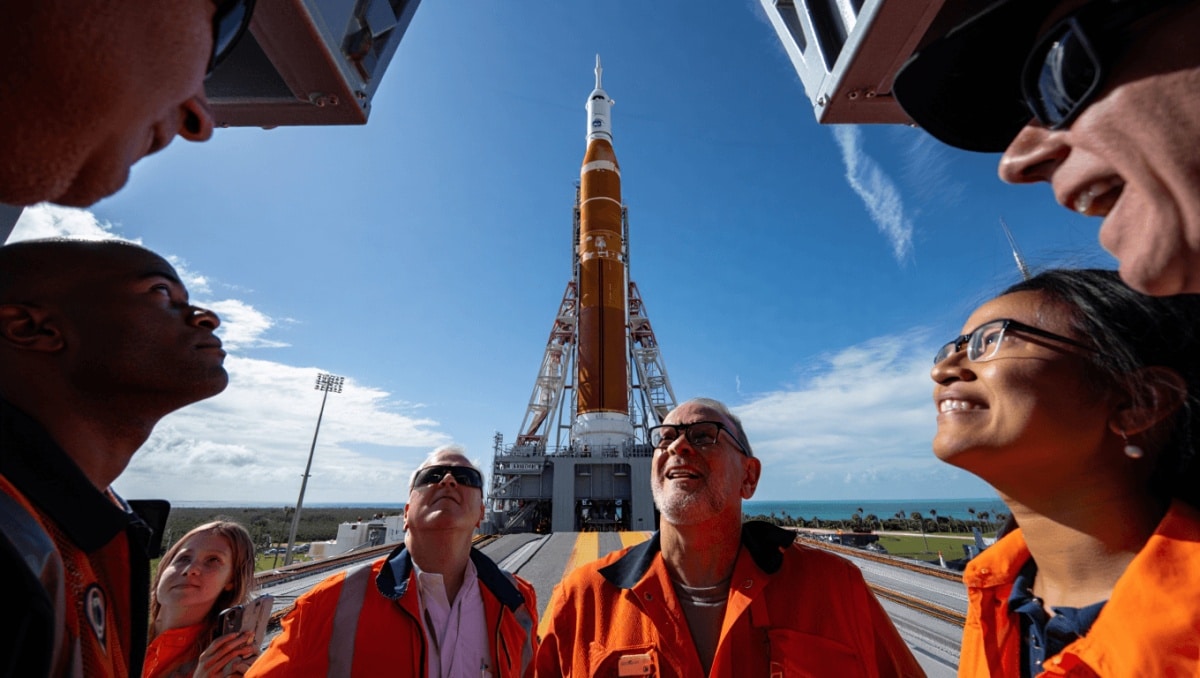
As NASA marks a new crewed voyage around the Moon, the agency’s strategy for returning people to the lunar surface is unmistakably commercial: the heavy-lift rocket and crew capsule were built by traditional aerospace contractors, but the landing vehicle is expected to come from Silicon Valley–style startups. That division of labor could determine who actually plants the next boots on lunar soil—and when.
The current Artemis-era architecture traces back to programs launched after the 2000s, when NASA rekindled plans for deep‑space exploration. That effort produced two very different paths: the government‑funded Space Launch System and Orion crew capsule, developed by established contractors, and a parallel shift toward purchasing services from private space companies.
Why NASA split the work
Agencies and Congress chose to keep a large, government-built launch stack while also spurring a nascent commercial space sector. The result is a hybrid approach: use the SLS to lift crews into lunar orbit and rely on commercial landers to ferry astronauts down to the surface.
SLS — assembled with major roles for Boeing, Lockheed Martin and European partners — is today one of the most powerful operational rockets. Its development was expensive and protracted, while private firms, led by SpaceX, advanced rapidly with reusable boosters and lower launch costs, attracting heavy venture investment.
The missing piece: a lunar lander
NASA did not try to build every component in-house. Instead, it turned to private firms for the lander that will carry astronauts from lunar orbit to the surface. Several companies won contracts to develop robotic landers and surface systems for reconnaissance and technology demonstrations.
In 2021, NASA selected SpaceX’s Starship as the first human landing system. The choice was contested inside and outside government because Starship’s concept requires multiple launches to refuel an enormous spacecraft in orbit before it can descend to the Moon—an operational model unlike anything NASA has previously bought.
Industry competitors and some former agency officials voiced concerns about that architecture. Critics argued the approach introduces technical and schedule risks, while proponents say Starship’s scale and reusability could ultimately lower costs and expand surface access.
- SLS & Orion: Government-built heavy launcher and crew capsule for transporting astronauts to lunar orbit.
- Starship (SpaceX): Selected as the primary crewed lander; requires in-orbit refueling from multiple launches.
- Commercial robotic landers: Smaller, venture-backed teams testing cargo and scouting technologies on the surface.
- Additional competitors: Other companies, including teams led by Blue Origin, are developing alternative human landing systems.
Tests, timelines and political stakes
NASA’s plan includes orbital rendezvous trials between Orion and one or more commercial landers before any crewed descent takes place. Those tests will be scrutinized as mission planners balance technical readiness, contractor schedules and budgetary constraints.
Delays or failures in any part of this mixed architecture will have consequences beyond program timelines. A successful commercial landing would validate NASA’s purchase‑service model and strengthen U.S. industry leadership in deep space. Conversely, setbacks could amplify calls for additional government investment or further program reshuffles.
Geopolitics adds urgency. China has an active lunar program and has expressed a goal of sending humans to the Moon within the coming decade, prompting U.S. policymakers to emphasize pace as well as safety and sustainability.
What to watch next
Key milestones that will shape the next phase include:
- Upcoming orbital and integrated tests of lander concepts and refueling operations.
- Further demonstrations by robotic landers that map and characterize candidate landing sites.
- Congressional funding decisions that will influence schedules for SLS upgrades and commercial lander procurement.
For the public and for policymakers, the immediate implication is straightforward: the Artemis program’s success now depends as much on private-sector engineering and launch cadence as it does on government-built hardware. If commercial providers deliver, NASA will have a new model for human exploration; if they struggle, the agency may face hard choices about how to maintain momentum toward the lunar surface.