Google is backing new workforce training for the factory floor with a $10 million grant to the Manufacturing Institute aimed at equipping roughly 40,000 U.S. manufacturing workers with practical artificial intelligence skills. The initiative launches as manufacturers accelerate automation and data-driven processes, making workforce readiness an immediate business and policy concern.
The money comes from Google.org’s AI Opportunity Fund and will support two tailored courses: an introductory track adapted for industry needs and an advanced program developed for technicians. Google says its in-house experts will help shape the curriculum so lessons reflect real shop-floor tasks rather than abstract theory.
The Manufacturing Institute, which operates apprenticeship and skills programs for the sector, will integrate the new training into its network and expand the Federation for Advanced Manufacturing Education—known as FAME—by opening chapters in at least 15 additional regions. That rollout is intended to pair classroom learning with hands-on placements at local manufacturers.
“This is about giving workers the tools to use AI on the job,” said a Google.org official, describing the partnership as an effort to make technology adoption faster and more practical for employers and employees alike.
- Grant source: Google.org — AI Opportunity Fund
- Reach: ~40,000 manufacturing workers
- Courses: AI 101 for Manufacturing; Advanced AI for Manufacturing Technicians
- Delivery: Collaboration between Google staff and Manufacturing Institute curriculum teams
- Expansion: FAME chapters to grow in 15+ new regions
Why it matters now
Manufacturers report rising demand for workers who can operate, interpret and maintain AI-enabled equipment. Without targeted retraining, companies risk slower adoption of efficiency-boosting tools and a deeper skills mismatch as automation reshapes production lines.
Industry data cited by the Institute projects significant job openings in the sector over the next decade. The new courses are positioned as a bridge: shorter, applied modules that aim to reduce barriers to entry for incumbent workers and apprentices.
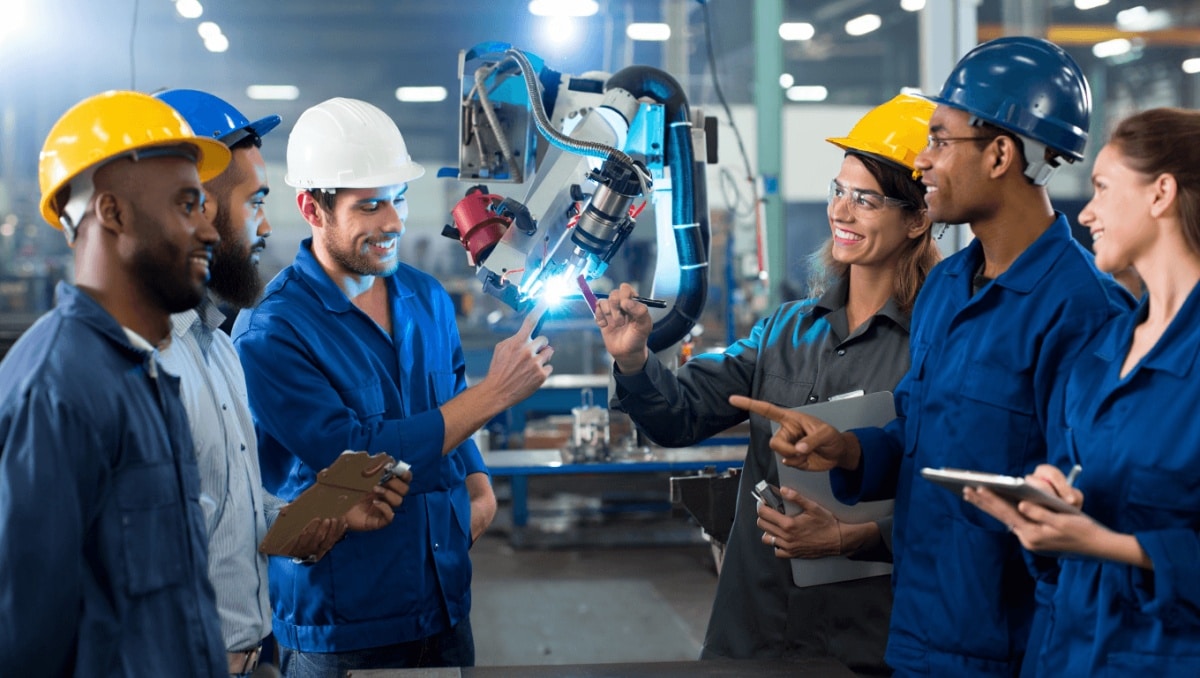
Carolyn Lee, president of the Manufacturing Institute, framed the effort as practical rather than theoretical. She said the curriculum will focus on examples workers encounter every day—diagnosing faults with predictive models, using AI to optimize machine settings, and interpreting analytics used in quality control. That concrete approach, she added, is intended to build confidence and reduce uncertainty about AI’s role in jobs.
Leaders on both sides emphasize that the training is meant to augment human labor, not replace it. By teaching employees how to partner with AI tools, manufacturers hope to improve productivity while preserving and upgrading existing roles.
Potential impact and limits
The program could accelerate AI adoption at small and medium-sized manufacturers that lack in-house training capacity. For trainees, shorter applied courses may speed transitions into higher-skilled roles without lengthy degree programs.
Still, experts caution that training funds and course development are only one piece of a broader workforce challenge. Adoption will depend on employers’ willingness to redesign jobs, invest in complementary technologies, and provide on-the-job mentoring—factors that vary widely across the industry.
For now, the $10 million injection signals growing private investment in reskilling tied explicitly to AI—a trend likely to draw attention from policymakers and labor groups as companies balance competitiveness with workforce stability.