Founders Fund has again placed a big bet on agricultural technology, leading a $220 million Series E that values New Zealand startup Halter at about $2 billion. The investment spotlights an often-overlooked corner of tech where solar-powered collars, low-frequency networks and smartphone apps are reshaping how ranchers manage land and livestock.
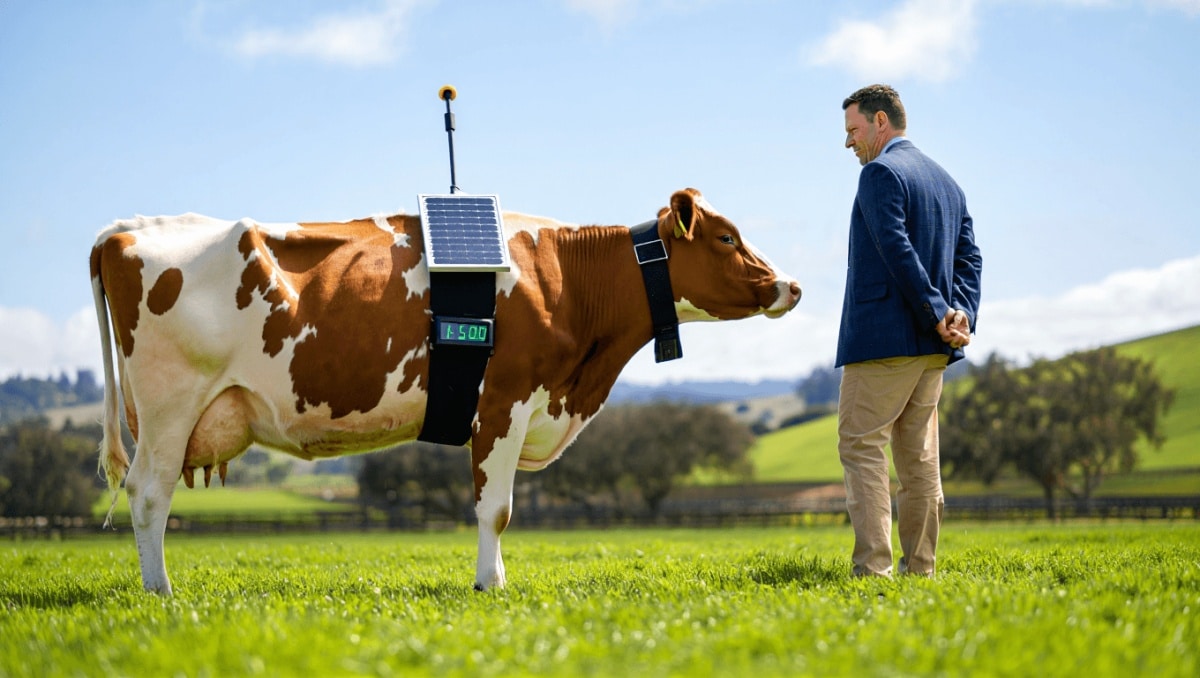
Halter has spent nearly a decade turning a simple question into a commercial product: how do you control and monitor cattle spread across remote pastures without rounding them up by hand? The company’s answer is a system of collars that guide animals with sound and vibration, combined with infrastructure and software that track herd behavior and health in real time.
Founder and CEO Craig Piggott, who launched the company in his early 20s after growing up on a dairy farm and a short engineering stint at Rocket Lab, says the technology is driven by hard financial logic rather than novelty. By directing grazing more precisely, Halter claims farms can boost land productivity by up to 20% and, in some cases, substantially increase output.
Here are the key facts at a glance:
- Funding: Series E of $220 million led by Founders Fund, valuing Halter at roughly $2 billion; the company has raised about $400 million in total.
- Deployment: Collars are in use on more than 1 million cattle across roughly 2,000 farms in New Zealand, Australia and the United States (present in 22 U.S. states).
- Technology: A solar-powered collar, a network of low-frequency towers and a smartphone app create virtual fences; collars give audio and vibration cues and continuously collect behavior data.
- Product traction: Ongoing firmware and software upgrades have produced rapid iteration; Halter is on its fifth hardware generation and has a reproduction-monitoring feature in beta in the U.S.
- Market opportunity: With roughly one billion cattle worldwide, current penetration is tiny—Halter estimates under 10% adoption even in its home market.
Piggott frames the system as both a herding tool and a sensor platform. Collars teach animals to respond to cues—usually within a handful of interactions—so farmers can shift herds across paddocks without manually moving them. Constant monitoring also builds what the company describes as one of the largest behavioral datasets for cattle, enabling earlier detection of illness and more precise reproductive management.
The approach is pragmatic rather than theatrical. There are no humanoid robots or advanced generative AI in play—just engineering focused on reliability. Piggott emphasizes the heavy lift is uptime: a large-scale system must be nearly flawless because even a small percentage of failures can leave dozens of animals uncontained. That operational resilience, he argues, is what took years to prove in New Zealand before scaling abroad.
Halter is not the only player in virtual fencing. Merck’s Vence is an established alternative, and startups exploring drone-based herding have recently surfaced from accelerator programs. Yet Halter’s leadership claims rest on long-term field validation, continuous product updates and a business model tied directly to farm economics rather than novelty.
Why this matters now: investment from a prominent Silicon Valley fund signals renewed venture interest in practical agtech solutions that show measurable returns. The sector has seen uneven fortunes in recent years, as many farm technologies struggled to demonstrate consistent ROI. Halter’s pitch is simple—deliver a clear lift in land productivity and the economics follow.
Beyond the financials, there are broader implications. Better-managed grazing can improve land stewardship and reduce wasted forage, while remote monitoring reduces labor demands and exposure to hazardous terrain. For large ranches and remote operations, the value proposition combines productivity, safety and data-driven animal health management.
Looking ahead, Halter plans further expansion across North and South America and into Europe. The company’s 1 million-cattle footprint is significant, but it represents a fraction of the global herd. That gap—roughly a billion animals worldwide—defines both the opportunity and the technical challenge: continuing to refine hardware, scale infrastructure and maintain extremely high reliability.
Ultimately, the toughest competitor may not be other technologies at all but the status quo. Many farmers still rely on traditional methods; persuading them to adopt new systems requires clear, repeatable gains. Halter’s recent capital infusion gives it time and resources to make that case on a larger map.