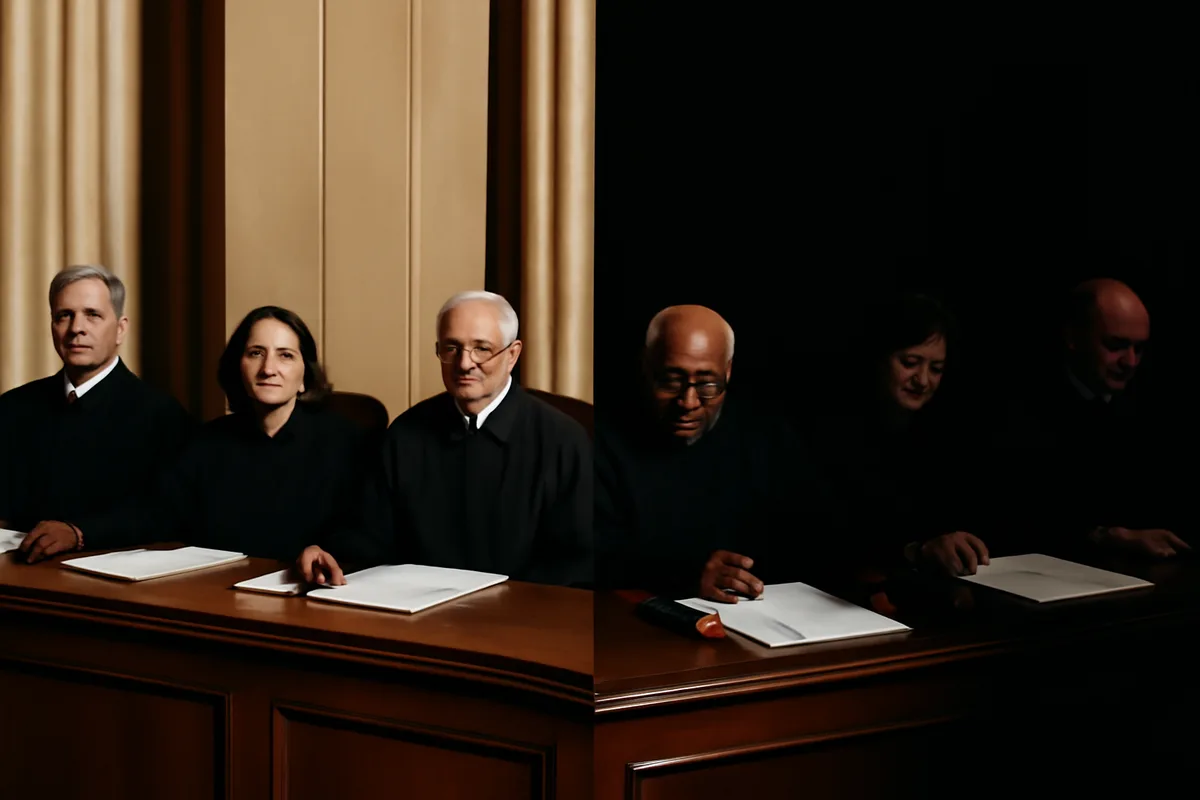
The Supreme Court’s conservative majority voted 6-3 on August 24 to allow President Trump’s executive order restricting mail-in voting to move forward, overturning a federal judge’s block and setting up continued legal battles before the 2026 midterm elections.
The decision split the justices sharply along ideological lines, with the six Republican-appointed conservative justices in favor and the three Democratic-appointed liberal justices in dissent. The Court’s order lifted an injunction that a Massachusetts federal judge had imposed earlier, clearing the way for the Trump administration to pursue its mail-voting restrictions despite ongoing legal challenges.
Trump’s executive order directs the U.S. Postal Service to establish new rules around mail-in ballots, including requirements for uniform envelope styles and new voter-specific data standards. The order also could allow USPS to refuse delivery of ballots from states that do not comply with the administration’s requirements—a power that has never been exercised before in modern elections.

The three liberal justices—Sonia Sotomayor, Elena Kagan, and Ketanji Brown Jackson—each filed separate dissents. Justice Jackson warned in her dissent that the ruling “needlessly injects chaos and uncertainty into the upcoming midterm elections,” according to multiple news reports. She argued that the Court’s emergency decision allowed the Trump administration to continue pursuing changes to state-run voting systems without fully addressing the constitutional questions at stake.
The Court’s ruling did not decide whether Trump’s order is ultimately constitutional—it only allowed the administration to move forward while legal challenges continue in lower courts. This narrow holding left significant uncertainty about how the mail-voting restrictions might be implemented before November’s elections, with federal judges already issuing new blocks on different parts of the order in subsequent rulings.
The decision reflects the broader ideological divide that has defined the Roberts Court in recent years. The six-justice conservative supermajority, composed of Justices Roberts, Thomas, Alito, Gorsuch, Kavanaugh, and Barrett, has consistently voted together on high-stakes political and constitutional questions. The 6-3 split in this case followed that pattern exactly, with no crossover votes from either side.

Election officials and voting rights advocates have raised concerns about the practical impact of Trump’s order. A federal judge in August noted that there is “no modern precedent for the federal government directing USPS to reject mail ballots based on voter eligibility,” highlighting the unprecedented nature of the administration’s approach. The order’s implementation could affect mail voting in at least 16 states and Washington D.C. that allow ballots postmarked on Election Day to be counted after polls close.
Federal judges have already blocked key parts of Trump’s mail-voting order, and the Trump administration continues to appeal court blocks on USPS mail voting rules, signaling that the legal fight will likely extend through Election Day. The uncertainty created by the competing court orders has forced election officials in multiple states to prepare contingency plans while the lawsuits proceed.
Sources
- NBC News — Supreme Court’s 6-3 vote along ideological lines, conservative majority allowing Trump’s mail-voting order to proceed.
- NPR — Justice Ketanji Brown Jackson’s dissent warning of “chaos and uncertainty” in the midterm elections.
- PBS NewsHour — The three liberal justices’ dissents and the narrow scope of the Court’s ruling.
- AP News — The Supreme Court’s decision lifting the federal judge’s injunction on August 24, 2026.
- The Guardian — Details of Trump’s executive order and the Court’s ideological split.
- Votebeat — Federal judge’s statement on the unprecedented nature of the government directing USPS to reject mail ballots.