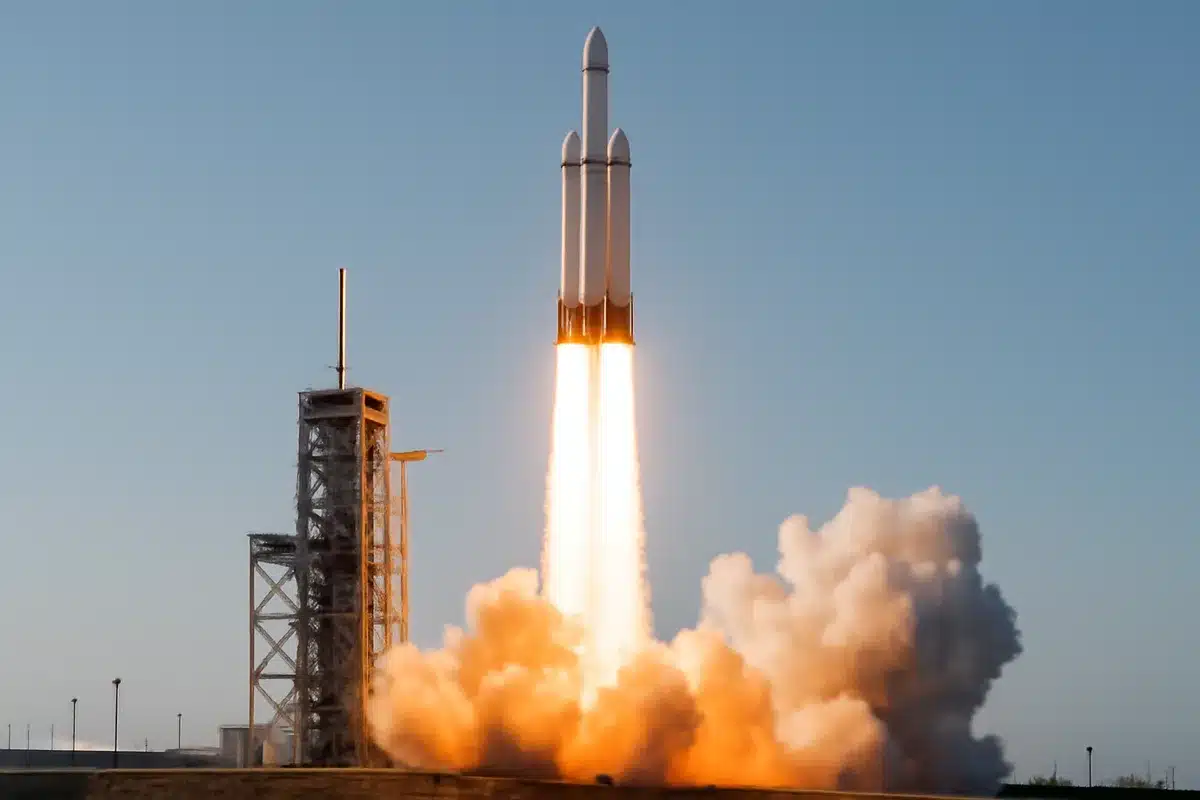
Update (Sep 1): The telescope successfully separated from the Falcon Heavy's second stage on August 30 at 7:57 a.m. EDT and completed its first mid-course correction burn on August 31, with Roman expected to reach its destination at the Sun-Earth L2 point in late September for a 90-day commissioning phase.
NASA’s Nancy Grace Roman Space Telescope launched aboard a SpaceX Falcon Heavy rocket on August 30, 2026, at 7:26 a.m. EDT from Kennedy Space Center in Florida, beginning a three-month journey to its final orbit 1.5 million kilometers away. The $4.3 billion mission marks a major step forward in space exploration technologies corp.’s role as a key launch provider for NASA’s most ambitious scientific endeavors.
The Roman telescope is equipped with a 300-megapixel infrared camera that provides a field of view 100 times larger than the Hubble Space Telescope, despite having the same 2.4-meter primary mirror. This expanded view will allow Roman to survey the universe far more rapidly than its predecessor, enabling it to image more than 50 times as much sky as Hubble covered across its entire 30-year operational history.
The flagship observatory will tackle some of astronomy’s deepest mysteries. Roman’s mission focuses on exploring dark matter and dark energy, the invisible forces that comprise 95 percent of the universe’s composition, while also hunting for exoplanets and studying the evolution of galaxies. The telescope is projected to discover as many as 200,000 potential planets beyond our solar system and survey over 1 billion galaxies during its five-year prime mission.
Roman’s capabilities represent a shift in how astronomers conduct surveys. While Hubble and the James Webb Space Telescope excel at deep, detailed observations of individual objects, Roman is designed to show the bigger picture—capturing enormous swaths of the sky in sharp, 300-megapixel images. This difference in approach allows Roman to survey the sky 1,000 times faster than Hubble, making it uniquely suited to discovering rare phenomena and completing a comprehensive census of the cosmos.
The telescope’s journey to its operational location at the Sun-Earth L2 Lagrange point will take approximately three months. Once settled into its orbit, Roman will begin its systematic study of the universe’s expansion, the nature of gravity on cosmic scales, and the properties of thousands of worlds orbiting distant stars.
Sources
- NASA — Roman Space Telescope launch date, time, and mission objectives
- SpaceX — Falcon Heavy launch confirmation and Roman mission details
- Space.com — Launch coverage and telescope specifications
- Scientific American — Roman’s science focus and dark energy research
- NASA Science — Telescope capabilities and comparison to Hubble
- Space News — Mission cost and technical overview