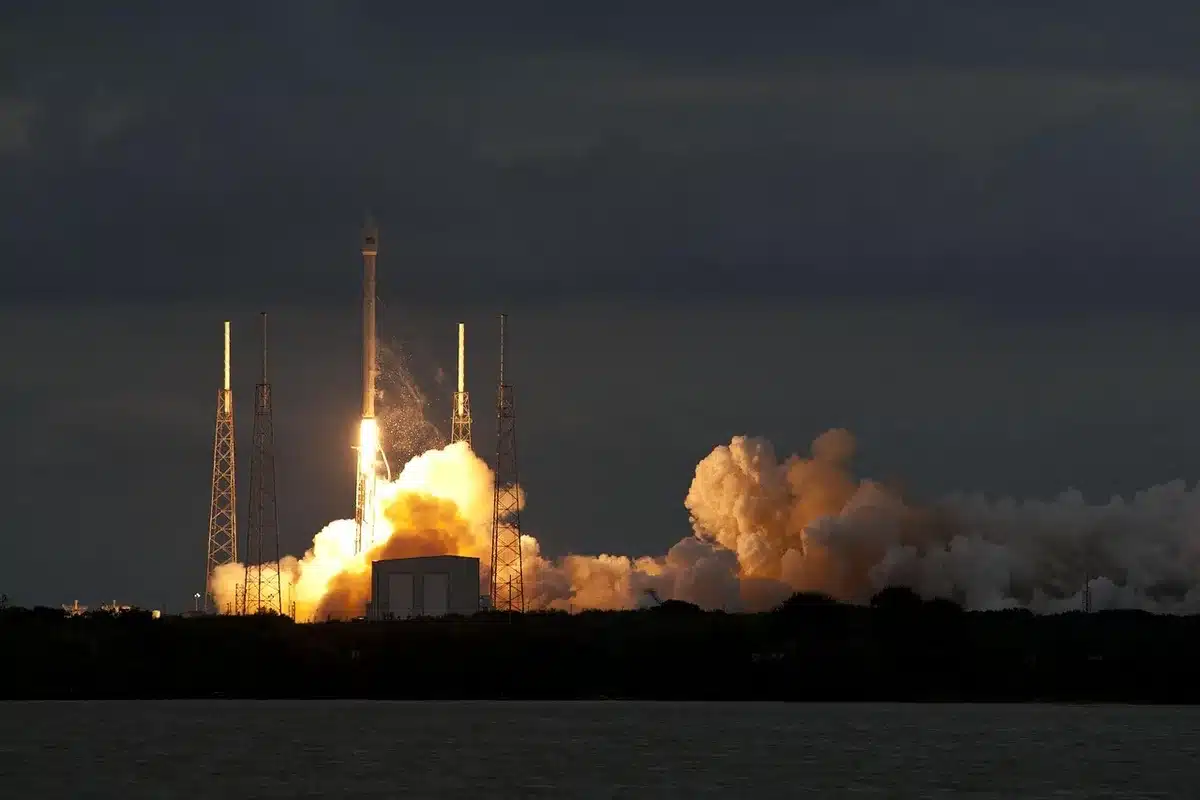
NASA’s Nancy Grace Roman Space Telescope launched successfully on a SpaceX Falcon Heavy rocket early Sunday morning, beginning a three-month journey to a distant orbital outpost one million miles from Earth. The telescope lifted off at 7:26 a.m. EDT from Kennedy Space Center’s Launch Complex 39A in Florida, separating from the rocket’s upper stage about 31 minutes after launch.
The 10.5-metric-ton observatory is the heaviest payload Falcon Heavy has ever carried to space, according to SpaceX. It will travel to the Sun-Earth L2 point, a gravitational balance zone where the James Webb Space Telescope already operates, allowing Roman to conduct its five-year primary survey mission without the interference of Earth’s heat and light.
The Roman Space Telescope is designed to investigate three central cosmic mysteries: dark energy, the invisible force accelerating the universe’s expansion; exoplanets, worlds beyond our solar system; and dark matter, the unseen substance that shapes galaxy structure. According to NASA, the mission will settle essential questions in these areas of astrophysics by surveying billions of galaxies and measuring light from stellar explosions called supernovae.
The telescope will employ a wide-field infrared instrument that gives it a field of view 100 times larger than the Hubble Space Telescope, enabling rapid surveys of vast regions of the sky. Its 300-megapixel infrared camera is central to both its cosmological mapping goals and its ability to detect Earth-like exoplanets using gravitational microlensing—a technique where a star’s gravity bends light from a distant galaxy, revealing planets orbiting that star.
The launch represents a significant milestone for NASA’s astrophysics program. The mission was completed nine months ahead of its original schedule, according to SpaceX and NASA sources. Once Roman reaches L2 and completes its three-month commissioning period, it will join Webb in conducting observations that will reshape humanity’s understanding of the cosmos.
Sources
- SpaceX — confirmed successful launch and payload deployment; provided mission details and Falcon Heavy specifications
- NASA Science — detailed mission objectives and telescope capabilities; confirmed three-month journey to L2 and primary science goals
- Space.com — launch time, location, and separation confirmation; provided payload weight and mission context
- Discover Magazine — explained Roman’s role in investigating dark energy and dark matter
- USA Today — confirmed mission objectives including dark energy, galaxy formation, and exoplanet discovery