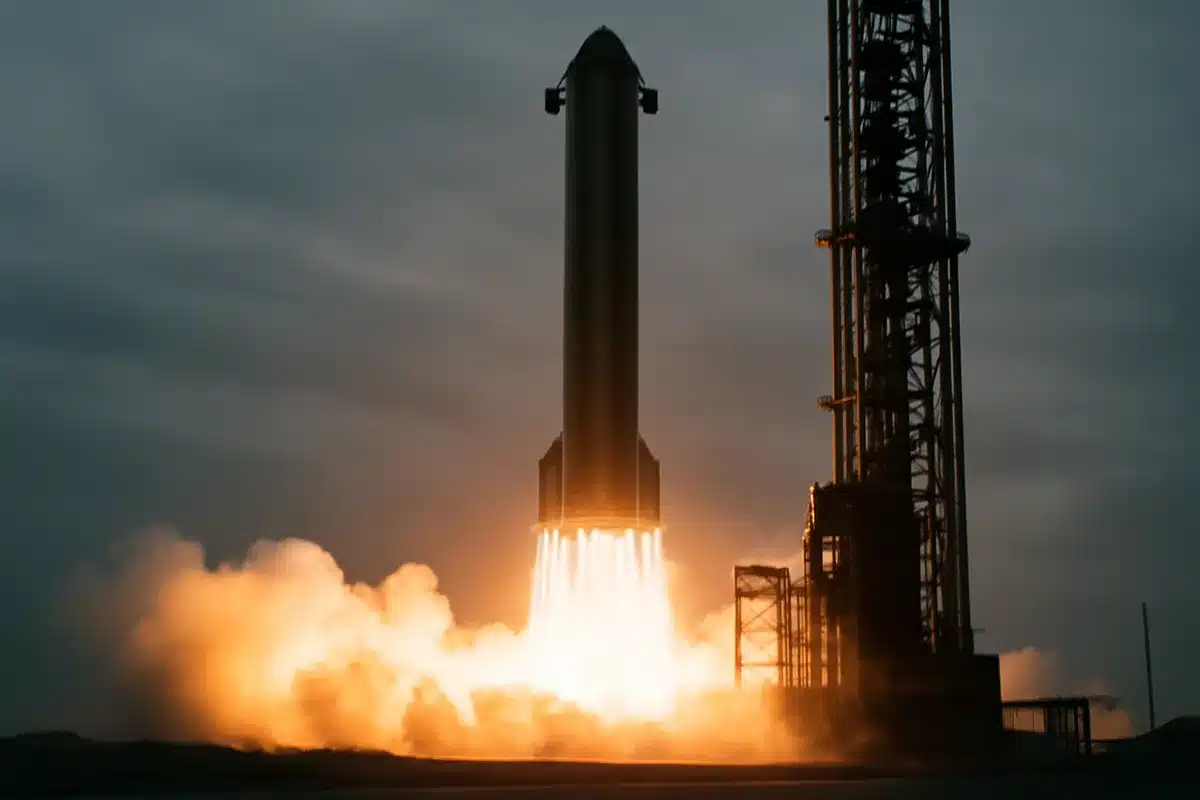
Update (Aug 30): SpaceX has pushed the Flight 14 launch target to mid-September 2026, with the FCC filing indicating September 15 as the scheduled date, after the initial late August target was delayed.
SpaceX’s Starship Booster 21 completed a full-duration static fire test on August 28, 2026, firing all 33 Raptor engines for approximately 15 seconds at Starbase in Texas, clearing the way for Flight 14’s orbital debut scheduled for early September.
The test represented the final major qualification milestone before the first orbital flight. Booster 21 had previously conducted a six-engine static fire on August 21 and single-engine tests on August 20, progressively validating the vehicle’s propulsion systems ahead of launch.
Flight 14 marks a historic shift for Starship. Unlike the previous 13 suborbital test flights, this mission will attempt to place Starship into Earth orbit for the first time, according to SpaceNews reporting from August 4, 2026. The flight will deploy approximately 20 operational Starlink V3 satellites into orbit, SpaceX’s next-generation broadband constellation.
Starlink V3 satellites represent a major step forward in SpaceX’s satellite network. According to reporting from August 6, 2026, these satellites will carry ten times the broadband capacity of earlier generations, and Starship’s massive payload bay enables deployment of roughly 20 V3 units per flight—a 20-fold increase compared to Falcon 9 launches, according to social media posts from SpaceX’s space agency blog.
The progression to orbital operations builds on steady incremental progress. Flight 13, conducted July 24, 2026, already deployed 20 Starlink V3 satellites during its suborbital trajectory and achieved SpaceX’s softest booster splashdown yet, according to space industry tracking reports. Flight 14 will extend that capability by sustaining orbit insertion and completing a full deorbit sequence.
Industry analysts view the flight as a critical proof point. UBS analysts stated in August that Flight 14 could demonstrate orbital capability, Starlink V3 deployment, and catch reusability—all key to SpaceX’s growth trajectory in connectivity and AI infrastructure. The combination of orbital operations, operational payload deployment, and reusability validation makes this test flight a watershed moment for the company’s commercial roadmap.
Sources
- NextSpaceFlight — confirmed Booster 21 completed a roughly 15-second full-duration static fire with 33 engines on August 28, 2026
- SpaceNews — reported Flight 14 will be Starship’s first flight to place satellites into operational orbit, and will carry Starlink V3 satellites, from August 4, 2026
- Technology.org — stated Flight 14 targets late August and aims to deploy the first batch of V3 Starlink satellites carrying ten times the broadband capacity, from August 6, 2026
- Seeking Alpha / UBS — analysts cited Flight 14 as proving orbital, Starlink V3 deployment, and catch reusability as key to growth, from August 12, 2026
- MLQ.ai — reported Flight 13 on July 24, 2026, deployed 20 Starlink V3 satellites and achieved the softest booster splashdown