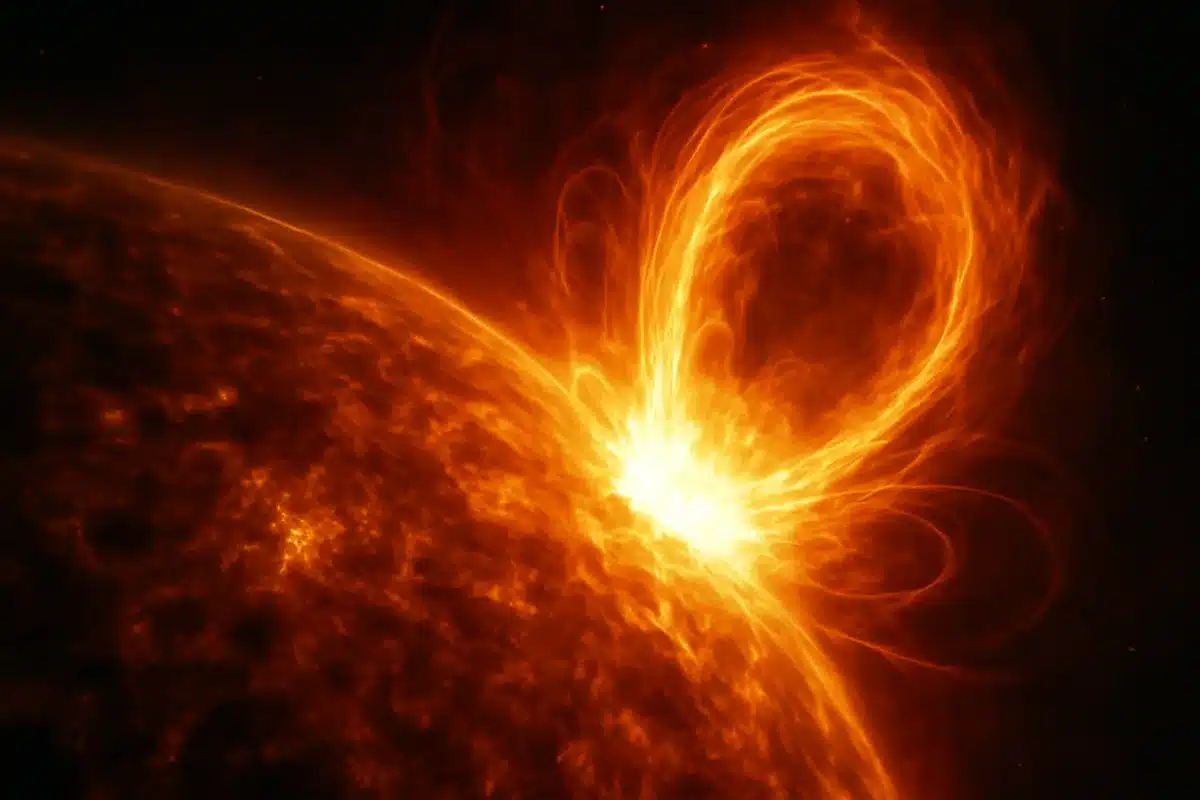
The sun unleashed a powerful M6.9 solar flare on August 25, 2026, triggering a coronal mass ejection now headed toward Earth, according to the Solar Influences Data Analysis Center and multiple space weather agencies. The flare peaked at 10:02 UTC from active region AR4513 and is forecast to deliver a glancing blow to Earth around August 28, potentially sparking a minor geomagnetic storm and northern lights displays across higher latitudes.
Early models show the CME could reach Earth around 6 to 7 a.m. EDT on August 28, according to Fox Weather forecasters. The exact arrival time will depend on how the CME’s magnetic field interacts with Earth’s magnetosphere when it arrives. If the CME occurs at the same time as a high-speed solar wind stream, the two could combine to enhance geomagnetic activity and increase aurora visibility.
M-class flares are ranked as the second-strongest category in the solar flare classification system, which ranges from A, B, C, M, and X classes. According to the European Space Agency, M-class flares generally cause brief radio blackouts that affect Earth’s polar regions, and minor radiation storms sometimes follow. When a CME reaches Earth, it can create a major disturbance in Earth’s magnetic field called a geomagnetic storm, which can disrupt radio communications, electric power grids, and navigation signals.
Active region AR4513 has been exceptionally active in recent days. On August 20, the region produced an M8.1 flare at 11:42 UTC, one of the strongest flares of the month, according to watchers.news. By August 25, AR4513 had unleashed five M-class flares in less than 24 hours, capped by the M6.9 eruption. Forecasters estimate a 45 percent chance of additional M-class flares and a 5 percent chance of an X-class event through August 26.
If the geomagnetic storm materializes as forecast, aurora watchers in northern regions including Seattle, Minneapolis, Edinburgh, and the Scottish Highlands may see displays by late August 26 or August 27, according to EarthSky forecasters. A comparable solar event in January 2026 triggered an X1.9 solar flare that produced an unusually fast CME, demonstrating how powerful Earth-facing eruptions from active sunspot regions can create widespread space weather effects across the planet.
Sources
- Space.com — reported the M6.9 solar flare eruption on August 25 and CME forecast arrival around August 28
- Fox Weather — provided detailed CME arrival timing (6-7 a.m. EDT August 28) and geomagnetic storm potential
- Solar Influences Data Analysis Center (SIDC) — confirmed the M6.9 flare peak time at 10:02 UTC August 25 from AR4513
- CCMC (NASA) — verified the flare source and CME observation details
- Watchers.news — documented the M8.1 flare from AR4513 on August 20
- EarthSky — provided aurora forecast and regional visibility information
- European Space Agency (ESA) — explained M-class flare effects and radio blackout impacts