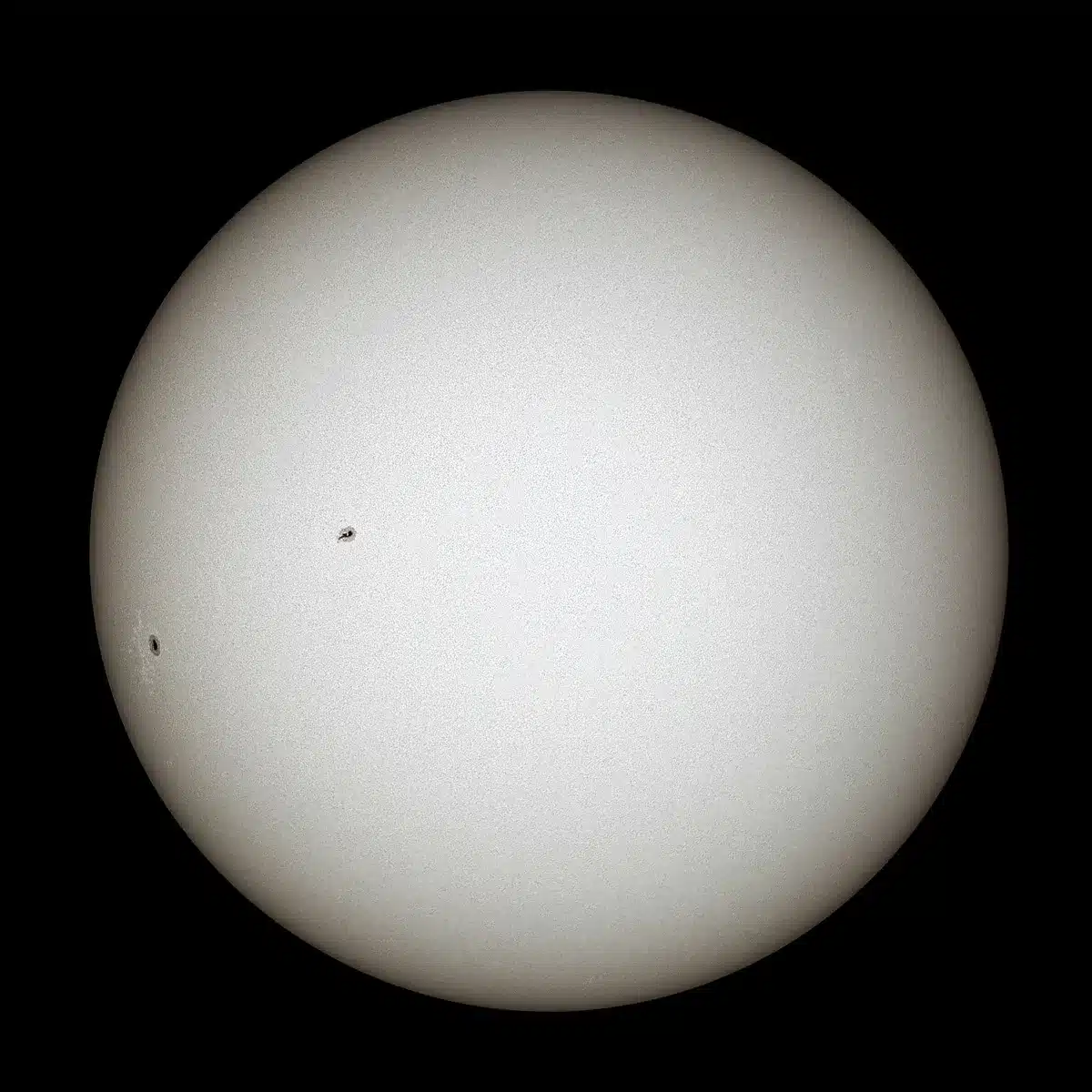
Update (Aug 26): On August 26, sunspot AR4513 unleashed an additional M6.98-class solar flare, and forecasters upgraded the threat assessment, noting the region has developed a 'beta-gamma-delta' magnetic field configuration that poses a threat for X-class solar flares. A coronal mass ejection is expected to reach Earth on August 27-28, potentially triggering a G2-class geomagnetic storm.
Sunspot AR4513 unleashed five M-class solar flares on August 25, 2026, with the strongest reaching M7 magnitude, as the active region continues to produce intense bursts of radiation while rotating further into Earth-facing view. The surge marks a significant uptick in solar flare activity from a region that has been crackling with eruptions since arriving at the sun’s eastern limb earlier this month.
M-class flares are medium-sized eruptions that can trigger minor to moderate radio blackouts on the sunlit side of Earth, according to the European Space Agency. The August 25 barrage means AR4513 is responsible for nearly all the flaring activity observed on the sun’s Earth-facing disk over the past day, with forecasters estimating a 55% chance of additional M-class flares and a 5% chance of more powerful X-class events in the coming days.
AR4513 first captured attention on August 20 when it produced a powerful M8.1 flare, the strongest in a series of three M-class eruptions within 24 hours, according to ScienceTimes. That event triggered minor radio blackouts across portions of Earth’s sunlit side, though the associated coronal mass ejection (CME)—a massive eruption of magnetized plasma—was directed away from our planet and posed no geomagnetic threat.
The timing is significant because the sun is near the peak phase of Solar Cycle 25, the 11-year cycle of solar activity. This means elevated sunspot numbers and more frequent eruptions are expected as the cycle advances, raising the potential for Earth-directed space weather events. When a CME reaches Earth, it can interact with our planet’s magnetic field and spark geomagnetic storms, which produce auroras and can disrupt communications and power systems.
A comparable precedent occurred in early February 2026, when sunspot AR4366 stunned scientists with its intensity. Within 24 hours, AR4366 unleashed 18 M-class flares and four X-class flares, according to Forbes, making it one of the most active sunspot regions observed in recent years. That earlier burst demonstrated how rapidly solar activity can escalate during the peak phase of a solar cycle, with multiple powerful eruptions occurring in quick succession.
Space weather forecasters are closely monitoring AR4513 as it continues to rotate toward Earth over the coming days. The region’s magnetic field structure remains complex and unstable, creating conditions favorable for additional flaring. If an Earth-directed CME does arrive in the next few days, it could spark auroras visible from higher northern latitudes, including parts of Scotland and the northern United States, according to EarthSky’s latest space weather forecast.
Sources
- EarthSky — Confirmed five M-class flares from AR4513 on August 25, 2026, capped by an M7, and provided forecast for continued activity and aurora potential.
- ScienceTimes — Reported on the M8.1 flare from AR4513 on August 20, 2026, and the CME that missed Earth; provided context on Solar Cycle 25 intensification.
- European Space Agency — Described M-class flare effects: minor to moderate radio blackouts on sunlit regions.
- Forbes — Documented February 2026 sunspot AR4366 activity: 18 M-class and 4 X-class flares in 24 hours, for precedent comparison.
- NASA — Provided information on M-class flares and coronal mass ejections, and solar cycle phases.