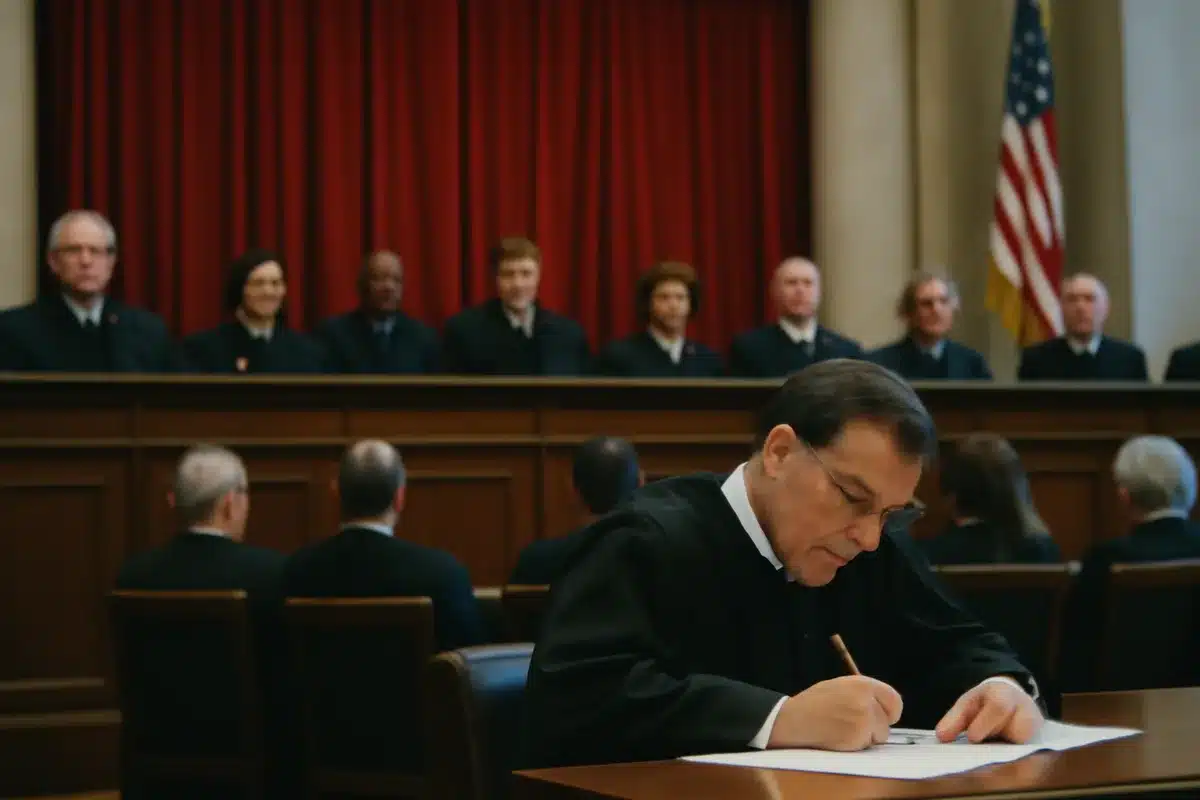
The Supreme Court allowed President Donald Trump to pursue his executive order restricting mail-in voting ahead of the November midterms, lifting one of two injunctions against the order on Monday, according to Votebeat and PBS News. The unsigned ruling, which cut along ideological lines, did not decide whether Trump’s order is constitutional, only that a lower court’s injunction was premature.
The order, issued by Trump in March, would mandate the creation of voter lists to be shared between the Department of Homeland Security, states, and the U.S. Postal Service. It also requires new ballot envelope designs and electronic tracking systems for mail ballots, according to Votebeat. The Postal Service issued final rules Friday implementing these requirements, which it said it would not enforce for November unless the Supreme Court cleared the way.

In her dissent, Justice Ketanji Brown Jackson warned that the ruling would create a “Kafkaesque nightmare” that “needlessly injects chaos and uncertainty into the upcoming midterm elections,” according to Votebeat. Jackson noted that states administering elections “deserve clarity, not caginess or confusion,” according to Courthouse News. Justice Sonia Sotomayor also dissented, joined by Justice Elena Kagan.
The practical obstacles to implementing the order are severe. Ballots in California start going out in 11 days, and the state has already printed its envelopes, according to PBS News. Jesse Salinas, registrar of Yolo County, California, said that “the capacity” to revise procedures “I just don’t see it.” North Carolina’s overseas and military voters will receive initial ballots in just over a week, on September 4, according to PBS News.

Election officials nationwide expressed concern about the timeline. Tammy Patrick, chief program officer at the Elections Center, an association of 2,500 election officers, said “there isn’t a single state that does their elections in a way that this postal rule lays out” and that “no one she talked to has tried” to comply, according to PBS News. Cisco Aguilar, Nevada’s Democratic Secretary of State, called it “impossible to implement this system in that time frame,” noting that the Postal Service had already misdelivered three dozen mail ballots from his state’s June primary, according to PBS News.
The Supreme Court’s order addressed neither a second injunction blocking the Postal Service from implementing the rules nor the final regulations the service issued Friday. Legal experts said further litigation is expected within days. Rick Hasen, a UCLA law professor, wrote that “this doesn’t necessarily mean anything in terms of November,” according to Votebeat. David Becker, executive director of the Center for Election Innovation & Research, said the majority “seemed to create complete chaos leading up to the midterm elections” and it would be “impossible” for states to comply with the new rules at this late date, according to PBS News.
The court’s majority made clear it was not endorsing the order’s constitutionality. “The court’s disposition of this application does not mean that any measure taken by the government to implement the order will necessarily be lawful,” the majority wrote, according to Votebeat. The ruling comes after U.S. District Judge Indira Talwani blocked key provisions of the order in June, finding some to be unconstitutional, and the 1st U.S. Circuit Court of Appeals upheld that decision in late July.
Trump has long sought to restrict mail voting, though he cast his own ballot by mail in Florida’s primary. The dissent from Justice Jackson underscored the stakes for voters who rely on mail ballots, which accounted for 29 percent of votes cast in 2024, according to PBS News.
Sources
- Votebeat — Supreme Court ruling details, Jackson’s dissent language, Hasen analysis, Talwani’s June injunction and July appeals court decision
- PBS News — Practical implementation challenges, election official quotes from Salinas, Patrick, and Aguilar, 29% mail voting figure, Trump’s mail ballot use
- Courthouse News — Jackson’s dissent quote on clarity and confusion