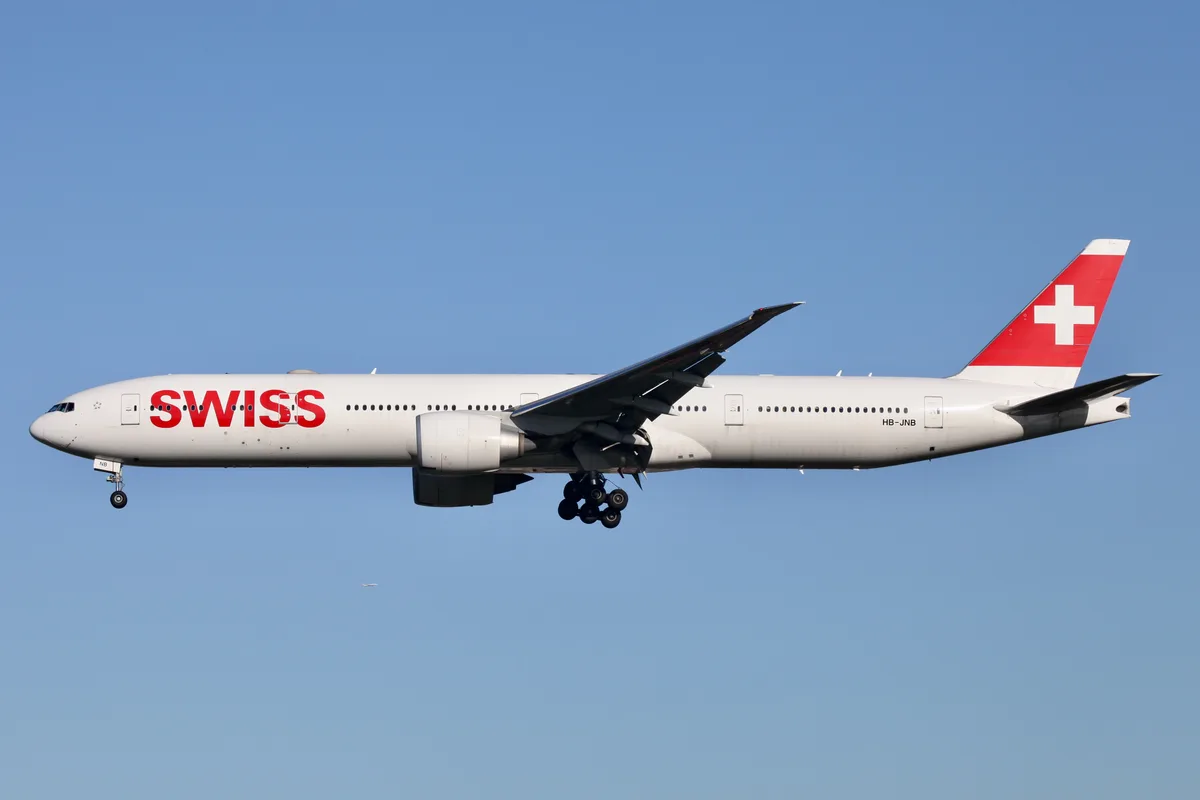
Swiss flight LX9 from Chicago to Zurich diverted to the Azores after its crew detected a chemical odor on board and issued a distress call over the Atlantic on Tuesday, according to reporting from Aviation A2Z and Bluewin. The Boeing 777 was carrying 222 passengers and 16 crew members when the crew declared an emergency and changed course mid-Atlantic.
Swiss Chief Operating Officer Oliver Buchhofer confirmed the emergency landing in remarks to media on Tuesday. “In such a situation, our crews take no risks and, as a precaution, decide to land at a suitable airport,” Swiss stated in a press release, adding that the airline consulted with air traffic control authorities and declared an in-flight emergency to receive priority in airspace.
About five passengers and one crew member underwent medical examinations as a precaution after landing, experiencing symptoms including eye irritation, nausea, and headaches, according to Bluewin. “None of the affected individuals required further medical attention,” Swiss confirmed. All 222 passengers and crew exited the aircraft normally.
The Azores, a Portuguese archipelago in the mid-Atlantic, serve as a critical diversion point for transatlantic flights. According to Simple Flying, for airlines operating routes across the Atlantic, the Azores provide essential ETOPS coverage—the Extended-range Twin-engine Operational Performance Standards that allow twin-engine aircraft to fly long distances over water. The location’s position roughly halfway across the Atlantic makes it an ideal alternate airport for emergencies.
Swiss has not disclosed what caused the chemical odor. “Our experts will thoroughly inspect the aircraft,” the airline stated, adding: “We ask for your understanding that we will not speculate on possible causes until these investigations are complete.” Buchhofer did not provide additional details about the nature of the odor or whether it was linked to any specific aircraft system.
When abnormal smells or fumes appear on aircraft, crews must assume there could be contamination in the air supply system until proven otherwise, according to aviation safety protocols. This approach reflects the principle that swift, precautionary action—rather than investigation—is the safest course when the source and severity of an odor are unknown. Swiss said it intended to send one of its own aircraft to the Azores on Tuesday afternoon to transport passengers onward to Zurich, with the airline hoping to return to Switzerland with the affected passengers the same evening.
Sources
- Aviation A2Z — reported the diversion, aircraft type, passenger and crew count, and Swiss’s plan to transport passengers onward
- Bluewin — confirmed the chemical odor, medical examinations, symptoms, and Swiss’s statement on investigation procedures
- Simple Flying — explained the Azores’ role as critical ETOPS diversion coverage for transatlantic flights