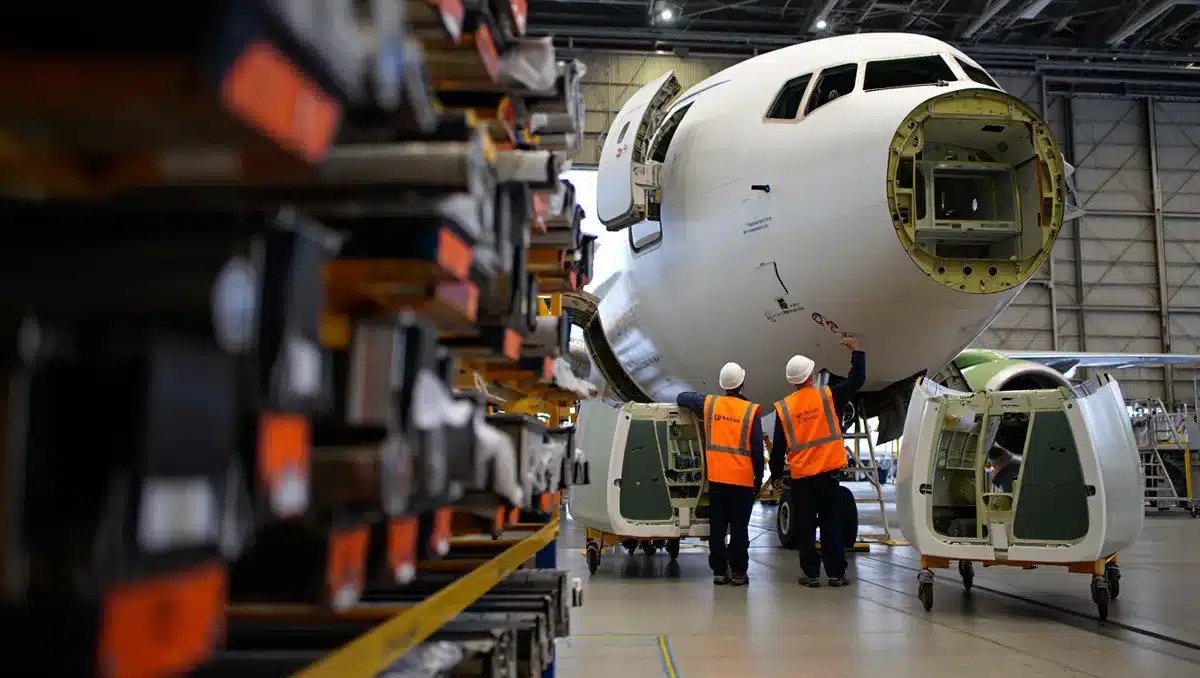
Emirates has completed its 100th aircraft retrofit, marking a landmark achievement in the airline’s $5 billion effort to modernize its widebody fleet with Premium Economy cabins and refreshed interiors. Since work began in November 2022, the airline has refurbished 47 Airbus A380s and 53 Boeing 777s at its engineering facilities in Dubai, investing 4.4 million man-hours over 44 months—making it the largest known fleet retrofit program undertaken by any airline globally.
The milestone, announced on July 14, 2026, reflects the scale of Emirates’ commitment to extend the operational life of its existing aircraft while upgrading the passenger experience across all cabin classes. By the end of December 2026, around 20 additional aircraft will emerge from the retrofit hangars, moving the airline significantly past the halfway point in its plan to refurbish 219 aircraft in total.
Premium Economy and Structural Reconfiguration
A defining feature of the retrofit program is the introduction of Premium Economy seating across the fleet. More than 3,800 new Premium Economy seats have been installed as part of the initiative, accelerating the rollout of this cabin class to more routes across Emirates’ global network. In May 2026, Emirates completed its first-ever retrofit of a two-class A380, converting it from a two-class to a three-class layout by moving Premium Economy to the upper deck in a 2-3-2 seating arrangement.
This reconfiguration required extensive structural work. The Emirates Engineering team removed 120 Economy Class seats from the upper deck and added 56 Premium Economy seats and 18 additional Business Class seats in their place. The project involved repositioning galley modules, stowage areas, overhead bins, and partitions, along with associated changes to electrical and plumbing systems. The first two-class A380 retrofit took approximately two months to complete, including planning and testing, but subsequent retrofits of the remaining 14 two-class A380s are expected to take around 30 days each, with all 15 scheduled to finish by the end of 2026.
Engineering Scale and Future Trajectory
The retrofit program’s complexity extends beyond cabin design. Emirates Engineering deployed more than 400 engineers and technicians to execute the transformation, with each A380 retrofit requiring more than 2,500 different types of parts and each 777 retrofit requiring more than 2,000 parts. The team developed innovative solutions to manage the project’s scale, including modified catering trucks to move large components within the hangars and specialized equipment for accessing all interior areas of the aircraft.
According to Cirium’s analysis of the program, the retrofit pace has shifted significantly. In 2023, Emirates completed 19 A380 retrofits, but the pace slowed to eight in 2024 and 11 in 2025, as average turnaround times extended beyond the original 16-day target—A380 refurbishments now average 52–60 days on the ground. By contrast, Boeing 777 retrofits have accelerated, with 30 completed in 2025 and 11 so far in 2026, averaging 21–22 days per aircraft. This shift reflects the shorter per-aircraft completion time for the 777s and suggests the airline may be prioritizing the twinjet program to maximize fleet availability.
Emirates President Tim Clark emphasized the achievement’s significance: “Completing full cabin retrofits for 100 wide-body aircraft in 44 months is a significant achievement. Backed by a US$5 billion investment, it ensures our customers ‘fly better,’ with elevated luxury, comfort, and thoughtful detail throughout each cabin.” Clark noted that executing a project of this magnitude entirely in-house required “unmatched planning, precision, craftsmanship and technical capabilities here in Dubai.”
The retrofit program also reflects Emirates’ long-term fleet strategy. With Boeing 777-9 deliveries not scheduled to begin until 2027—seven years after the original target—and no direct A380 replacement available, the airline has committed to keeping its existing widebody fleet modern and competitive. The airline’s upgraded A380s are flying with configurations ranging from 484 to 569 seats, compared to 615 seats in pre-retrofit two-class layouts, reflecting the airline’s premium positioning. For sustainability, Emirates has upcycled thousands of kilograms of leather, fabrics, and other materials from retrofitted aircraft into limited-edition collector pieces under the “Aircrafted by Emirates” brand, and has distributed over 4,000 backpacks made from repurposed Economy Class seat fabric to children across 11 countries.
Sources
- Emirates Media Centre — Official announcement of 100-aircraft retrofit milestone, program scope, investment amount, man-hours, and timeline; details on the first two-class A380 retrofit completion and Premium Economy specifications.
- Cirium — Analysis of retrofit program cadence, aircraft turnaround times, completion rates by year and aircraft type, and implications for fleet strategy and maintenance demand.