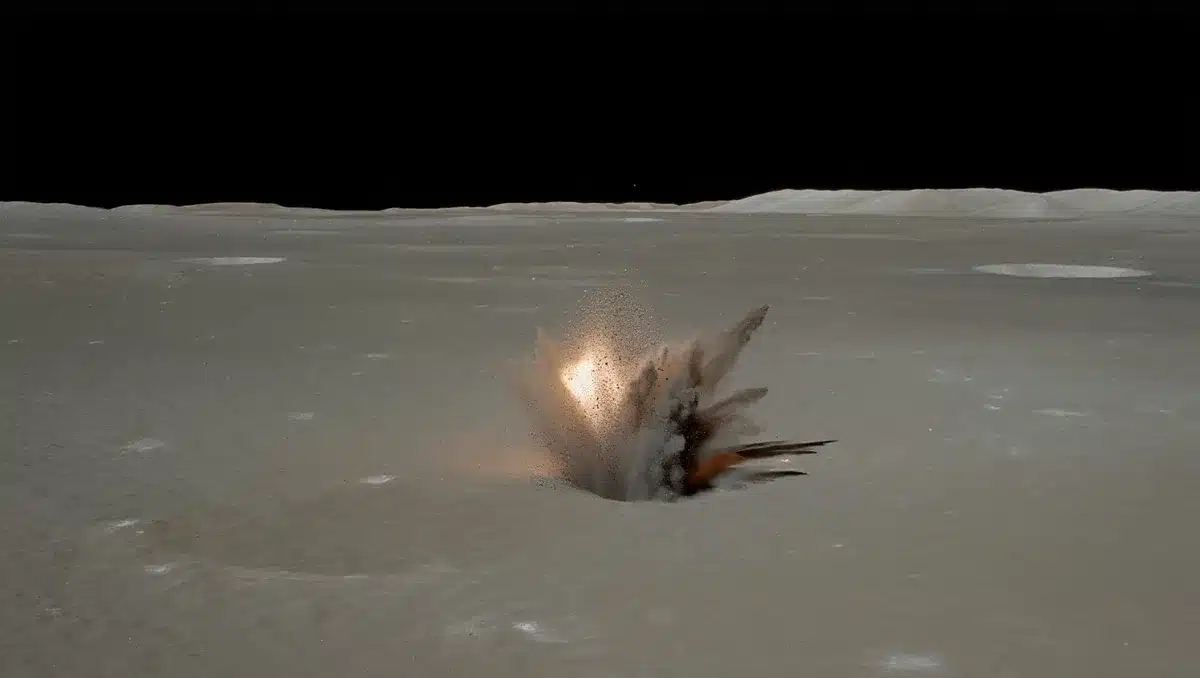
A SpaceX Falcon 9 rocket upper stage crashed into the moon on August 5, 2026, at 5,400 miles per hour, striking near Einstein Crater on the lunar far side and carving out a fresh impact crater. The impact occurred at 2:35 a.m. EDT, when the 45-foot stage, which had been drifting through space for nearly seven months, collided with the lunar surface.
The rocket stage launched on January 15, 2025, as part of a mission carrying Firefly’s Blue Ghost lunar lander and ispace’s Resilience lander to the moon. After completing its objective, the upper stage remained in orbit rather than returning to Earth’s atmosphere, gradually destabilizing until astronomers confirmed in May that it would strike the moon.
NASA estimated the impact would create a crater about 60 feet wide and 12 feet deep, excavating millions of pounds of lunar soil and ejecting rock and dust outward. Although the collision occurred on the sunlit side of the moon and was not visible from Earth, scientists hoped to observe a dust plume briefly rising above the lunar horizon. South Korea’s Danuri lunar orbiter captured images of the crater the day after impact, providing direct confirmation of the event.

The crash highlighted a growing concern for space exploration: accumulating debris on the lunar surface. According to reports, human-made objects on the moon now total approximately 209 tons, including spent rocket stages, spacecraft, scientific instruments, and mission debris left since the Soviet Union’s Luna 2 became the first spacecraft to reach the moon in 1959.
This unintentional collision is not without precedent. In 2009, NASA deliberately crashed its LCROSS spacecraft into the moon’s south pole to search for water ice, intentionally sending a Centaur rocket stage to impact the lunar surface. That mission successfully excavated subsurface material and revealed evidence of water ice, demonstrating the scientific value of studying impact events.
The Growing Challenge of Lunar Space Junk
The SpaceX impact adds to escalating concerns about orbital debris as lunar exploration accelerates. The moon now hosts approximately 3,000 human-made objects, with more than 100 lunar missions planned over the next decade by government agencies and commercial companies.
Scientists warn that without improved tracking systems and international regulations for spacecraft disposal, the growing debris field poses risks to future robotic missions and eventual lunar bases. Concerns also include potential contamination of pristine regions that preserve billions of years of geological history, and the possibility that historic Apollo landing sites could be disturbed. NASA’s planned permanent moonbase near the lunar south pole, part of its Artemis program, will operate in an increasingly crowded lunar environment.
Sources
- Forbes — Impact details, timing, rocket stage specifications, lunar debris totals, and NASA moonbase context
- NASA — Crater size estimates and scientific observation plans
- Space.com — Danuri orbiter confirmation and future lunar mission projections
- BBC — Lunar object count and debris weight figures