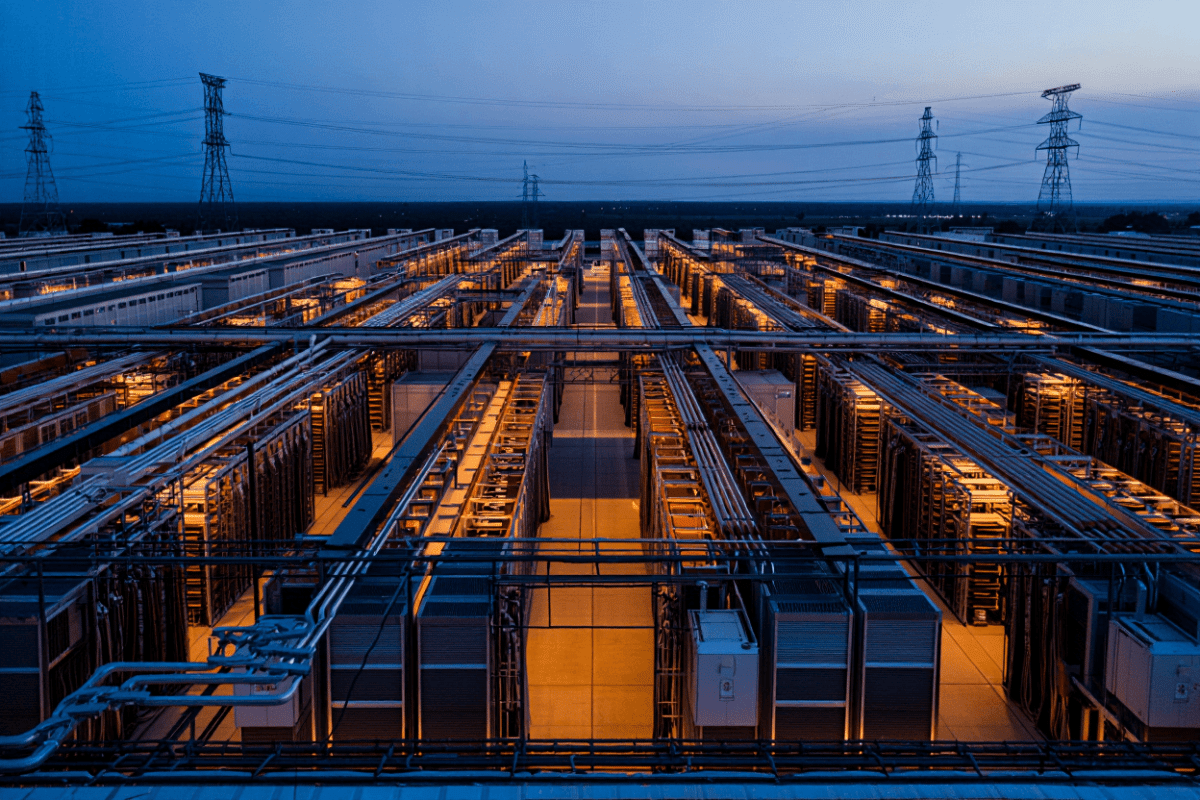
Investment in AI infrastructure is dominating capital allocation in 2026, with hyperscalers committing roughly $700 billion to compute, data centers, and supporting systems this year—a sharp acceleration from the $400 billion deployed in 2025. But the infrastructure boom is running headlong into an equally urgent bottleneck: global energy supply. Electricity and power grid investment have emerged as the central constraint shaping how fast and far the AI buildout can actually proceed.
The scale of AI capex is unprecedented. Goldman Sachs projects $765 billion in annual AI capital expenditure in 2026, growing to $1.6 trillion annually by 2031, according to their May 2026 analysis. This represents cumulative spending of $7.6 trillion between 2026 and 2031 across compute, data centers, and power infrastructure. The growth is driven by the extraordinary power demands of AI workloads—each new generation of accelerator chips draws more electricity, and the data centers housing them require industrial-scale cooling and redundant power systems.
Energy demand from AI is the new constraint. The International Energy Agency reports that global investments in electricity supply and infrastructure are expected to reach $1.6 trillion in 2026, with power grid investment alone approaching $550 billion, a roughly 20% year-on-year increase. Yet this acceleration may still fall short of what AI deployment requires. Deloitte estimated in June 2025 that power demand from AI data centers in the United States alone could grow more than thirtyfold, reaching 123 gigawatts—a figure that underscores the mismatch between projected compute growth and current grid capacity.
Energy as the Limiting Factor
The IEA notes that meeting electricity demand through 2030 will require annual grid investment to increase by approximately 50% from today’s baseline of $400 billion per year. That expansion is being driven by two competing forces: the rise of AI data centers and the simultaneous transition to renewable energy, both of which demand grid modernization and new transmission infrastructure. The two trends are not sequential—they are happening in parallel, creating a coordination challenge that extends timelines and inflates costs.
Data center construction itself has become more complex and expensive. Goldman Sachs research shows that next-generation AI data centers now cost $15 million to $20 million per megawatt to build, compared to roughly $10 million per megawatt for traditional cloud facilities from the 2010s. This cost escalation reflects the need for advanced cooling, tighter power delivery tolerances, and greater redundancy as rack densities rise. When combined with the need for dedicated power infrastructure—either grid connections or behind-the-meter generation—the total capital requirement per facility has surged.
Hyperscalers are responding by pursuing power deals directly. Major tech companies are signing long-term contracts with utilities, investing in renewable energy projects, and even building private power generation to bypass grid constraints. This strategy accelerates deployment on individual projects but fragments the broader energy infrastructure investment landscape, potentially duplicating costs and reducing overall system efficiency.
The investment trends reveal a sector in transition. In 2025, the AI capex increase from 2024 exceeded 50%, far outpacing earlier analyst forecasts that had predicted 20% growth. That acceleration has continued into 2026, signaling that the capital deployment is driven by genuine competitive urgency rather than speculative overconfidence. Yet the energy constraint is real. Every delay in grid upgrades, every permitting bottleneck, and every shortage of specialized labor for power infrastructure extends the timeline for deploying new compute capacity and raises the effective cost of the entire build-out.
Sources
- Goldman Sachs Global Institute — baseline AI CapEx model projecting $765 billion in 2026 and $7.6 trillion cumulative spend through 2031
- International Energy Agency (IEA) — World Energy Investment 2026 report on electricity infrastructure and grid investment reaching $550 billion in 2026
- Deloitte — June 2025 analysis of US AI data center power demand growth to 123 gigawatts
- RBC Wealth Management — February 2026 report on capex reaching $427 billion in 2025
- CoBank — April 2026 analysis tracking hyperscaler AI capex at $400 billion in 2025 and $700 billion in 2026
- Hanwha Group — July 2026 summary of IEA findings on grid investment priorities