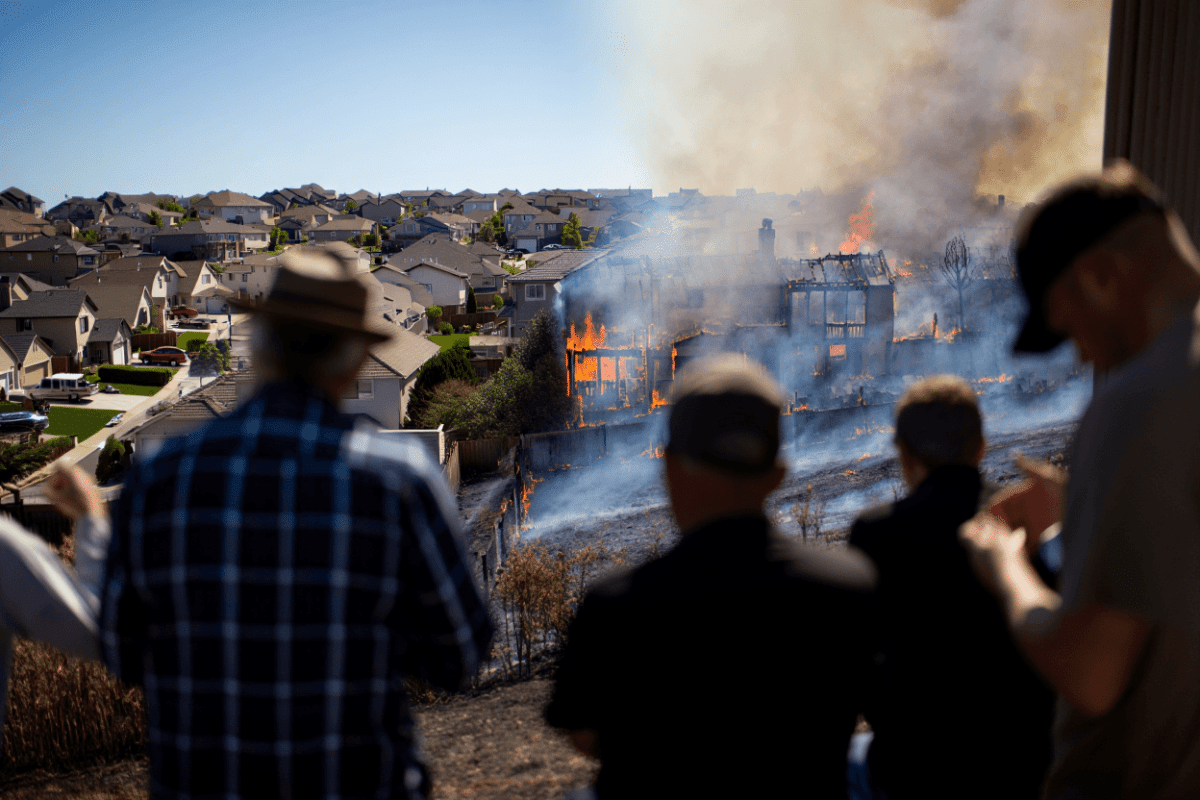
More than 2.5 million properties across 10 western states face moderate or greater wildfire risk, representing nearly $1.4 trillion in reconstruction cost value, according to Cotality’s 2026 Wildfire Risk Report released earlier this week. The analysis highlights a growing concern for insurers and homeowners as conflagration—fire spreading from home to home—reshapes how the insurance industry assesses risk across the region.
California remains the most exposed state, with 1.28 million at-risk properties and $850 billion in reconstruction cost value. But nearly half of all at-risk properties across the top 10 states are located outside California, with Colorado, Texas, and fast-growing metros such as Austin and Denver showing substantial exposure.
Traditional wildfire models, which emphasize terrain and vegetation, often understate neighborhood-level conflagration hazard. Cotality’s modeling found that layering conflagration potential onto a standard wildfire risk score can add as many as 40 points to an individual property’s score, pushing meaningful hazard into areas legacy maps have classified as low risk.
How Property Mitigation Changes the Equation
The report introduces a property-level mitigation score evaluating community protections, on-site conditions, and structural fire resistance. Homes in the top 10% of mitigation scores carry expected losses roughly 78% below the statewide average, while properties in the bottom 10% have more than 10 times the average expected loss.
This spread illustrates how targeted risk-reduction measures—defensible space, roof and vent hardening, and neighborhood-scale fuel management—can materially change loss outcomes even in high-hazard regions. For lenders, servicers, and investors, property-level mitigation data could influence underwriting decisions and insurance availability.
Insurance Market Strain and State Response
Insurers in wildfire-prone states have already been pulling back capacity, raising rates, or exiting specific areas as catastrophic losses and reinsurance costs have climbed. California homeowners insurance premiums have risen 84% since 2020, according to Stanford Woods Institute research released in June 2026.
The state’s FAIR Plan—a last-resort insurer for high-risk properties—has seen explosive growth. Enrollment nearly tripled from under 2% to 5% of California homes, with policies ballooning 152% from roughly 270,000 in 2022 to more than 680,000 as of March 2026. The FAIR Plan is implementing a 29% rate increase effective October 15, 2026, to cover mounting losses.
Beyond California, at least 18 states have introduced legislation in 2026 to reform insurance programs and improve disaster risk preparedness. Nevada enacted a law effective January 1, 2026, allowing insurers to exclude wildfire coverage from standard homeowners policies—a controversial move aimed at keeping carriers in the state. California, by contrast, prohibited insurers from dropping residential policies for wildfire risk alone under regulations that took effect January 1, 2026.
Sources
- HousingWire — Cotality’s 2026 Wildfire Risk Report findings on 2.5 million properties, $1.4 trillion exposure, conflagration modeling, and mitigation scores.
- Las Vegas Sun — Cotality report confirmation of 2.5 million properties and $1.4 trillion exposure across 10 western states.
- Stanford Woods Institute for the Environment — California homeowners insurance premium increase of 84% since 2020 and FAIR Plan enrollment growth from under 2% to 5%.
- Jefferson Public Radio — California FAIR Plan policy growth of 152% from 270,000 in 2022 to 680,000 as of March 2026.
- Cal-Society Insurance Services — FAIR Plan rate increase of 29% effective October 15, 2026.
- National Caucus of Environmental Legislators — At least 18 states introduced insurance reform legislation in 2026.
- E&E News by POLITICO — Nevada law effective January 1, 2026, allowing insurers to exclude wildfire coverage.
- National Mortgage Professional — California insurance regulations under Code § 675.1 and Bulletin 2025-1 prohibiting policy drops for wildfire risk alone.