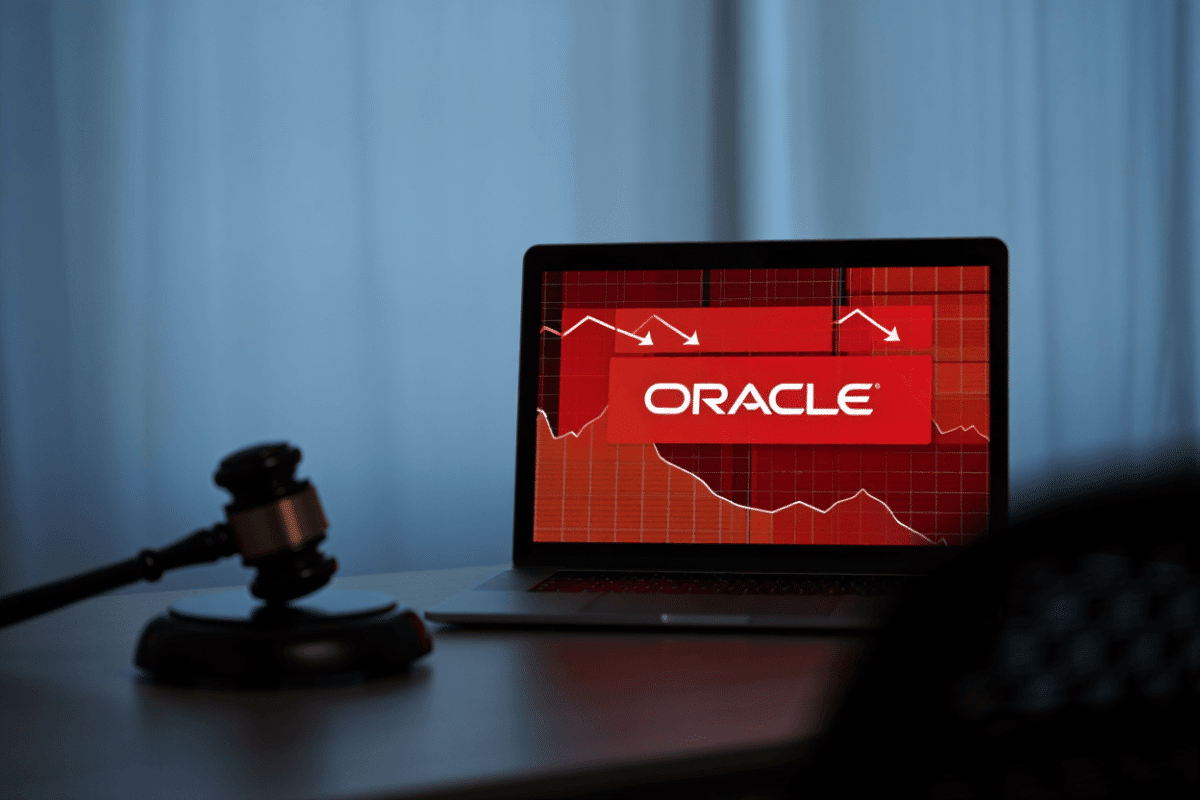
Oracle stock declined sharply following S&P Global’s downgrade of the company’s credit rating to BBB-, the lowest investment-grade level, on July 9, 2026, as the rating agency cited mounting risks from the company’s aggressive artificial intelligence infrastructure buildout.
S&P lowered Oracle’s long-term issuer credit rating from BBB to BBB-, placing the software and cloud giant just one notch above speculative-grade status. The agency maintained a stable outlook despite the downgrade, signaling it does not expect further immediate action.
The downgrade reflects S&P’s reassessment of Oracle’s creditworthiness in light of accelerating capital spending on AI data centers and a heavy reliance on customer concentration. S&P noted in its rating action that it “underestimated the scale of the investments required to expand the AI business and its impact on our overall view of Oracle’s creditworthiness.”
Oracle’s fiscal 2027 capital expenditures are now projected by S&P to reach $90 billion to $95 billion—a significant jump from the agency’s prior forecast of $60 billion. This increase stems from soaring costs for AI chip components and accelerated data center construction. The company’s free operating cash flow deficit is expected to widen to nearly $42 billion in fiscal 2027, nearly double S&P’s previous projection of a $24 billion shortfall.
Leverage metrics also deteriorated in S&P’s view. The agency expects Oracle’s adjusted debt-to-leverage ratio to reach the mid-4x area in fiscal 2027, above the 4x threshold S&P considers appropriate for a standard BBB rating. Oracle currently carries $167 billion in total debt and is planning a $20 billion equity issuance in calendar 2026 to help fund its expansion.
OpenAI Concentration and Industry Risk
A critical vulnerability S&P highlighted is Oracle’s extreme customer concentration. OpenAI accounts for roughly half of Oracle’s $638 billion in remaining performance obligations—the revenue the company expects to recognize from signed contracts over time. If OpenAI faces financing challenges or fails to meet its contractual obligations, Oracle would be left with massive data center leases it may struggle to exit or re-lease on favorable terms.
S&P also flagged broader industry risks. The AI infrastructure sector is rapidly expanding capacity, and near-term demand is strong, but the agency warned that competitive dynamics—including SpaceX’s decision to lease compute capacity to Anthropic and Alphabet—could pressure re-leasing terms when contracts come up for renewal. In an industry downturn, S&P expects Oracle to perform worse than other hyperscalers given its higher reliance on external customers versus internal workloads and lower financial flexibility compared to larger competitors.
On the day of the downgrade, July 9, Oracle stock surprisingly gained 2.7%, as investors focused on the company’s strong backlog rather than the credit warning. However, the stock resumed its decline in subsequent trading. On July 13, Oracle shares fell 6.5%, bringing the stock’s year-to-date decline to approximately 25 percent. The stock is down more than 50 percent from its all-time closing high of $324.33 in September 2025.
S&P noted that Oracle remains “firmly committed to keeping an investment-grade rating” and pointed to the company’s stated financial policy and planned equity raises as evidence of intent. The agency said it could lower the rating again if Oracle sustains leverage exceeding 4.5x, fails to reach positive free cash flow by fiscal 2029, or if S&P takes a negative view of Oracle’s AI strategy or the broader AI industry. An upgrade would require Oracle to achieve its growth objectives while consistently generating positive cash flow and approaching mid-3x leverage on a sustained basis.
Sources
- S&P Global Ratings — Official downgrade announcement and detailed rating rationale citing AI infrastructure risks, capex projections, and leverage expectations
- Yahoo Finance / Investing.com — Oracle stock reaction on July 9, 2026, including 2.7% gain and context on the $638 billion backlog and $167 billion debt load
- Trefis / Yahoo Finance — Oracle stock decline of 6.5% on July 13, 2026, and year-to-date performance metrics
- Barron’s — Oracle stock down 26.2% year-to-date and 56.2% from all-time closing high of $324.33