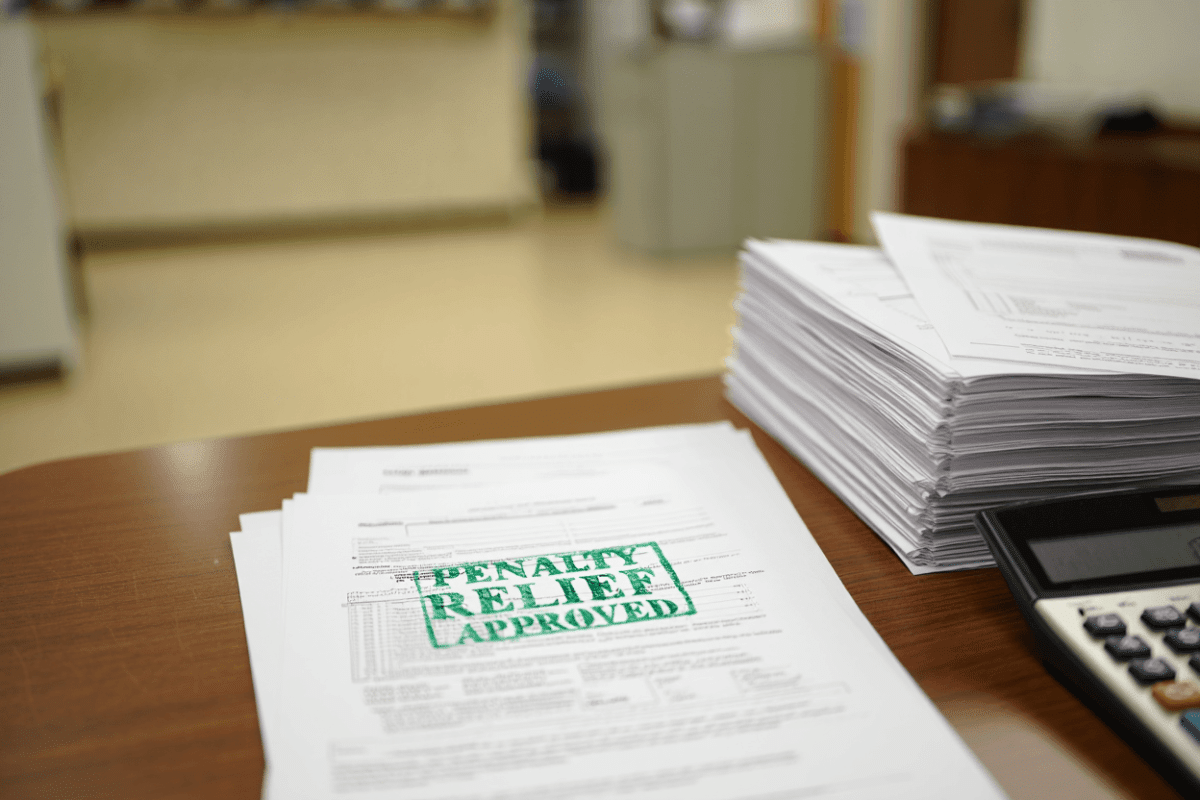
The Internal Revenue Service announced a new automatic penalty relief program on July 8, 2026, that will eliminate filing and payment penalties for millions of eligible taxpayers without requiring them to request assistance. The Automatic Exemption from Penalty (AEP) program will begin this summer and represents a significant shift in how the IRS administers tax penalty relief.
Taxpayers qualify for AEP if they have timely filed returns and paid any tax due for the prior three years, or 12 consecutive quarters for those who file quarterly returns. When eligible taxpayers file late or pay late, the IRS will automatically prevent penalties for failure to file, failure to pay, and failure to deposit from being assessed during processing. Taxpayers don’t need to take action or submit forms to receive the relief; the IRS will apply it automatically and send a notice confirming the relief was granted.
The new program replaces First Time Abate (FTA), the IRS’s long-standing administrative penalty relief process that required taxpayers to request relief. The IRS will begin phasing out FTA and transitioning to AEP during summer 2026, with AEP becoming the standard relief for eligible returns with original due dates on or after January 1, 2027.
The National Taxpayer Advocate Service estimates the scale of the program’s impact. According to the Taxpayer Advocate Service, in fiscal year 2025, approximately 220,000 taxpayers received FTA relief through the manual request process. The service estimates that if AEP had been in place during that same period, over 1.5 million taxpayers would have received penalty relief—about seven times as many. The disparity reflects the fact that many eligible taxpayers never learned relief was available, couldn’t reach the IRS by phone, or lacked professional representation to help them request it.
The shift to automatic relief addresses a long-standing equity issue in tax administration. The Taxpayer Advocate Service noted that penalty relief should not depend on a taxpayer’s income, ability to reach the IRS, or access to professional representation. The automatic approach helps low-income taxpayers and those without tax professionals who might otherwise pay penalties they could have avoided. According to prior IRS estimates, about 70% of taxpayers affected by failure-to-file and failure-to-pay penalties have household incomes below $100,000.
IRS Chief Executive Officer Frank J. Bisignano stated in the announcement: “Automatic Exemption from Penalty reflects the IRS’ commitment to making the payment of taxes owed simpler and more consistent. By automatically applying penalty relief, the IRS recognizes that taxpayers who historically pay on time should not have to make a formal request for relief that is routinely granted.”
The program applies to eligible original returns beginning with tax year 2025 and 2026 quarterly returns, as well as future tax periods. Not all returns are eligible for AEP; for example, information returns and returns filed only in response to specific transactions or infrequent events—such as Form 706 (Estate Tax Return) or Form 709 (Gift Tax Return)—generally are not eligible. Taxpayers who do not qualify for AEP may still request penalty relief based on reasonable cause, which applies when a taxpayer exercised ordinary care but was unable to comply due to circumstances beyond their control.
During the transition period, some taxpayers with eligible 2025 tax year returns or 2026 quarterly returns may still receive penalty notices if their returns were processed before AEP was available. The IRS recommends that taxpayers who believe they qualify for relief contact the agency to request assistance, as they may be eligible for AEP, FTA, or reasonable cause relief depending on their circumstances.