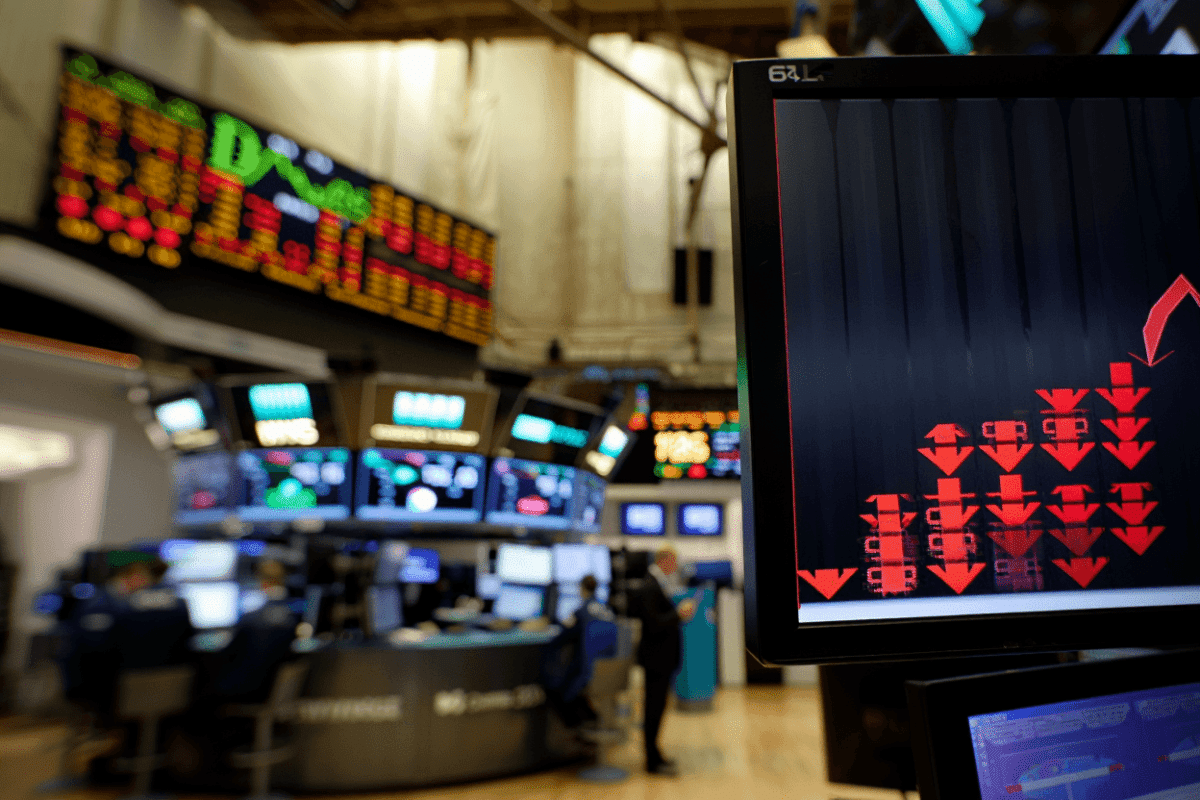
The stock market finished mixed on July 2 after the June jobs report showed weaker-than-expected hiring, a development that cooled expectations for Federal Reserve rate hikes and left investors navigating conflicting signals across different sectors.
U.S. employers added just 57,000 jobs in June, according to the Bureau of Labor Statistics, far below the 110,000 to 115,000 new positions economists had forecast. The weak print marked a sharp slowdown from May’s revised figure of 129,000 jobs, itself a downward revision from the initially reported 272,000.
The unemployment rate, however, edged down to 4.2% in June, slightly better than expectations and an improvement from May’s 4.3%. Average hourly earnings growth moderated to 3.5% on a year-over-year basis, down from earlier peaks during the inflation surge of prior years, according to reporting from The New York Times.
The divergence in labor market signals created a split reaction across the stock market. The Dow Jones Industrial Average surged 1.1%, or nearly 600 points, to close at a record high, marking its 20th record close of 2026, according to MarketWatch and Investopedia. The S&P 500 finished flat, while the Nasdaq declined as technology and chip stocks sold off, according to reporting from Barron’s and the Wall Street Journal.
Investors interpreted the softer jobs data as a sign that the Federal Reserve would be less likely to raise interest rates in the near term. The weak hiring report “prompted investors to reduce rate-hike expectations,” according to the Wall Street Journal. Reuters reported that the Fed was “seen less likely to raise rates as job growth slows.” This shift in rate expectations boosted large-cap stocks in the Dow, which benefit from lower borrowing costs, while technology shares—which had surged on earlier expectations of rate hikes—retreated.
The June jobs report followed a run of stronger employment gains earlier in the year. When job growth cools significantly from prior months, it typically prompts financial markets to reassess the economic outlook and central bank policy. In this case, the substantial miss below expectations and the downward revisions to prior months created enough doubt about labor market momentum to shift the conversation away from rate increases.
Wage growth’s slowdown to 3.5% year-over-year, while still elevated by historical standards, also suggested that inflation pressures may be easing, giving the Fed more room to hold rates steady rather than tighten further. This backdrop set the tone for a market that rewarded dividend-paying blue-chip stocks while penalizing the high-growth, rate-sensitive technology sector.
Sources
- CNBC — June jobs report showing 57,000 new positions and 4.2% unemployment rate
- Reuters — Dow reaching record closing high after soft jobs data; Fed rate-hike outlook
- Wall Street Journal — Stock market reaction on July 2, 2026; investor rate-hike expectations
- MarketWatch — Dow’s 20th record close of 2026; S&P 500 and Nasdaq performance
- Investopedia — Dow Jones Industrial Average 1.1% gain to record close
- Barron’s — Nasdaq decline and tech stock sell-off
- The New York Times — Average hourly earnings growth at 3.5% year-over-year
- Intellectia AI — June jobs report and Fed rate-cut expectations shift