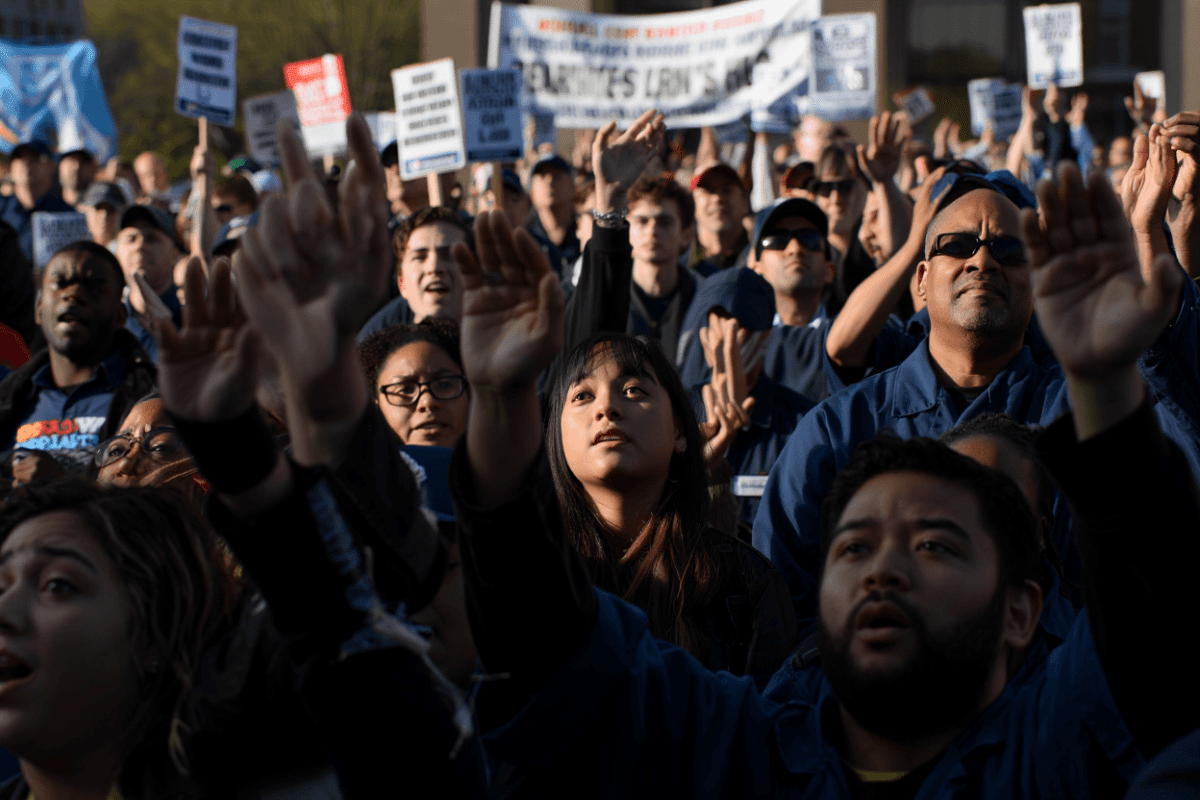
Thousands of California state workers rallied at the Capitol on July 1, 2026, as Governor Gavin Newsom’s return-to-office mandate officially took effect, requiring approximately 108,000 employees to work in-person four days a week—double the previous two-day requirement.
The executive order, which Newsom issued in March 2025, sparked significant pushback from state worker unions who argue the mandate will increase traffic, worsen air pollution, strain childcare arrangements, and create office-space shortages.
Members of SEIU Local 1000, the state’s largest public employee union, gathered outside the Capitol to protest the mandate and the stalled contract negotiations. “I refuse to be disrespected and pushed aside by this administration,” SEIU Local 1000 president Anica Walls told the crowd, according to reporting from CapRadio.
The union has been negotiating a new contract with the state and filed an unfair labor practice complaint with the Public Employment Relations Board, alleging that the administration refused to bargain in good faith over telework options. “Telework is absolutely a negotiable working condition,” Walls told CapRadio. “The state can’t simply make a unilateral decision that affects hundreds of thousands of workers without meeting its obligation to bargain.”
The state’s labor relations agency, CalHR, acknowledged the complaint but declined to comment on ongoing negotiations, saying it “remains committed to continuing to negotiate in good faith with SEIU Local 1000,” according to CapRadio.
State workers expressed diverse concerns about the mandate. Some worried about logistics: one California Department of Developmental Services employee told CapRadio she arrived an hour early to find parking but still struggled. “If I could figure out the child situation and the parking situation, I’m fine coming back to work. Those are the big issues for me,” she said. Others noted that departments may lack sufficient office space after hiring increases during the pandemic, creating what one Department of Social Services employee described as “a lot of chaos because seating, preparation, those things they quite figured it all out yet,” according to CapRadio.
The mandate was not new—Newsom originally planned to implement it in July 2025, but following union negotiations, the administration delayed the deadline by a year, according to CBS News. When the governor confirmed in late June that he would not extend the deadline further, workers and lawmakers intensified their push for alternatives.
Legislative Effort and Retention Concerns
Assembly Bill 1729, introduced by Democratic Assemblymember Alex Lee, would allow state agencies to develop their own telework policies and require the Department of General Services to establish a telework dashboard measuring cost savings and efficiency. The bill passed the Assembly and is moving through Senate committees with bipartisan support, but requires the governor’s signature to become law. Newsom has indicated he is unlikely to support it, according to CapRadio.
Lee warned that the mandate could trigger departures. “I think it is a disaster pending and you may see people frankly go find other opportunities because they’re not going to uproot their entire families and their lives just so that they can suddenly change their work life habits even though they’ve lived this entire way for six years,” Lee told CapRadio.
The governor has defended the mandate on productivity and economic grounds, arguing that in-person work will improve collaboration and support downtown Sacramento businesses that have struggled since the pandemic.
Sources
- CapRadio — Reporting on the July 1 rally, worker concerns, union leadership statements, SEIU Local 1000’s unfair labor practice complaint, CalHR’s response, and Assembly Bill 1729
- Sacramento Bee — Coverage of the mandate’s implementation and contract negotiation breakdown
- ABC10 — Reporting on the scale of the rally and the mandate’s effect on state employees
- CBS News Sacramento — Confirmation that the original July 2025 deadline was delayed by a year
- California State Portal (gov.ca.gov) — Official executive order details and date of issuance