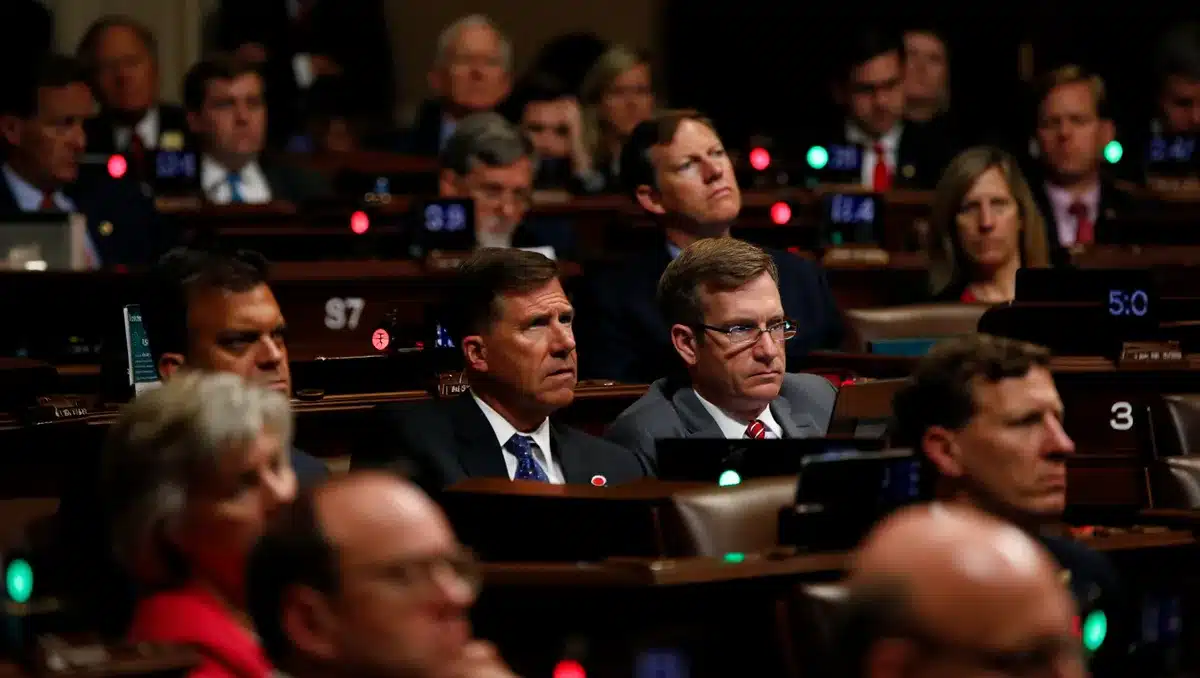
The House passed its $1.15 trillion fiscal year 2027 National Defense Authorization Act in a narrow 216-212 vote on July 22, authorizing record military spending and advancing a slate of Trump administration defense priorities, though the legislation faces an uncertain path in the Democratic-controlled Senate.
Just six Democrats backed the bill, while seven Republicans opposed it, underscoring deep partisan divisions over the measure. The vote gave Speaker Mike Johnson a win after steering the bill rightward to secure hard-line GOP support, including the addition of Republicans’ election overhaul known as the SAVE America Act.

Senate Democrats had already blocked the bill on July 14 in a 50-46 procedural vote—well short of the 60 votes needed to advance it. They cited concerns over President Trump’s conduct of the war against Iran, the price tag, and other contentious administration policies including strikes against suspected drug smuggling boats and the deployment of National Guard troops to U.S. cities. According to Politico, compromise defense legislation is unlikely to materialize until after the midterm elections.
The House bill includes several conservative provisions aimed at solidifying GOP support. It would rename the Department of Defense to the Department of War, codifying Trump’s rebranding of the Pentagon. The measure also blocks coverage for gender-affirming care, makes it easier for troops to carry personal firearms on military bases, and includes Section 219, a provision that would expand U.S.-Israel defense technology cooperation through a dedicated Pentagon executive agent.
Military personnel would receive pay raises ranging from 5 to 7 percent under the bill. The legislation also aims to speed up Pentagon acquisition processes to field new technology faster and renews restrictions on significant troop withdrawals from Europe, addressing bipartisan concerns about potential NATO force reductions.

The $1.15 trillion authorization represents a down payment on Trump’s historic $1.5 trillion military budget request. The remaining $350 billion would require approval through a separate party-line reconciliation bill. According to the Congressional Budget Office analysis cited in reports, the 2027 authorization is $252.4 billion more than the $891.4 billion in discretionary defense funding from the previous year.
Democrats won some provisions in the bill despite their opposition. The measure protects collective bargaining rights for civilian defense employees and requires the Pentagon to provide lawmakers an explanation within five days when senior military officers are dismissed—a response to Defense Secretary Pete Hegseth’s abrupt removal of several top generals and admirals. The bill also includes a Democratic-authored provision to change the names of nine Army bases previously named for Confederate military officials.
House Armed Services Committee Democrat Adam Smith of Washington said before the vote that Trump and Defense Secretary Hegseth’s “out of control” policies are undermining bipartisan consensus on national security. The six Democrats who voted for the bill—Reps. Henry Cuellar of Texas, Don Davis of North Carolina, Jared Golden of Maine, Vicente Gonzalez of Texas, Adam Gray of California, and Marie Gluesenkamp Perez of Washington—bucked their leadership’s recommendation to oppose.
The bill now heads to the Senate, where its prospects remain unclear. While defense bills typically enjoy bipartisan support and pass each year, this year’s measure represents a sharp departure from that tradition due to partisan disputes over the Iran war, the record budget increase, and Trump’s broader defense agenda.
Sources
- Politico — House passage vote, bill provisions, Democratic and Republican positions, Senate prospects
- Reuters — Senate Democrats’ July 14 block vote and Iran war objections
- The Hill — Senate procedural vote details and defense bill status
- Military.com — Section 219 Israel defense technology cooperation details
- Congressional Record / C-SPAN — Official House vote count and passage confirmation