New York Times reporters Maggie Haberman and Jonathan Swan’s regime change book arrives June 23, offering an intimate portrait of Trump’s second term liberated from the constraints that defined his first, based on more than 1,000 interviews conducted over three years.
Published by Simon & Schuster at $34.00, “Regime Change: Inside the Imperial Presidency of Donald Trump” covers the first 14 months of the presidency, depicting a president wielding power without restraint to pursue perceived enemies, reshape global markets, and wage war abroad.
The book reveals striking personal moments alongside consequential policy decisions. When Trump sat down for an interview with Haberman and Swan in March, he proudly displayed a document claiming he was more powerful than Attila the Hun, Genghis Khan, Napoleon, Stalin, Mao, and Hitler. According to CNN, the document’s author turned out to be a golf caddy, not the “presidential historian” Trump claimed. The caddy had shared his assessment with Trump over golf in Florida.
Trump’s second-term foreign policy has been dominated by his decision to go to war with Iran alongside Israel, according to the book. Haberman and Swan capture Trump’s conflicted feelings about Israeli Prime Minister Benjamin Netanyahu, including Trump’s initial reluctance about the conflict. The book describes Trump calling Netanyahu a “con man,” one of the worst insults in Trump’s vocabulary.
One of the book’s most striking revelations concerns the White House’s response to the Epstein files scandal. According to the New York Times, Trump’s top advisers gathered in a series of Situation Room meetings as they struggled to contain the scandal engulfing the president. Vice President JD Vance expressed worry about audio recordings of those confidential meetings potentially being leaked to the reporters.
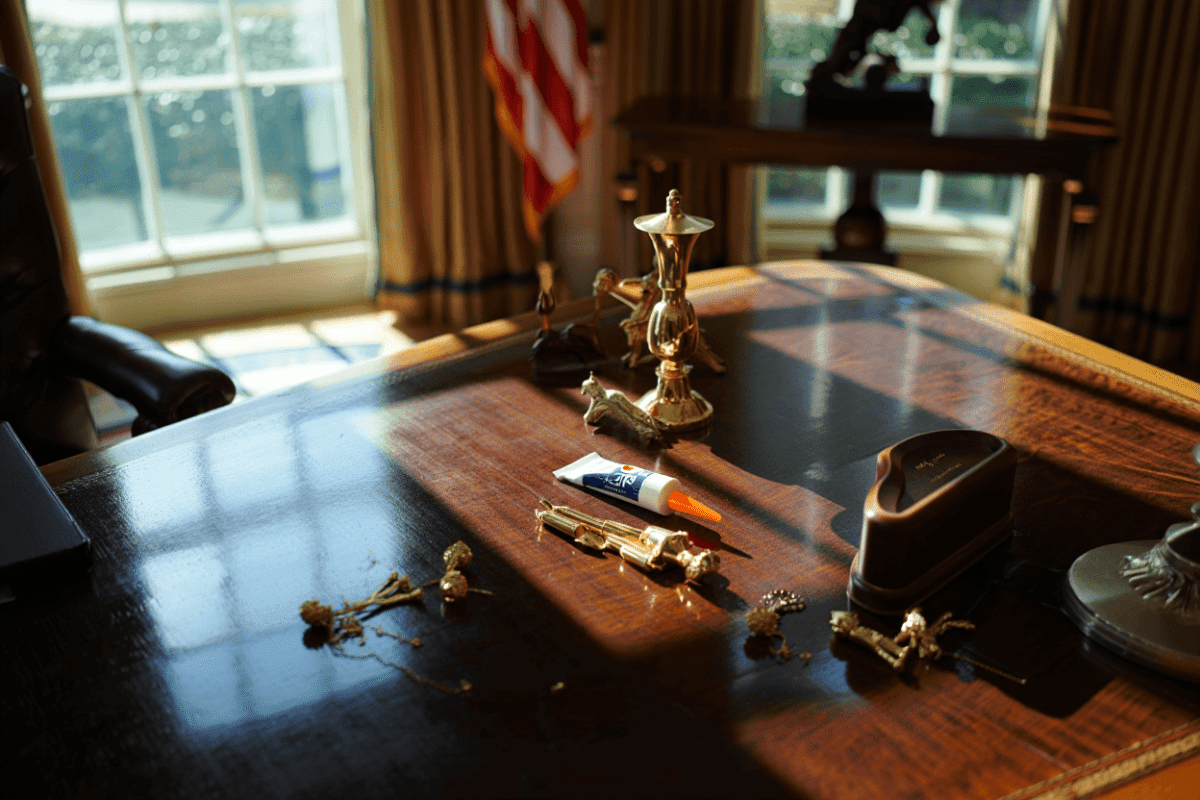
The book captures Trump’s personal habits and unfiltered comments about his own Cabinet. In one scene, White House press secretary Karoline Leavitt found Trump in the Oval Office “clutching a tube of superglue and attempting to affix gold decorations to the marble fireplace mantel,” according to CNN’s account. Trump told Commerce Secretary Howard Lutnick, a longtime associate, that he had become weak and soft, using crude language to criticize the once-tough businessman.
Haberman and Swan write that Trump issued executive orders in April 2025 directing the Justice Department to investigate Chris Krebs, former head of DHS’ Cybersecurity and Infrastructure Agency, after Trump couldn’t initially remember his name. Krebs had stated that the 2020 election was “the most secure in American history.” According to the book, Stephen Miller and Boris Epshteyn helped Trump identify the target, and Miller then had a presidential memo drawn up to investigate him.
The authors also detail Trump’s efforts to make Federal Reserve Chairman Jerome Powell’s life miserable without firing him. Trump told staff he wanted to “bust his fucking balls,” directing aides to appoint Trump allies to an obscure board overseeing Federal Reserve building renovations in an attempt to halt the project.
The book’s sourcing is substantial. Haberman and Swan explain that their direct quotes come from the person speaking, someone who heard them directly, or from “contemporaneous notes, recordings, or transcripts.” The two conducted multiple interviews with Trump over the course of their daily reporting, in addition to their March sit-down interview.
Sources
- CNN — detailed account of book’s revelations including Trump’s comparison document, Epstein scandal, Netanyahu comments, and Cabinet interactions
- The New York Times — reporting on Situation Room meetings and Epstein scandal response
- Simon & Schuster — publisher information and book pricing
- Wikipedia — publication date and publisher confirmation