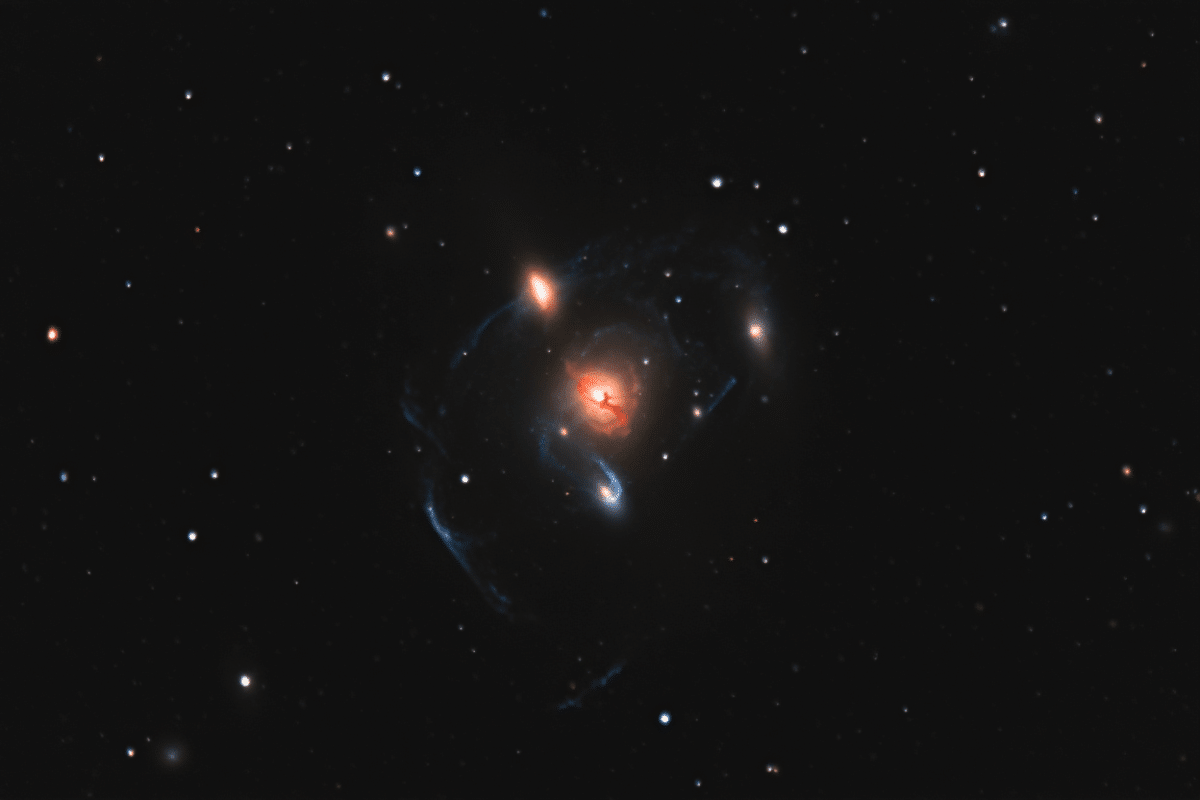
The James Webb Space Telescope has discovered the most distant galaxy cluster yet observed to display strong gravitational lensing, pushing back the frontier of early-universe observations and challenging conventional models of how massive structures form. At over 10 billion light-years away, the cluster XLSSC 122 marks a record-breaking milestone announced June 17 at the American Astronomical Society meeting.
When light from even more distant galaxies passes near XLSSC 122, the cluster’s immense gravity warps and magnifies that light, creating visible arcs around the cluster’s center. This ultra-rare phenomenon, called strong gravitational lensing, had never been detected so far back in cosmic time until JWST’s observations revealed it in XLSSC 122.
“When we got those first images back from JWST, we said, ‘Wow, look at this, there’s strong lensing coming from this cluster!'” said Kyle Finner, a staff scientist at IPAC (Infrared Processing and Analysis Center) at Caltech and lead author of the discovery paper published in The Astrophysical Journal Letters. “XLSSC 122 has now set the record for the most distant galaxy cluster displaying strong lensing, which is a valuable tool for astronomers.”
The serendipitous alignment revealed something even more surprising: the cluster’s mass is extraordinarily concentrated toward its center. This feature contradicts prevailing cosmological models, which predict that such massive structures should take far longer to assemble and develop such dense cores.
XLSSC 122 resides during “cosmic noon,” approximately 10 billion years ago, when the universe hit its peak in star formation. Galaxy clusters were just beginning to form in bulk during this era, cranking out stars roughly 100 times faster than the present-day cosmos. Yet XLSSC 122 appears as mature and organized as clusters in the nearby, modern universe—a paradox that has drawn intense scrutiny from astronomers.
The cluster was first detected in 2014 during an X-ray survey by the European Space Agency’s XMM-Newton spacecraft. The Hubble Space Telescope later confirmed its distance at approximately 10.4 billion light-years and revealed its unexpectedly advanced features. However, Hubble data showed no definitive signs of strong lensing. JWST’s unmatched resolving power changed that picture entirely.
Strong gravitational lensing works because the visible matter in XLSSC 122—its bright stars and illuminated gases—contributes little to the lensing effect. Instead, dark matter dominates. Dark matter is an invisible substance that exerts gravity but produces no detectable radiation. Estimates suggest dark matter outweighs ordinary matter (stars, planets, and people) by a factor of five. By analyzing how the cluster’s gravity bends background light, researchers can map dark matter distribution without directly observing it, providing a sensitive test of cosmological models.
Follow-up studies examined the cluster using weak gravitational lensing—subtler distortions requiring statistical analysis to detect—combined with X-ray and radio observations. These analyses confirmed that XLSSC 122 is actively merging, with galaxies still assembling into the cluster’s core. The research team also detected intracluster light, a glow from stars drifting freely between galaxies in the cluster. This earliest-known detection of intracluster light in the early universe further confirmed the merger state and showed that the light traces the dark matter concentration revealed by strong lensing.
“XLSSC 122 is one of the first clusters we know of that formed in the universe, and it has a mass concentration that doesn’t agree with our cosmological model predictions,” Finner said. The finding suggests that massive structure in the early universe may have assembled faster than current theories predict.
Looking ahead, the research team hopes to discover and study dozens more ultra-distant galaxy clusters. Wide-area surveys in X-rays and radio wavelengths are the primary discovery tools, since JWST’s narrow field of view makes it unsuitable for finding new targets. One promising avenue is the Sunyaev–Zel’dovich effect, which reveals “holes” in observations of the cosmic microwave background—the afterglow from the Big Bang—when high-energy particles in galaxy clusters scatter that ancient light.
Should additional early-universe clusters with similar properties emerge, cosmologists may need to fundamentally revise their models of how the universe developed. “It’s still early in the JWST era,” Finner noted, “and if we can start to get data on tens or hundreds of these types of objects at this stage in the universe, then we can really start putting our cosmological models to the test.”
Sources
- Phys.org — reporting on JWST discovery of strong lensing in XLSSC 122 and its implications for early galaxy cluster formation
- Caltech IPAC — official announcement and details of the discovery presented at the American Astronomical Society meeting, June 17, 2026
- The Astrophysical Journal Letters — peer-reviewed publication of the discovery by Kyle Finner and colleagues
- NASA Science — background on gravitational lensing and dark matter measurement techniques