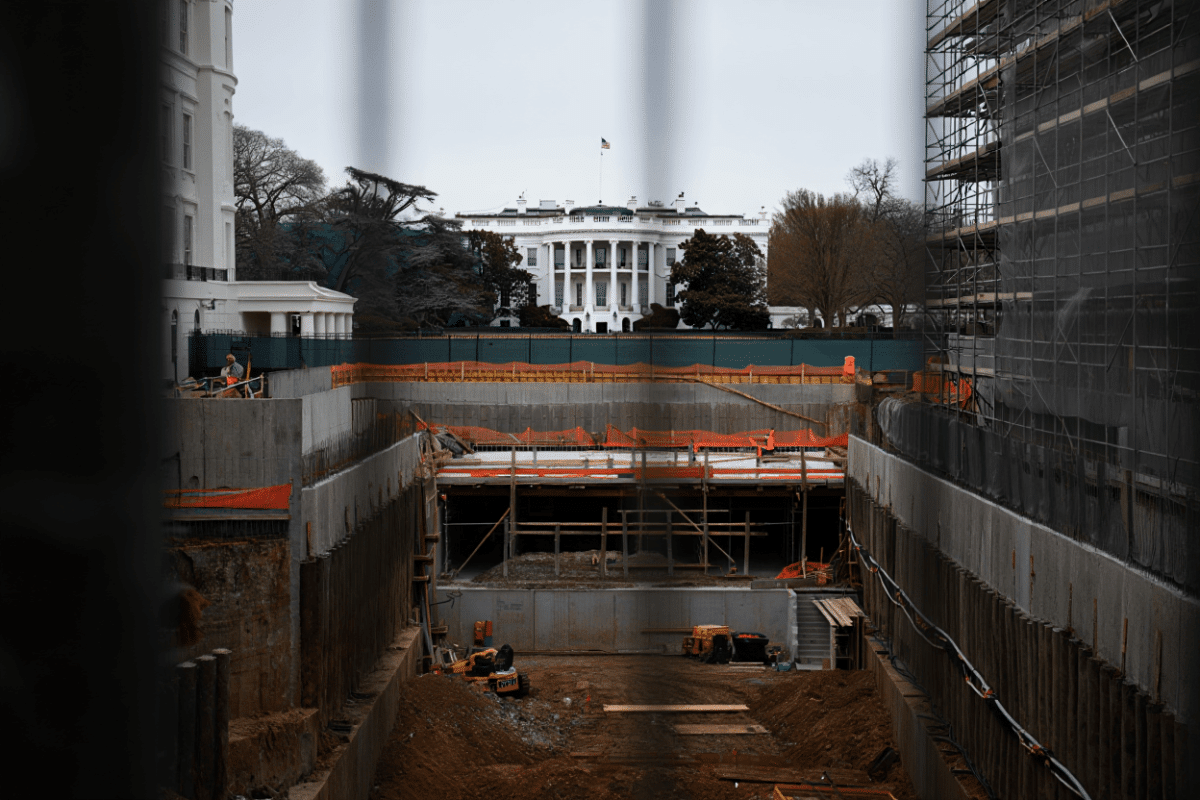
The estimated cost of President Trump’s White House ballroom has doubled to $400 million as a bid to secure $1 billion in taxpayer funding for the project collapsed in Congress, leaving the administration’s promise of private financing under renewed scrutiny.
Trump announced the ballroom project in July 2025 with an initial estimate of $200 million, promising it would be funded entirely through private donations without using federal money. By December 2025, the president indicated the cost could reach $400 million, citing an expansion in scope and size requested by the military.
The Cost Escalation and Private Funding Claims
In May, Trump defended the cost increase, stating the project would come in “something less than $400 million” and that it remained “right on budget” because the size had doubled at the military’s request. He emphasized the ballroom’s security features, including drone-proof and bulletproof construction, especially after an assassination attempt at the White House Correspondents’ Association dinner in April.
The project includes not only the 90,000-square-foot ballroom itself, but also underground facilities. According to the BBC, the latest plans revealed in April suggest the site could feature bomb shelters, an underground state-of-the-art hospital and medical facilities, “top secret” military facilities, and a rooftop drone landing space, with excavations reported to be three stories deep.
Trump has repeatedly claimed the ballroom would be privately funded. In late March, when the cost had already doubled to $400 million, he maintained that “this is taxpayer-free. We have no taxpayer putting up 10 cents.” The White House released a list of donors in October that included companies such as Amazon, Google, and Meta, as well as billionaire investors including the Winklevoss twins and Stephen A. Schwarzman.
Congressional Funding Bid and Rejection
Despite Trump’s private-funding pledge, Senate Republicans proposed $1 billion in federal funding in May for “security adjustments and upgrades” related to the ballroom. The Secret Service chief reportedly told Republican lawmakers that only $220 million of the $1 billion would fortify the ballroom specifically with bulletproof glass, drone detection equipment, and chemical filtration systems, with the remainder allocated to broader White House security and training.
The Senate Parliamentarian, Elizabeth MacDonough, ruled on May 17 that the $1 billion security funding provision violated budget reconciliation rules because it funded activities outside the Judiciary Committee’s jurisdiction. Additionally, several GOP senators aired public concerns about including ballroom funding in a bill otherwise dedicated to immigration enforcement.
On May 20, Senate Republicans removed the $1 billion security funding from their immigration enforcement legislation. “We were told that the ballroom money is out,” Sen. John Kennedy of Louisiana told reporters after a GOP lunch meeting. Senate Majority Leader John Thune confirmed that both the parliamentary issues and insufficient vote support remained obstacles.
Democrats had criticized the funding request sharply. Rep. Jared Huffman of California said Republicans were “sending Trump $1 billion to build a gilded room for their balls,” while Rep. Jamie Raskin of Maryland noted on social media that Trump’s claim of using no federal money became questionable when “$1 billion is a lot more than one penny.”
The ballroom project has also faced legal challenges. The National Trust for Historic Preservation filed a lawsuit to stop construction, arguing that no president is legally allowed to tear down portions of the White House without review. A federal judge temporarily blocked construction in March, though the Trump administration appealed and construction resumed pending a June hearing.
Sources
- Politico — Senate Republicans’ decision to drop the $1 billion security funding request on May 20, 2026
- BBC — Cost doubling from $200 million to $400 million, expanded project scope including underground facilities, and timeline of cost announcements
- FactCheck.org — Trump’s private funding claims, the $1 billion congressional proposal, the Senate Parliamentarian’s ruling, and details on donor list