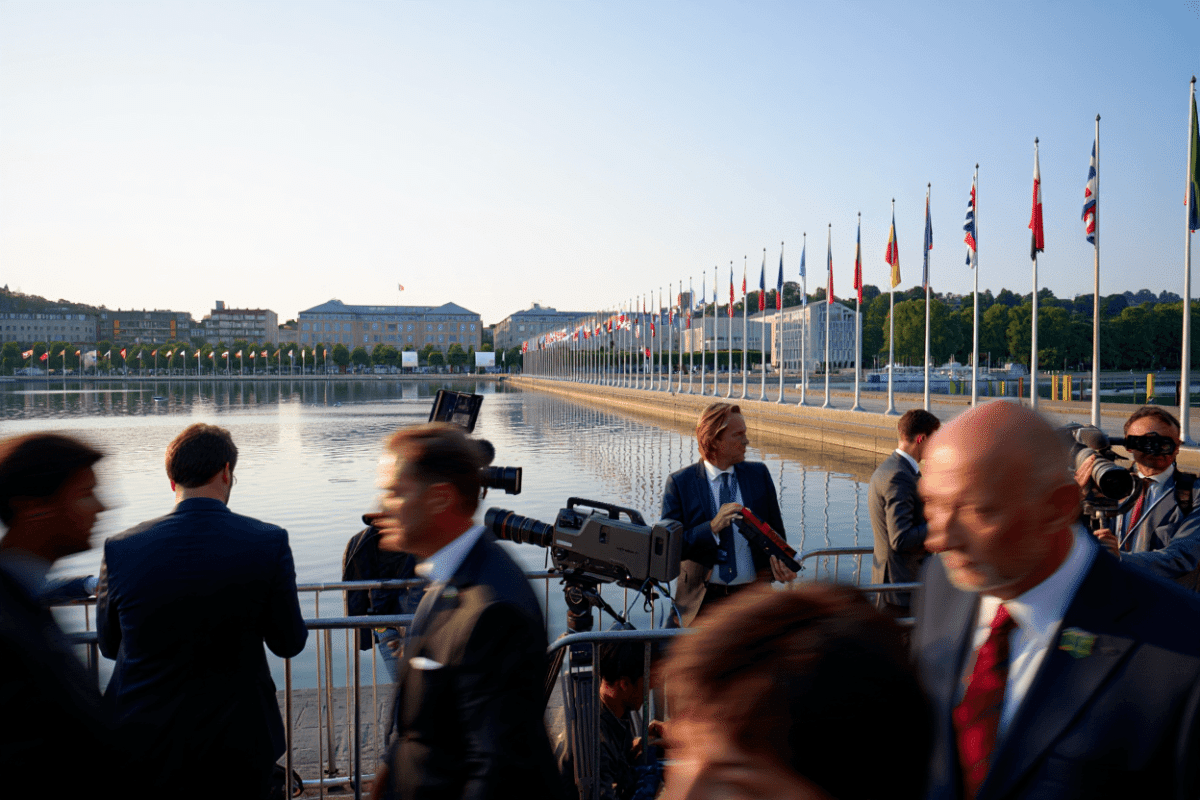
The 52nd Group of Seven summit opens today in Évian-les-Bains, France, bringing together leaders of the world’s major democracies to tackle geopolitical crises as a landmark U.S.-Iran peace deal reshapes the Middle East landscape.
The three-day summit, running through June 17, convenes the leaders of Canada, France, Germany, Italy, Japan, the United Kingdom, and the United States under French President Emmanuel Macron’s presidency. According to the Council of the European Union, the agenda centers on geopolitical challenges, peace and security for Ukraine and Europe, and the situation in the Middle East.
The most immediate headline overshadowing the summit is the U.S.-Iran agreement announced on Sunday. President Trump confirmed the deal would end months of conflict and immediately reopen the Strait of Hormuz, a critical global shipping corridor. According to NPR, the U.S. and Iran announced a deal to end the war and reopen the Strait of Hormuz. The New York Times reported that Trump and an Iranian negotiator signed the agreement, with a full formal signing set for June 19 in Switzerland. The accord establishes a framework for ending the fighting and includes a pathway toward dismantling Iran’s nuclear program, according to Reuters.
Ukraine dominates the diplomatic agenda alongside Iran. PBS NewsHour reported that Macron invited Ukrainian President Volodymyr Zelenskyy for a working session with G7 leaders on Tuesday to discuss the Russia-Ukraine war. Bloomberg reported that European leaders aim to use meetings with Trump at the summit to push for new peace talks between Russia and Ukraine, signaling that despite the Iran breakthrough, Western allies remain focused on finding diplomatic paths in the ongoing European conflict.
Macron framed France’s 2026 G7 presidency around reducing global instability and addressing economic imbalances, according to the Council on Foreign Relations. The French government emphasized that profound imbalances are threatening the stability of the global economy, making the summit a forum to coordinate responses among the world’s leading democracies. This year’s gathering also includes invited guests from middle powers and developing nations, expanding the traditional G7 format to address interconnected global challenges.
The summit comes at a moment of significant geopolitical flux. The Iran deal, which emerged after months of indirect negotiations mediated by Pakistan, represents a dramatic shift in U.S. Middle East policy and removes one major source of regional tension. At the same time, the unresolved Russia-Ukraine conflict and broader questions about global economic cooperation remain central to G7 deliberations. Zelenskyy’s participation signals that Western leaders intend to maintain focus on supporting Ukraine even as other regional crises demand attention.
Sources
- Council of the European Union — confirmed summit dates, location, and agenda topics including Ukraine, the Middle East, and geopolitical challenges
- NPR — reported U.S.-Iran deal announcement and Strait of Hormuz reopening
- The New York Times — confirmed Trump and Iranian negotiator signed the agreement, with formal signing scheduled for June 19
- Reuters — detailed the framework for ending the war and pathway toward dismantling Iran’s nuclear program
- PBS NewsHour — reported Macron invited Zelenskyy for a working session on the Russia-Ukraine war
- Bloomberg — confirmed European leaders aim to push Trump for new peace talks between Russia and Ukraine
- Council on Foreign Relations — explained Macron’s framing of the G7 presidency around reducing instability and addressing economic imbalances
- French Government (Diplomatie.gouv.fr) — stated that profound imbalances threaten global economic stability