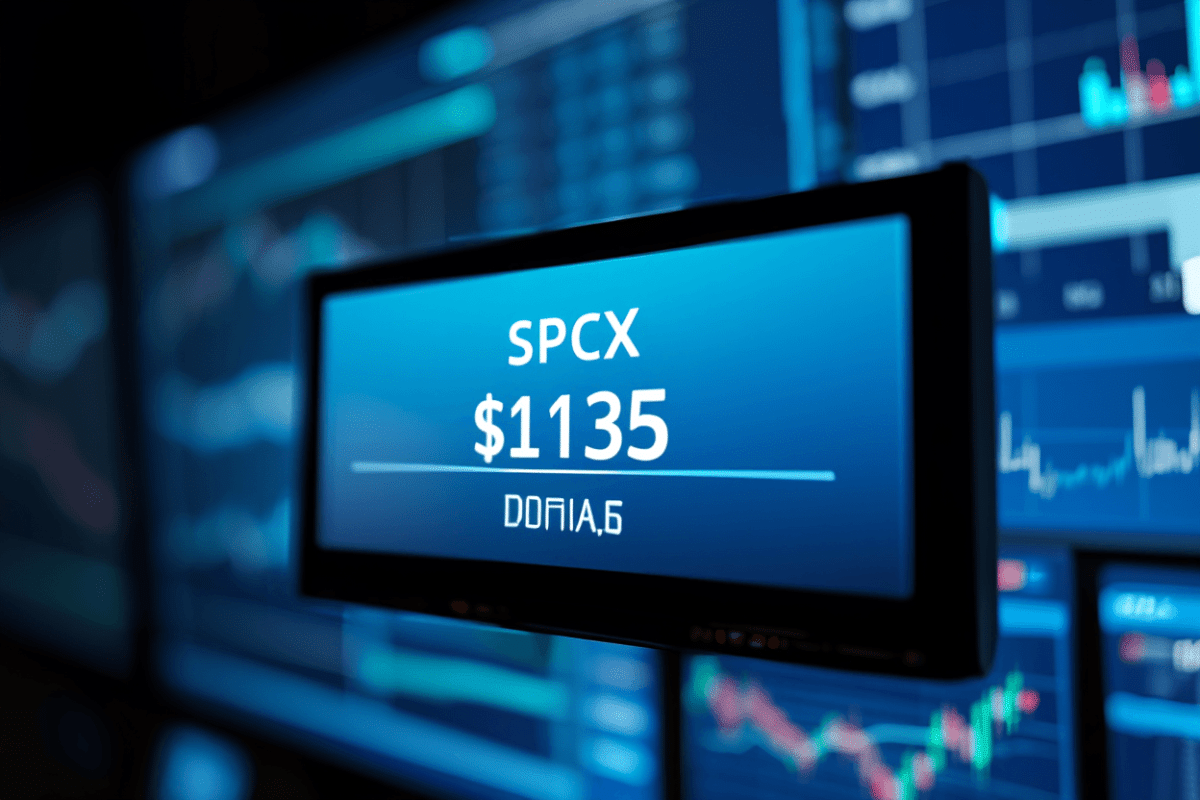
SpaceX began trading on Nasdaq earlier today under the ticker symbol SPCX, marking the largest initial public offering in history with a $75 billion raise at a $135 per share price that values Elon Musk’s rocket and satellite company at approximately $1.77 trillion.
The company sold 555.56 million shares to raise the record amount, surpassing the previous IPO record set by Saudi Aramco in December 2019, which raised $25.6 billion. SpaceX’s offering is roughly three times the size of Aramco’s debut, according to multiple financial outlets including Reuters and the New York Times.
The IPO process broke from Wall Street convention by setting a fixed price of $135 per share rather than using the traditional price-discovery mechanism. According to Reuters, SpaceX received more than $100 billion in retail orders, demonstrating extraordinary demand for the public debut.
Goldman Sachs and Morgan Stanley led the offering, according to CNBC’s IPO coverage. The company had accelerated its timeline in May, targeting a June 12 trading debut on Nasdaq under the ticker SPCX, as reported by Reuters.
The valuation could potentially make Elon Musk the world’s first trillionaire, a prospect highlighted across financial media coverage. The IPO pricing was finalized on June 11, with trading commencing this morning on the Nasdaq exchange.
Analyst sentiment on the valuation has been mixed. New Street Research initiated coverage with a $165 price target, 22% above the IPO price, according to Barron’s. However, some analysts have expressed skepticism about the valuation. Fortune reported that Wall Street analysts believe SpaceX stock is worth approximately $63 per share, significantly below the $135 IPO price, citing concerns about the company’s addressable market and profitability timeline.
Yahoo Finance reported that Morningstar analyst Owens allows for the possibility of a $1.3 trillion valuation but assigns only a 7% probability of the company achieving that level. The IPO filing itself revealed AI-related losses exceeding $6 billion in 2025, with additional losses of $2.5 billion in the first quarter of 2026, according to Yahoo Finance.
SpaceX’s public listing represents a watershed moment for the space economy, bringing one of the world’s most valuable private companies into public markets. The company operates Starlink, a satellite internet network with over 7,000 satellites in orbit, and the Falcon 9 rocket, which has transformed commercial access to space.
Sources
- Reuters — IPO pricing at $135 per share, $75 billion raise, Nasdaq listing under SPCX, company valuation at $1.77 trillion
- Yahoo Finance — IPO raise amount, retail order volume, analyst commentary on valuation, AI-related losses in prospectus
- The New York Times — IPO pricing and valuation details, comparison to Saudi Aramco record
- CNBC — Lead underwriters (Goldman Sachs, Morgan Stanley), IPO timeline and Nasdaq debut
- NBC News — Trading commencement on June 12, company valuation
- Barron’s — New Street Research analyst coverage with $165 price target
- Fortune — Analyst valuation concerns, $63 per share fair value estimate
- Al Jazeera — Saudi Aramco 2019 IPO details ($25.6 billion raise)
- Investopedia — Saudi Aramco IPO comparison and historical context