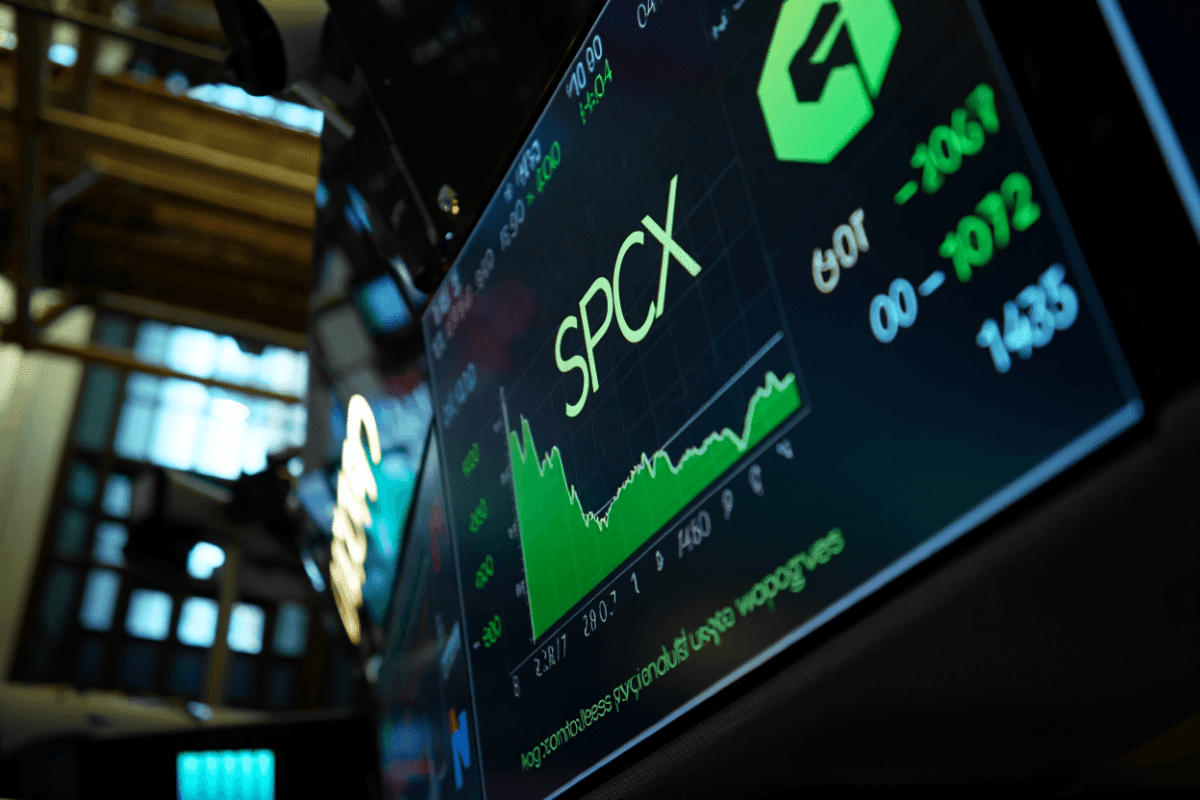
SpaceX began trading on Nasdaq on June 12 under the ticker SPCX after pricing its record $75 billion initial public offering at $135 per share the previous day, valuing the rocket maker at approximately $1.77 trillion and marking the largest IPO in history.
The company sold 555.6 million shares to raise the historic sum, according to multiple sources including Reuters and the Wall Street Journal. SpaceX’s IPO dwarfs the previous record set by Saudi Aramco in December 2019, which raised $25.6 billion—making SpaceX’s offering nearly three times larger and establishing a new benchmark for capital markets.
The IPO reflected extraordinary investor appetite. Retail investors alone placed more than $100 billion in orders, according to Forbes, though SpaceX reduced retail allocation to the low 20% range due to overwhelming demand. Institutional investors also showed strong interest, with reports of $250 billion in total demand across all investor types, according to Reuters.
SpaceX’s valuation of $1.77 trillion makes it the seventh most-valuable U.S. company on day one of trading, according to reporting from the Los Angeles Times. The company’s Falcon 9 rocket accounts for roughly 80% of global mass launched to orbit since 2023, and Starlink has grown to more than 10 million subscribers accessing internet via a constellation of roughly 9,600 satellites, according to Gwynne Shotwell, the company’s President and Chief Operating Officer.
Shotwell, who joined SpaceX as vice president of business development in 2002 and now oversees day-to-day operations of a 22,000-person workforce, characterized the IPO as just the beginning of SpaceX’s ambitions. “This is one small step in a very futuristic journey,” she told CNBC on June 12. Shotwell emphasized that SpaceX’s long-term vision extends far beyond quarterly earnings, noting that investors should understand “what we’re doing is very futuristic.”
That vision centers on Starship, SpaceX’s next-generation fully reusable rocket designed to carry cargo and people to Mars. The company recently completed its 12th test flight and is targeting orbital flights by year’s end, with regular monthly flights to follow, according to Shotwell’s interview. Starship development has cost $15 billion so far, invested in technical development, production, and infrastructure at SpaceX’s Starbase facility in Texas.
SpaceX also announced plans to integrate artificial intelligence infrastructure into its space operations. The company acquired xAI earlier in 2026 and is building Colossus data centers in Memphis, Tennessee, while jointly developing a semiconductor fabrication plant with Tesla. Shotwell told CNBC that SpaceX expects to deploy AI compute satellites as early as 2028, representing a new frontier in cloud infrastructure delivered from orbit.
The company’s track record of launching 165 orbital missions last year, with 157 using reused rocket boosters, demonstrated the commercial viability of reusable spaceflight—a core innovation that drove launch costs down by more than 90% compared to the Space Shuttle era, according to SpaceX’s operational data cited in Shotwell’s remarks.
Sources
- Reuters — IPO pricing at $135 per share, $75 billion raise, 555.6 million shares, Saudi Aramco 2019 IPO comparison, investor demand figures
- Wall Street Journal — SpaceX IPO pricing and capital raised confirmation
- Forbes — Retail investor order volume exceeding $100 billion
- Los Angeles Times — SpaceX valuation at $1.77 trillion and ranking as seventh most-valuable U.S. company
- CNBC — Gwynne Shotwell exclusive interview, company operations details, Starship development, AI infrastructure plans
- SpaceX.com — Falcon 9 launch statistics, Starlink subscriber count and satellite constellation size