Microsoft unveiled Majorana 2, its next-generation topological quantum chip, on June 2, 2026, claiming a 1,000-fold improvement in qubit reliability over its predecessor—a leap that cuts the company’s timeline to commercially viable quantum computing in half, to 2029.
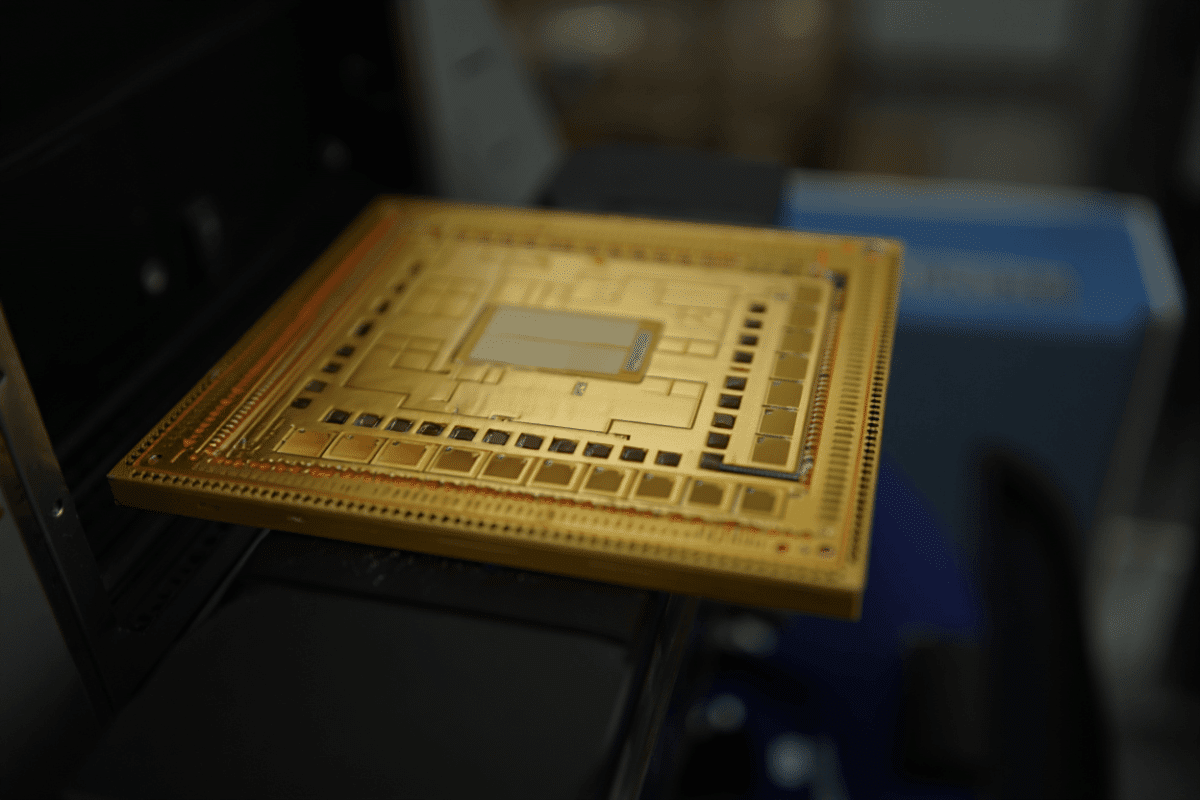
The reliability gain stems from a fundamental redesign of the chip’s materials stack. Majorana 2 replaces the aluminum-based superconductor in Majorana 1 with lead, paired with indium arsenide and indium arsenide antimonide semiconductors. Lead, commonly used to shield equipment from radiation in hospitals, creates a stronger barrier against the cosmic disturbances and environmental noise that destabilize qubits.
The performance improvement shows in qubit lifetime—the duration a quantum bit can maintain its state before losing information to errors. In Majorana 1, qubits survived for between one and 12 milliseconds. Majorana 2 achieves a mean qubit lifetime of 20 seconds, with some instances lasting as long as one minute. Chetan Nayak, a Microsoft technical fellow, described the advance: “We’re 1,000 times better” than the prior generation, enabling microsecond-scale operations and positioning the team to reach a scalable quantum computer by 2029.
Quantum computing has long been hampered by decoherence—the tendency of qubits to lose their quantum state and produce errors. Topological qubits, like those in Majorana 2, are designed to be inherently more resistant to these errors by encoding quantum information in a way that leverages topology, a branch of mathematics concerned with properties that persist under continuous deformation. This approach offers a path toward fault-tolerant quantum systems without requiring as many redundant qubits for error correction as other approaches demand.
Microsoft’s quantum team deployed agentic AI—specifically, capabilities from its newly released Microsoft Discovery platform—to accelerate the development of Majorana 2. The AI agents automated measurements, optimized fabrication parameters, synthesized data across decades of research, and identified previously unnoticed flaws in materials and processes. According to Zulfi Alam, corporate vice president for quantum at Microsoft, the AI reduced the cycle time for setting hundreds of parameters and running measurements from weeks to orders of magnitude faster, compressing years of materials science into automated optimization loops.
The announcement arrives amid broader momentum in quantum computing. When Microsoft introduced Majorana 1 in February 2025, it sparked both excitement and skepticism about topological qubits. Majorana 2 addresses skepticism by demonstrating concrete gains in the metric that matters most for practical quantum computing: qubit stability. The achievement also underscores how AI and quantum hardware development are beginning to reinforce each other—better AI tools accelerate quantum chip design, and more capable quantum systems could eventually enhance AI itself.
Sources
- Microsoft Source — Official announcement of Majorana 2, including 1,000-fold reliability improvement, 20-second mean qubit lifetime, new materials stack details, and 2029 timeline
- BBC — Confirmation of qubit survival times: 20 seconds vs. milliseconds in Majorana 1
- The Verge — Details on materials stack change and qubit lifetime comparison
- Science News — Attribution of the 1,000x improvement claim to Microsoft physicist Chetan Nayak
- The Next Web — Confirmation of Majorana 2 specifications and agentic AI role in development