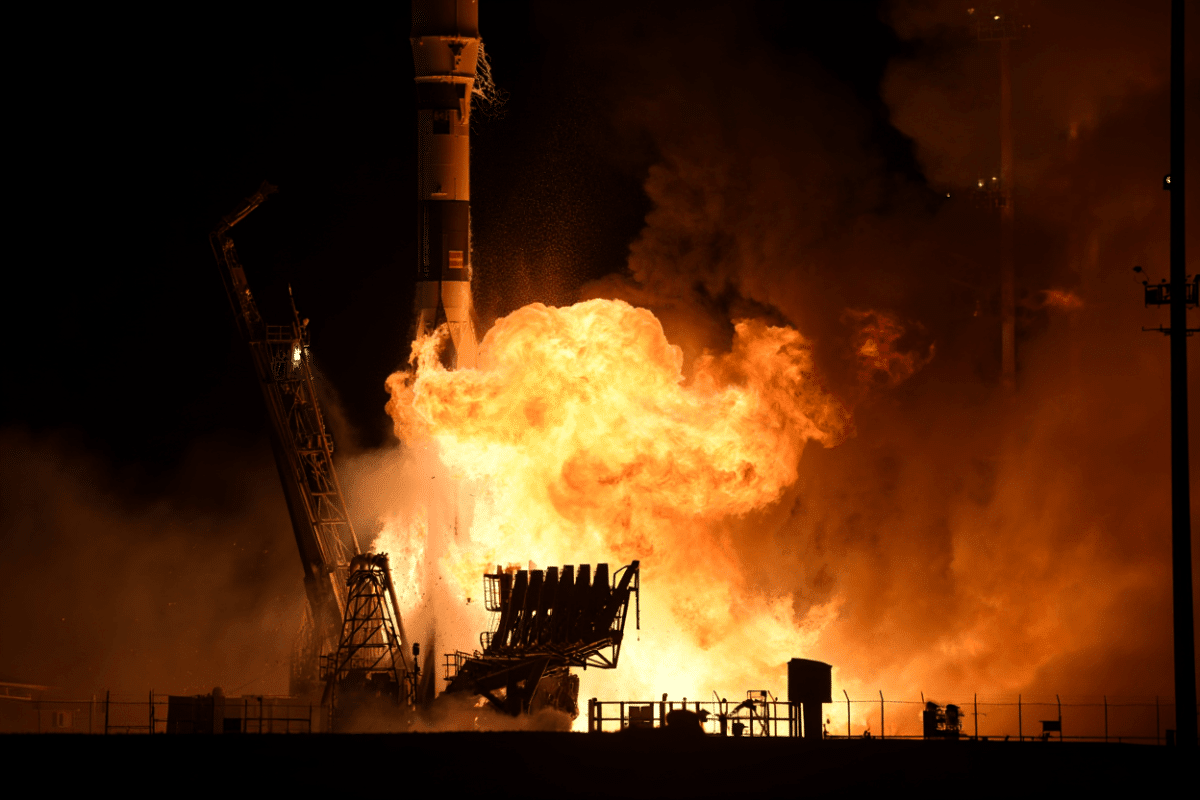
Blue Origin’s New Glenn rocket exploded on May 28, 2026, at 9 p.m. EDT during a static fire test at Launch Complex 36 in Cape Canaveral, Florida, dealing a major setback to the company founded by Jeff Bezos and its ambitious spaceflight plans.
The rocket erupted in a giant fireball as engines appeared to be igniting for the pre-launch test, destroying the launch pad’s lightning protection towers and transporter erector. The explosion occurred just days before the rocket was scheduled to launch Amazon Leo satellites for another Bezos venture, Amazon.
“All personnel are accounted for and safe,” Bezos wrote on social media following the incident. “Very rough day, but we’ll rebuild whatever needs rebuilding and get back to flying. It’s worth it.”
The NG-4 mission had been slated to launch as soon as June 4, carrying a batch of satellites. The Amazon Leo constellation had booked 24 launches on New Glenn rockets, with this test flight representing the first of those missions.
Prior Issues and Recovery Plans
The explosion marked the second major setback for New Glenn in recent weeks. On April 19, 2026, the rocket’s third mission (NG-3) experienced an in-flight anomaly when an upper stage failure prevented it from placing AST SpaceMobile’s BlueBird-7 satellite into the correct orbit. The FAA investigation concluded that a cryogenic leak froze a hydraulic line and caused a thrust anomaly during the second stage engine burn.
Blue Origin had just received FAA clearance to resume New Glenn launches on May 22, following the NG-3 investigation. The FAA stated it would not conduct a new investigation into the static fire explosion, as the test fell outside the scope of FAA-licensed activities.
Despite the setback, Blue Origin CEO Dave Limp announced the company aims to return New Glenn to flight before the end of 2026. However, industry sources cited by Ars Technica suggested a more realistic timeline for rebuilding the launch pad and resuming operations is 12 to 18 months.
Launch Complex 36 is currently Blue Origin’s only orbital launch facility, making the damage assessment critical to the company’s near-term schedule. The last major launch pad explosion at Cape Canaveral occurred in September 2016 when a SpaceX Falcon 9 rocket exploded at Space Launch Complex 40. SpaceX, which operated multiple pads, resumed Falcon 9 flights from Vandenberg Space Force Base in January 2017 but did not return to the damaged pad until December 2017.
Impact on NASA and Artemis Program
The explosion has immediate implications for NASA’s Artemis program. The space agency is heavily relying on New Glenn to support lunar missions and its Moon Base ambitions. On the day before the explosion, NASA announced several contract awards, including selecting Blue Origin to deliver lunar terrain vehicles to the Moon using its Blue Moon Mark 1 lander.
Blue Origin’s Blue Moon Mark 2 crewed lander was also selected by NASA as one of two options for the Human Landing System program, alongside SpaceX’s Starship. NASA Administrator Jared Isaacman acknowledged the setback in a statement, saying “Spaceflight is unforgiving, and developing new heavy-lift launch capability is extraordinarily difficult.” He noted that Artemis 3, an Apollo 9-style demonstration in low Earth orbit, was scheduled for mid-2027.
The incident mirrors challenges faced by other heavy-lift programs. In June 2025, SpaceX’s Starship 36 exploded during a routine static fire test in Texas as it was being readied for Flight 10 testing. Like the New Glenn explosion, no personnel were injured, and the incident underscored the inherent risks in developing new launch systems.
Sources
- Spaceflight Now — detailed coverage of the explosion, damage assessment, and impact on Blue Origin’s mission schedule and NASA partnerships
- Reuters — Blue Origin CEO Dave Limp’s statement on return-to-flight timeline before year-end 2026
- Ars Technica — industry analysis of realistic pad recovery timeline (12 to 18 months)
- AP News — confirmation that fuel tanks and critical launch pad components were spared in the explosion
- Space.com — comparison to SpaceX Starship 36 static fire test explosion in June 2025