
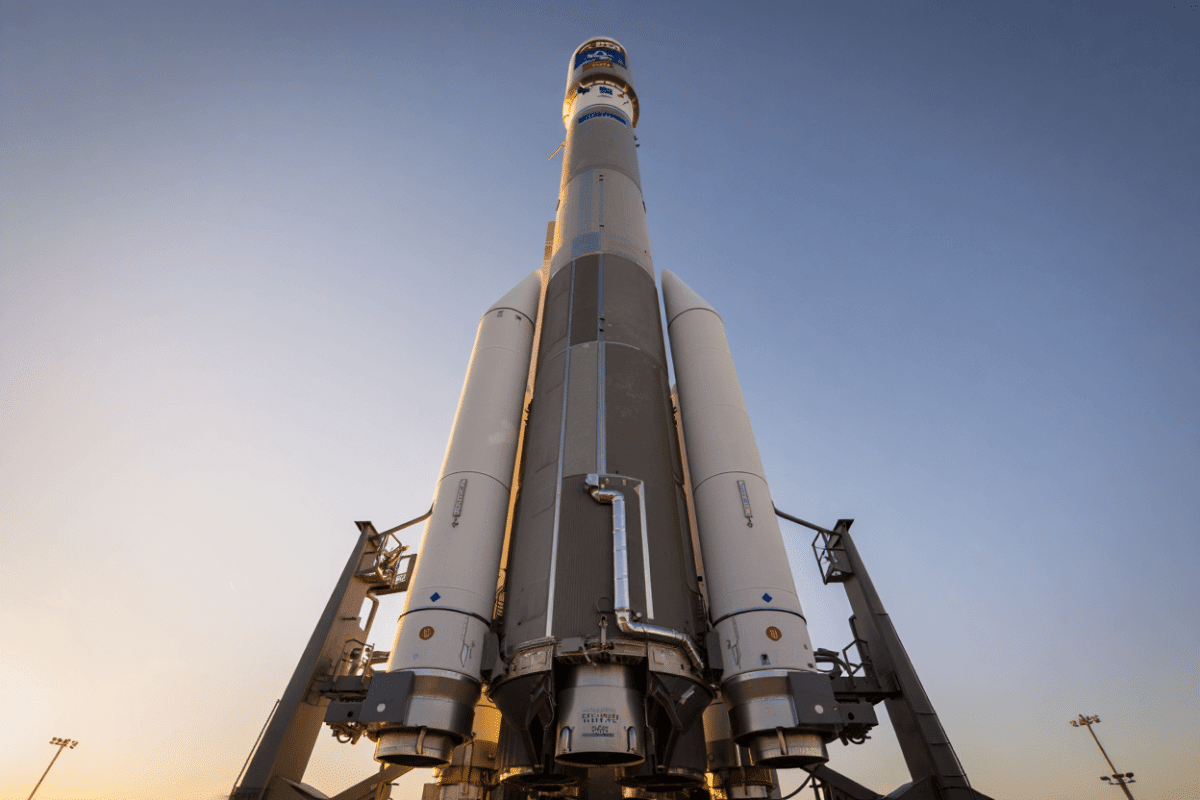
United Launch Alliance is launching 29 Amazon Leo broadband satellites tonight at 7:33 p.m. EDT from Space Launch Complex-41 at Cape Canaveral Space Force Station in Florida. This marks the seventh Amazon Leo mission for ULA and matches the constellation’s largest batch deployment to date. The Atlas V 551 rocket will carry the payloads into low Earth orbit as part of Amazon’s accelerated schedule to meet deployment milestones set for mid-2026.
🔥 Quick Facts
- Launch time: 7:33 p.m. EDT (11:33 p.m. UTC) on May 29, 2026
- Vehicle: Atlas V 551 with five solid rocket boosters
- Payload: 29 Amazon Leo satellites for global broadband service
- Location: Cape Canaveral Space Force Station, Florida’s SLC-41
- This is ULA’s 7th Amazon Leo deployment of 2026
Amazon Leo’s Accelerating Deployment Timeline
Amazon Leo, formerly known as Project Kuiper, represents one of the largest satellite constellation efforts underway. The service was officially rebranded in November 2025 to signal the transition from development to commercial deployment. Under its federal license agreement, Amazon must launch and operate half of the 3,236-satellite constellation by July 30, 2026—a deadline approaching in just two months.
Tonight’s launch is critical to meeting that regulatory requirement. With six prior missions completed since Amazon’s launch campaign began in April 2026, each mission deploys 29 satellites across three orbital altitudes: 590 km, 610 km, and 630 km. This multi-layer approach reduces latency and improves global coverage compared to single-altitude constellations. Amazon CEO Andy Jassy confirmed in late April that service rollout is scheduled for mid-2026, putting the company on trajectory to compete directly with established providers in rural and underserved markets.
Atlas V 551: The Workhorse Behind Amazon Leo
The Atlas V 551 configuration is specifically optimized for the Amazon Leo mission requirements. The rocket stands 196 to 205 feet tall in full launch configuration and carries a 1 RD-180 main engine producing 860,300 pounds of thrust at sea level. Five GEM 63 solid rocket boosters add an additional 380,000 pounds of peak vacuum thrust, enabling the vehicle to reach the specific orbital altitudes needed for the constellation.
ULA has completed 11 Leo missions across multiple launch vehicles since April 2026, alternating between Atlas V flights and planned Vulcan missions. The satellite deployment occurs during a 16-minute deployment window, with 10 individual satellite releases spaced from 21 minutes into the mission. This careful sequencing prevents collisions and ensures proper orbital spacing across all three altitude layers.
Mission Profile: Orbital Mechanics and Deployment Architecture
Tonight’s launch will follow a standard profile for Leo missions. Liftoff at 7:33 p.m. EDT initiates a climb to initial low Earth orbit, where payload fairings separate. The upper stage then performs multiple coast and re-ignition sequences to reach the three discrete orbital altitudes required by the constellation design.
| Mission Parameter | Specification |
| Vehicle | Atlas V 551 |
| Payload Count | 29 Amazon Leo satellites |
| Orbital Altitudes | 590 km, 610 km, 630 km |
| Deployment Window | 16 minutes (10 separate releases) |
| Launch Site | Space Launch Complex-41, Cape Canaveral SFS |
| Liftoff Time | 7:33 p.m. EDT (May 29, 2026) |
The constellation’s three-altitude architecture is an engineering choice that distinguishes Amazon Leo from competitors. Lower altitudes reduce latency—critical for gaming, videoconferencing, and financial transactions—while the broader layer distribution improves regional coverage reliability. This means financial market communications and enterprise services will benefit from reduced signal delay compared to traditional geostationary alternatives.
“Amazon Leo is designed to provide fast, affordable connectivity to unserved and underserved communities worldwide. Our constellation architecture delivers low-latency, high-throughput service to compete with terrestrial broadband.”
— Amazon Leo Program Leadership, Amazon Space Operations
What Tonight’s Launch Means for Global Broadband Competition
Tonight’s seventh Leo deployment represents Amazon’s aggressive push to capture satellite internet market share before competitors scale up. Starlink has operated for years, but Amazon’s multi-altitude design and focus on underserved regions creates a distinct value proposition. Regulatory deadlines are accelerating deployment: Amazon must maintain operational half-constellation status by July 30, 2026, or face licensing consequences.
For rural America and developing nations, the immediate impact will be availability. Current satellite providers serve limited geographies; Leo satellites promise near-global coverage by 2027. Latency improvements mean video streaming and cloud services become viable in areas previously limited to legacy satellite or no broadband access. SpaceX’s Starlink generated over $1 billion in revenue by 2026, proving consumer demand for this service layer.
Enterprise infrastructure providers are also watching closely, as satellite internet becomes an alternative WAN (wide area network) link for business continuity and disaster recovery. Tonight’s progress directly affects the timeline for commercial service rollout and competitive positioning in 2026’s growing satellite broadband market.
How Will You Track Tonight’s Launch?
ULA provides live coverage on its official channels starting 30 minutes before liftoff. The 7:33 p.m. EDT time matches Atlantic coast viewing windows, making Cape Canaveral visible for observers across the southeastern United States. Clear weather is currently forecast for the Space Coast, though launch windows can slip if atmospheric conditions deteriorate.
For those unable to watch live, recorded footage will be available within hours on ULA’s website and social media platforms. Each Amazon Leo mission reinforces the commercial space industry’s maturation—tonight’s launch is routine execution of a complex orbital mechanics problem, but each satellite brings global broadband connectivity one step closer to reality.
Sources
- United Launch Alliance – Official Atlas V Amazon Leo 7 mission details and launch timeline
- Spaceflight Now – Live coverage coordination and mission updates
- Florida Today / Space Coast Daily – Regional launch timing and visibility forecasts
- Amazon Leo – Constellation architecture and service rollout announcements
- RocketLaunch.Live / NextSpaceflight – Orbital deployment specifications










