
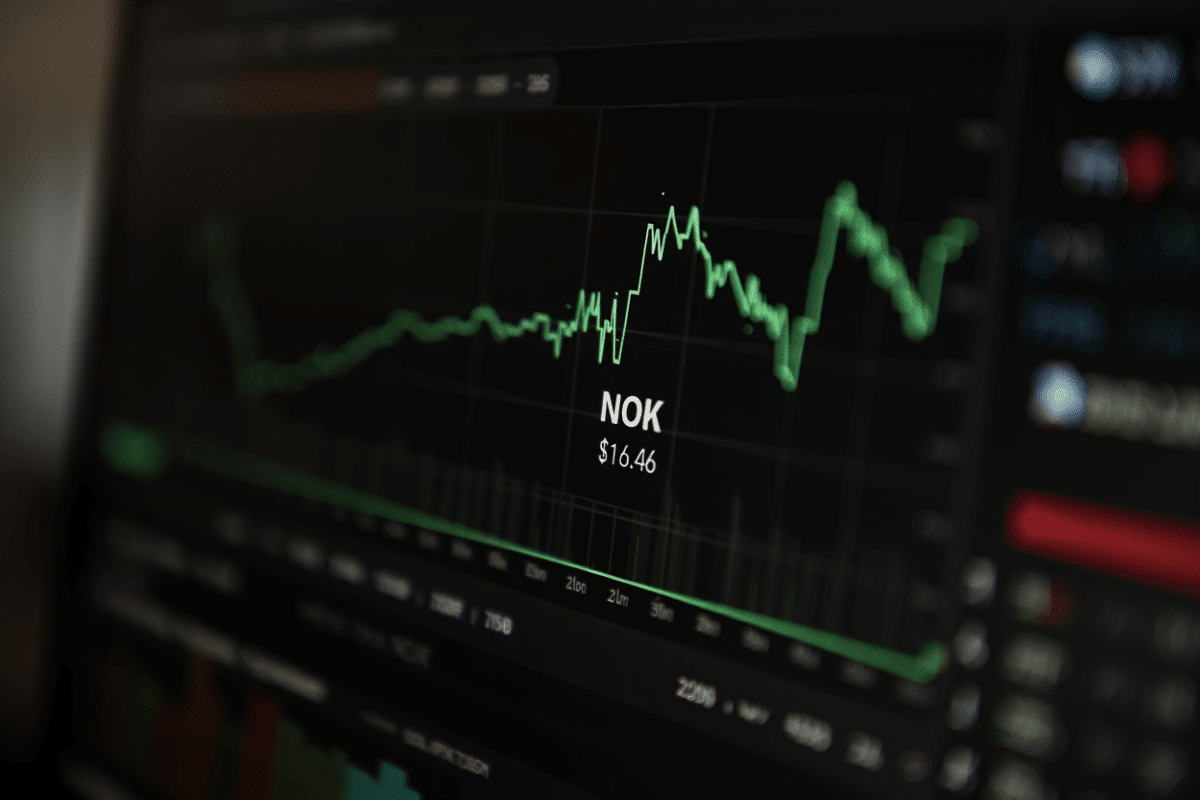
Nokia stock rose to $16.46 on May 26, 2026, extending its remarkable 140% year-to-date surge as the Finnish network equipment maker captures explosive growth in AI infrastructure demand. The rally reflects a strategic transformation from traditional telecoms into a leader in optical networking and AI-powered data center connectivity—positioning Nokia as a critical supplier for the infrastructure that powers the AI supercycle.
🔥 Quick Facts
- Stock Price: $16.46 as of May 26, 2026, up 140% year-to-date
- Q1 2026 Results: AI & Cloud sales surged 49% with €1 billion in new orders
- NVIDIA Investment: $1 billion stake at $6.01/share (2.9%), announced October 2025
- Market Cap: Approximately $93.12 billion, reaching 16-year highs
- Guidance Raised: AI & Cloud addressable market growing at 27% CAGR (2025–2028)
The AI Infrastructure Pivot: From Telecom Equipment to Data Center Dominance
Nokia’s transformation represents a fundamental repricing of the company as the market shifted its focus from declining mobile network deployments to booming AI data center infrastructure. Under CEO Justin Hotard—who left Intel’s data center and AI leadership to join Nokia—the company has repositioned itself as a pure-play on the infrastructure needed to connect, power, and optimize artificial intelligence workloads across global data centers.
The shift began in earnest with Nokia’s $2.3 billion acquisition of Infinera in February 2025, which bolstered its optical networking capabilities. Optical networks—the backbone of high-speed, power-efficient data transmission—have become critical bottlenecks as hyperscalers like Amazon, Google, Microsoft, and others race to build out AI inference and training infrastructure. Nokia’s optical products achieved 20% organic growth in Q1 2026, while AI & Cloud revenue surged 49% compared to the same period last year, signaling how rapidly the company is capturing this transition.
The NVIDIA Catalyst and Strategic Partnership
NVIDIA’s $1 billion investment in Nokia, announced in October 2025, marked a watershed moment. The acquisition of a 2.9% stake at $6.01 per share represented more than a financial transaction—it was a signal that NVIDIA sees Nokia’s optical and networking technology as essential to the AI infrastructure ecosystem.
The partnership centers on AI-RAN (Artificial Intelligence Radio Access Networks) and the eventual transition from 5G to 6G standards. NVIDIA invested to accelerate these innovations, recognizing that GPU-powered AI workloads require exponentially more network capacity and lower-latency connectivity than traditional mobile networks. Since the NVIDIA announcement, Nokia shares have climbed 173% from the investment price, reflecting investor confidence in the partnership’s strategic value.
Financial Momentum: Q1 2026 Earnings Validate the Growth Story
| Metric | Q1 2026 Result | Year-Over-Year Change |
| AI & Cloud Net Sales | €1 billion in new orders | +49% |
| Optical Networks Growth | High-capacity backbone | +20% |
| Book-to-Bill Ratio | Greater than 1.0 | Positive indicator |
| 2026 Network Infrastructure Growth Guidance | 12%–14% expected | Raised from prior view |
| AI & Cloud 2025–2028 CAGR | Market size growing | 27% (raised from 16%) |
On April 23, 2026, Nokia released Q1 2026 results that exceeded expectations and triggered a significant guidance raise. The company reported that its AI & Cloud business captured €1 billion in new orders during the quarter alone, with a book-to-bill ratio above 1.0—a critical metric indicating that order backlog exceeds quarterly revenue, suggesting strong demand sustainability. Most tellingly, Nokia raised its addressable market estimate for AI & Cloud to grow at a 27% compound annual growth rate through 2028, up from a previous estimate of 16%—evidence that even management underestimated the velocity of AI infrastructure buildout.
“Machine-to-machine network traffic will explode and dominate infrastructure demand in the long term. The infrastructure needs to be AI-ready from day one.”
— Justin Hotard, President & CEO, Nokia, April 2026
Why AI Infrastructure Demand Accelerated Faster Than Predicted
The explosive demand for Nokia’s optical and AI networking products stems from a technical imperative often overlooked by casual investors. Large language models like ChatGPT, Claude, and proprietary corporate AI systems require interconnected clusters of GPUs and TPUs consuming enormous amounts of electrical power and data bandwidth. A single modern AI data center can demand multiple petabits per second of internal networking capacity—orders of magnitude beyond 5G or traditional enterprise networks.
As detailed in recent industry deals valuing AI data center infrastructure, hyperscalers have begun competing fiercely for optical networking equipment. Nokia’s Infinera acquisition positioned the company with vertically integrated capabilities—designing both the optical transceivers and the network software layers needed for AI clusters—giving it a structural advantage over competitors who rely on piecemeal solutions.
Valuation Crossroads: Is 140% Still Justified?
Nokia faces an important valuation inflection. At $16.46, the stock trades at the highest level since 2008, a period when Nokia was the undisputed mobile phone giant. Analyst price targets remain mixed: consensus estimates vary widely, with some bullish calls targeting $19–21 by year-end while bears cite a need for earnings growth to justify current multiples. Nokia’s financial guidance suggests 12–14% growth in core Network Infrastructure through 2026, with AI & Cloud potentially growing 30%+, which would support further appreciation if execution remains flawless.
The critical variables are: (1) How much of the AI data center buildout does Nokia actually capture versus competitors like Ericsson and Cisco? (2) Can management maintain 27% CAGR growth in AI & Cloud beyond 2028? (3) Will telecom customers continue to prioritize Nokia’s solutions over lower-cost alternatives as the market matures? The next two quarterly reports will determine whether this rally has legs or represents a peak in enthusiasm.
What Changes If Nokia Achieves Its 2028 Targets?
Nokia targets a 60% profit boost by 2028 if its AI-focused strategy gains traction. For U.S. investors, this means exposure to a pure-play on AI infrastructure monetization without the regulatory scrutiny facing chip makers or cloud giants. Nokia’s European domicile and open network approach also appeal to governments seeking alternatives to concentrated U.S. tech dominance in infrastructure. If the profit target materializes and the stock re-rates toward 25–30x forward earnings (in line with growth tech), current holders could see another 50%+ upside from today’s levels. Conversely, if AI capex spending slows or competitors undercut pricing, downside to $12–13 remains a risk.
Sources
- Yahoo Finance – Nokia stock news and market data (May 26, 2026)
- MacroTrends – Nokia 32-year stock price history and current valuation
- Nokia Newsroom – Q1 2026 Interim Report and earnings guidance
- NVIDIA Investor Relations – Press release on $1 billion Nokia investment (October 28, 2025)
- CNBC – Nokia–NVIDIA partnership and strategic implications
- Seeking Alpha – Nokia Q1 2026 earnings call analysis
- Fierce Network – Nokia CEO interview on machine-to-machine traffic and AI-RAN
- Capacity Global – Nokia Infinera integration and optical network expansion










