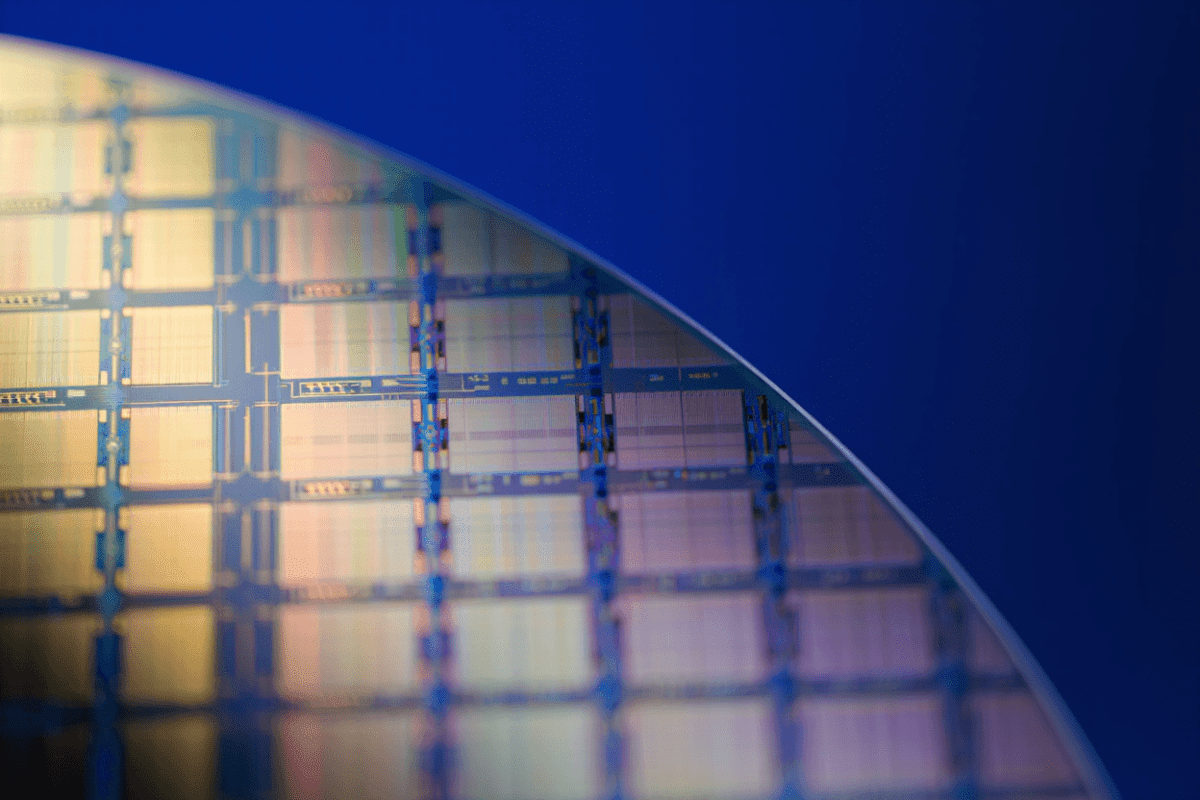
SK Hynix stock surged 5.72% during May 26, 2026 trading, driven by strengthening demand for high-bandwidth memory (HBM) chips used in artificial intelligence systems. The South Korean memory manufacturer has accumulated gains exceeding 200% this year, outpacing broader semiconductor indices as data centers race to secure supplies amid ongoing shortages.
🔥 Quick Facts
- SK Hynix stock price climbed 5.72% on May 26, 2026, reflecting investor confidence in AI memory supply dominance
- Year-to-date gains exceed 200%, with shares reaching 2,052,000 KRW at close
- Q1 2026 revenue hit ₩52.58 trillion ($35.5 billion), a 198% year-over-year increase
- HBM market leadership: SK Hynix holds approximately 57% of global high-bandwidth memory share
- $20+ billion committed to expanding HBM production capacity through 2027
The AI Memory Shortage Driving Stock Momentum
Memory chip scarcity has become one of the semiconductor industry’s primary bottlenecks in 2026. Samsung and SK Hynix both publicly warned in late April that AI-driven memory shortages could persist through 2027, with severe supply constraints overwhelming production capacity. SK Hynix‘s ability to deliver HBM3E memory for Nvidia’s H100, H200, and B100/B200 GPUs has positioned the company as a critical infrastructure supplier in the AI buildout race.
The global semiconductor market is projected to reach $1.29–1.3 trillion in 2026, with AI infrastructure accounting for roughly 50% of total industry revenue. Within this landscape, memory represents the fastest-growing segment. Gartner data indicates memory prices will increase 125% in 2026, while storage chip prices surge 234%. This inflationary pressure on memory costs has benefited SK Hynix, which can command premium pricing due to limited HBM availability.
SK Hynix’s Competitive Advantage in the AI Era
SK Hynix has decisively outpaced Samsung in the race to capture AI memory market share. According to Counterpoint Research, SK Hynix held 57% HBM revenue share in Q3 2025, compared to Samsung’s 22%. The South Korean chipmaker’s focus on memory products—unlike Samsung’s diversified portfolio—has enabled faster iteration on cutting-edge HBM4 specifications and 2.5D packaging innovations.
Operating margins at SK Hynix have expanded dramatically, with recent reports indicating 76.7% gross margins on HBM products. This compares sharply to Samsung’s more modest 40% margin profile across its broader memory business. SK Hynix overtook Samsung in annual operating profit for the first time in 2025, marking a historic shift in competitive positioning.
The company’s aggressive investment in memory production capacity reflects confidence that AI demand will remain structurally elevated. Tech giants including Google, Microsoft, and Meta have reportedly offered to fund SK Hynix’s new production lines or purchase expensive lithography tools to secure guaranteed supply agreements.
Market Data: HBM Dominance and Capacity Constraints
The following table illustrates SK Hynix’s market position relative to competitors and the scale of production constraints:
| Metric | SK Hynix | Samsung | Micron |
| HBM Market Share (Q1 2026) | 57% | 22–40% | 10–21% |
| Gross Margin (HBM) | 76.7% | 40% | TBA |
| Q1 2026 Revenue | ₩52.58T | ₩133.9T (overall) | TBA |
| Capacity Expansion Investment | $20B+ | TBA | TBA |
| Supply Constraint Timeline | Through 2027 | Through 2027 | Through 2027 |
SK Hynix‘s reported HBM4 production levels are already 62% sold out, according to recent analyst coverage. This reserve booking reflects hyperscaler confidence in sustained AI infrastructure spending and suggests pricing power will persist through 2026. Related developments in the broader memory sector—such as the surge in DRAM stock valuations alongside memory ETF gains to 121% YTD, underscore how comprehensively the memory shortage affects the entire semiconductor ecosystem.
“Chip demand will likely continue to outpace supply over the next three years, especially for high-bandwidth memory products. The memory market is facing acute supply constraints that will define the competitive landscape for years to come.”
— SK Hynix Management, Q1 2026 Earnings Guidance, April 23, 2026
Implications: What This Stock Surge Signals About AI Infrastructure Investment
SK Hynix’s continued stock appreciation reflects deeper structural dynamics in artificial intelligence deployment. Data centers globally are expected to consume 70% of all memory chips manufactured in 2026, a dramatic shift from historical norms. Large-scale language model training, inference acceleration, and AI application deployment are consuming memory at unprecedented rates.
The 5.72% gain on May 26 occurred amid stable macroeconomic conditions and uninterrupted demand signals from Nvidia, Tesla, Google, Amazon, and Microsoft. Analysts maintain bullish outlooks, with price targets ranging from ₩1,370,000 to above ₩2,000,000 KRW on multi-year visibility into memory scarcity. SK Hynix’s execution on capacity expansion, combined with its technical leadership in advanced HBM packaging, positions it to capture disproportionate share of the $1.3 trillion global semiconductor opportunity in 2026.
Will the Memory Shortage Persist Beyond 2026?
SK Hynix, Samsung, and industry analysts agree: supply constraints will extend through 2027 at minimum. Even with $20+ billion invested in new capacity, manufacturing ramp timelines extend 18–24 months from tool installation to full production. The question for investors is not whether memory will remain scarce in 2026, but whether SK Hynix can continue expanding share despite aggressive competition from Samsung HBM4 launches and Micron’s advanced node insertions.
Historical precedent from prior semiconductor shortages (2021–2022) suggests that first-mover advantage compounds during supply constraints but can evaporate rapidly once capacity normalizes. SK Hynix’s current 57% HBM market share represents peak bargaining power—a position the company must defend through sustained innovation and manufacturing excellence as competitors catch up through 2027–2028.
Sources
- Yahoo Finance – SK Hynix (000660.KS) historical price data and May 26, 2026 stock movement
- Business Insider – “The AI Chip Frenzy Is Creating a New Trillion-Dollar…” (May 13, 2026)
- Morningstar – Q1 2026 earnings report: memory chip maker revenue tripled YoY
- Counterpoint Research – Global DRAM and HBM market share analysis (Q4 2024–Q1 2026)
- CNBC – “SK Hynix overtakes Samsung in annual profits for the first time” (January 29, 2026)
- Wall Street Journal – “SK Hynix Paints Rosy Outlook for Memory Chips” (April 23, 2026)
- Financial Times – Memory chipmakers’ long-term contract strategies amid AI demand (April 28, 2026)
- Gartner – Semiconductor industry revenue and memory pricing forecasts (2026)
- IDC – Global semiconductor market forecast at $1.29 trillion by 2026