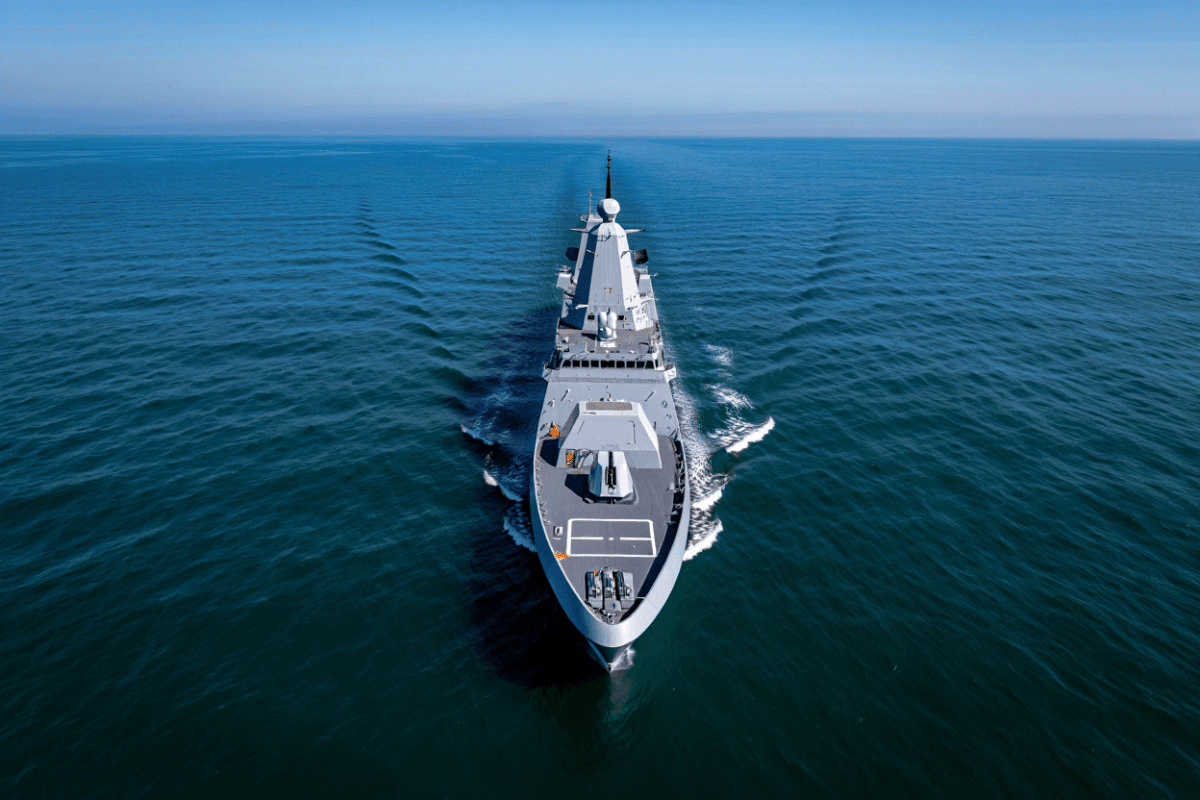
USS Zumwalt (DDG-1000), the Navy’s stealthiest destroyer, is undergoing transformation into the service’s first hypersonic strike platform. The ship will carry 12 Conventional Prompt Strike (CPS) missiles capable of traveling at Mach 5+ speeds over 1,700 miles, fundamentally redefining how the Navy projects power across oceans. The $1.356 billion CPS contract awarded in April 2026 marks the forward momentum of this historic modernization, with the vessel set to return to sea in 2026 after three years in dry dock.
🔥 Quick Facts
- First U.S. Navy hypersonic destroyer: USS Zumwalt scheduled for 2026 return to active service
- CPS payload: Four vertical launch tubes with three missiles each equals 12 total hypersonic weapons
- Range and speed: CPS system travels Mach 5+ at speeds exceeding conventional missiles by factor of four
- Defense investment: Navy awarded $1.356 billion CPS contract in April 2026 to accelerate platform deployment
- Operational shift: Both Advanced Gun Systems removed, replaced with four large missile tubes for strategic strike capability
From Gun Ship to Hypersonic Striker: The Zumwalt’s Evolution
The USS Zumwalt represents one of the Navy’s most dramatic operational transformations. Originally designed around two 155-millimeter Advanced Gun Systems (AGS) for naval gunfire support, the destroyer has undergone complete weapon systems redesign. The Navy removed both gun turrets—along with the sophisticated (though never operationally deployed) Long-Range Land Attack Projectile (LRLAP) ammunition system—to make room for a radically different strike posture.
This pivot reflects Pentagon strategy shifts over the past five years. Where once the Navy envisioned sustained gunfire bombardment from stealthy platforms, today’s doctrine prioritizes distributed hypersonic capability. The Zumwalt-class displacement of 15,656 tons and advanced stealth hull design—with its distinctive tumblehome configuration—make it ideal for covert strike missions. Unlike conventional destroyers, the Zumwalt’s radar cross-section approximates a fishing vessel, enabling it to approach strike range undetected.
CPS Technology: Capability and Strategic Implications
The Conventional Prompt Strike (CPS) system represents years of joint Army-Navy development. The missile employs a boost-glide architecture—a rocket booster accelerates a hypersonic glide vehicle to extreme altitude, where aerodynamic control surfaces guide the warhead to targets at speeds exceeding 3,500 miles per hour. This profile creates extraordinary defensive challenges; existing air defense systems cannot intercept targets traveling at Mach 5+.
Each Zumwalt-class destroyer will carry four vertical launch tubes, with each tube accommodating three CPS missiles in a stacked configuration. This equals 12 operational hypersonic weapons per ship—a quantum leap in strike density compared to conventional Tomahawk cruise missile loads. The range exceeds 1,700 nautical miles, enabling strikes against targets across entire ocean basins without exposing the launch platform.
Specifications and Operational Profile
| Specification | Details |
| Ship Class | Zumwalt-class (DDG-1000) guided-missile destroyer |
| Displacement | 15,656 tons (full load) |
| Hypersonic Missiles | 12 CPS missiles (four vertical tubes, three per tube) |
| CPS Velocity | Mach 5+ (exceeds 3,500 mph) |
| Strike Range | 1,700+ nautical miles |
| Radar Signature | Equivalent to fishing vessel (stealthy tumblehome hull) |
| Crew Size | 142 sailors (reduced vs. conventional destroyers) |
| Propulsion | Integrated Power System with two gas turbines, two diesel engines |
| CPS Contract Value (Apr 2026) | $1.356 billion Navy award |
The integration demands unprecedented systems engineering. The Navy replaced the destroyer’s entire forward gun battery with a four-tube vertical launch cell module. Each tube measures significantly larger than standard Mk-41 cells (which accommodate Tomahawks and Standard missiles). Fire control systems updated to command hypersonic boost-glide vehicles required new software architectures and sensor fusion algorithms.
Strategic Deterrence in the Indo-Pacific Context
Three Zumwalt-class destroyers exist in the world—USS Zumwalt, USS Michael Monsoor, and USS Carl M. Levin. All three will eventually receive the CPS upgrade. When fully operational, this force multiplier fundamentally alters regional military balance. A single Zumwalt carrying 12 hypersonic strikes operates as a strategic asset comparable to surface combatants twice its tonnage from prior decades.
The Navy intends to proliferate CPS across the surface fleet. Future Constellation-class frigates and Virginia-class submarines will carry CPS weapons by the early 2030s. This distributed hypersonic network creates adversary dilemmas: defending against simultaneous missile salvos from multiple stealthy platforms exceeds current air defense integration capabilities. The January 21, 2026 underway period confirmed USS Zumwalt’s readiness for operational trials.
“The destroyer is the first vessel armed with hypersonic missiles in United States Navy inventory, sporting 12 of the CPS missiles. The Navy replaced the guns with four large missile tubes each capable of holding three of the hypersonic missiles apiece.”
— Naval News, Reporting on USS Zumwalt Refit Completion, January 2026
Budget and Industrial Base Implications
The April 2026 $1.356 billion contract award represents significant acceleration in the CPS supply chain. Previous development timelines projected operational deployment in 2027. The accelerated awards suggest Navy confidence in boost-glide vehicle maturity following successful joint Army-Navy hypersonic test launches in March 2026.
Defense contractors Lockheed Martin (CPS prime) and Raytheon will increase production rates. The Navy has publicly acknowledged demand for multiple salvo quantities across surface and subsurface platforms. Each Zumwalt upgrade requires specialized vertical launch cell installation, power management system integration, and combat management system software certification—labor-intensive work supporting maritime industrial base employment across multiple U.S. shipyards.
Will Zumwalt Finally Achieve Its Combat Mission?
The original Zumwalt-class design faced criticism and budget overruns since the late 1990s. Gun systems proved ineffective with available munitions. The advanced stealth hull—revolutionary in appearance—lacked robust air defense integration compared to earlier Arleigh Burke-class destroyers. Congressional skeptics questioned whether the $5+ billion unit cost justified limited tactical advantages.
CPS retrofit transforms this narrative. A stealthy, hypersonic-armed destroyer directly counters emerging A2/AD threats from near-peer competitors. The Zumwalt’s reduced radar cross-section enables it to survive detection long enough to launch; its 12-missile payload guarantees penetrating strike effect. After 15+ years of operational uncertainty, the ship class finally acquires the armament matching its stealth capability.
The real question: Can the Navy sustain three stealthy hypersonic platforms, or will budget pressures force concentration on lower-cost alternatives? The $1.356 billion investment suggests institutional commitment. Yet future acquisition cycles will determine whether all three Zumwalts complete modernization or receive phased upgrades.
Sources
- Naval News — USS Zumwalt to Put to Sea in 2026 Without Main Gun Systems (January 15, 2026)
- Army Recognition — U.S. Advances USS Zumwalt Destroyer Hypersonic Strike Role With $1.356B CPS Contract (April 1, 2026)
- Navy Lookout — Repurposing the U.S. Navy’s Zumwalt-Class Destroyers With Hypersonic Strike Capability (August 19, 2025)
- Military Arnyi — Destroyer Zumwalt Armed With Hypersonic Missiles to Set Sail for First Time in 2026 (January 24, 2026)
- USNI News — USS Zumwalt Underway for First Time Since 2023 After Missile Refit (January 21, 2026)
- U.S. Navy Official — Destroyers (DDG 1000) Fact File (Navy.mil, January 5, 2023)