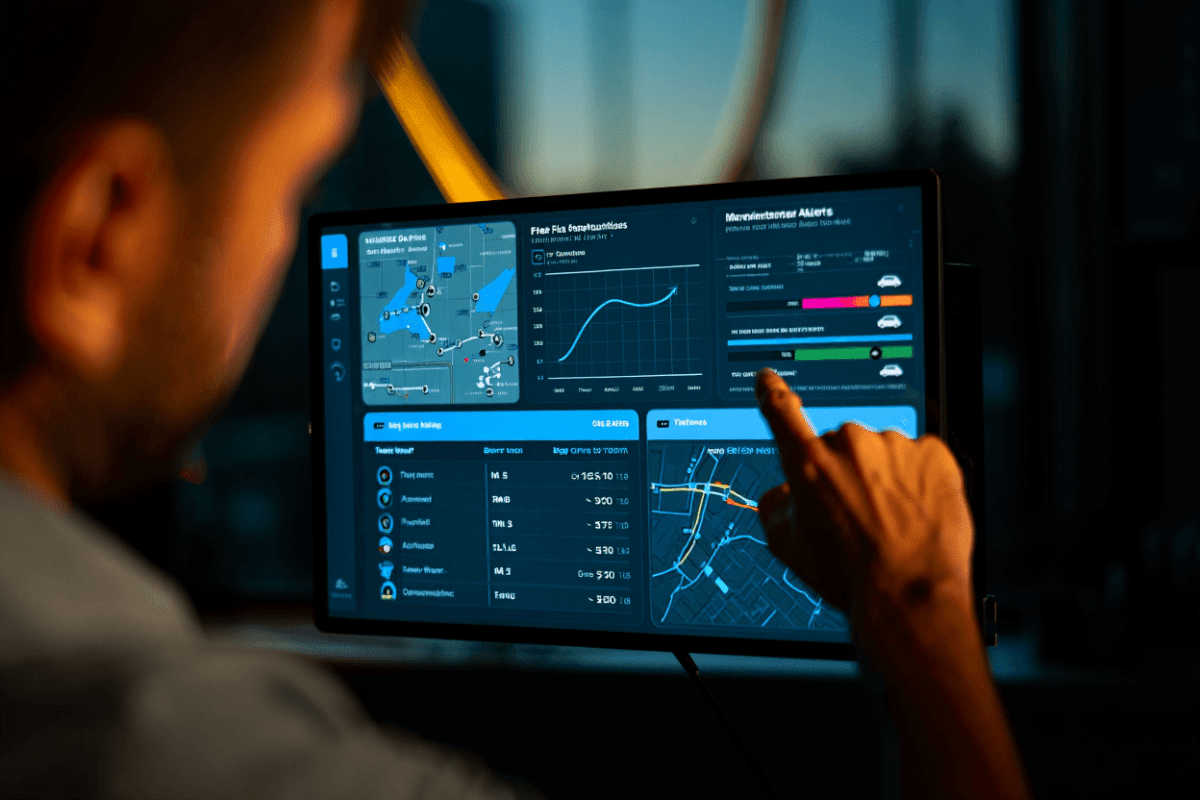
Samsara unveiled four new AI-powered features on May 20, 2026, significantly expanding its fleet management platform with intelligent tools for fuel management, maintenance recovery, and dynamic route optimization. The updates represent the company’s continued investment in reducing operational costs while improving driver efficiency and vehicle uptime across commercial fleets.
🔥 Quick Facts
- Four new features announced May 20, 2026 targeting fuel costs, driver behavior, maintenance, and routing
- AI-powered analytics analyze driver patterns, vehicle diagnostics, and route efficiency in real time
- Samsara’s platform already serves thousands of fleets with dash cam, GPS, and telematics integration
- Revenue growth of 28% year-over-year to $444.3M demonstrates platform adoption surge
Why Fleet Operators Need These AI Solutions Today
Fuel costs remain the largest controllable expense for fleet operators, often consuming 25-30% of total operating budgets. Maintenance failures create unplanned downtime, while inefficient routing adds unnecessary miles. Samsara’s new releases address each bottleneck with machine learning models that continuously learn from fleet behavior patterns. The company has been advancing AI capabilities since its 2024 launch of Samsara Intelligence, which demonstrated 75% crash rate reduction across 2,600+ fleets. These May 2026 features extend that expertise into operational efficiency.
The Four Core AI Features: Fuel, Driver, Maintenance, and Route
Feature 1: Intelligent Fuel Spending Controls uses real-time telematics data to identify inefficient driving behaviors that spike fuel consumption—chronic idling, aggressive acceleration, excessive braking, and speeding. The AI compares individual driver performance against fleet benchmarks and road conditions, delivering personalized coaching recommendations. Rather than generic metrics, Samsara’s approach accounts for vehicle weight, topography, and weather.
Feature 2: Driver Efficiency Coaching transforms safety events into teachable moments. AI automatically prioritizes risky behaviors—hard braking, large following distances, lane departures—and feeds ranked alerts to fleet managers. This focuses human attention on the highest-impact coaching targets instead of overwhelming managers with low-severity notifications.
Feature 3: Automated Maintenance Recovery leverages vehicle diagnostics to predict maintenance needs before failures occur. Connected Maintenance, part of Samsara’s suite, combines real-time fault code descriptions with AI interpretation, allowing technicians to act faster. Preventive maintenance visibility reduces emergency roadside repairs and extends vehicle lifespan.
Feature 4: AI-Optimized Route Planning dynamically recalculates routes based on real-time traffic, weather, and vehicle load data. Unlike static GPS routing, Samsara’s engine continuously updates driver navigation to avoid congestion, reduce idling, and lower fuel burn. The system learns from historical patterns to predict optimal departure times and waypoint sequences.
Technical Architecture and Data Integration
These features operate on Samsara’s unified platform, which collects data from telematics hardware, AI dash cams, GPS units, and vehicle diagnostic interfaces every second. The AI models run on edge devices (in-vehicle units) and centralized cloud infrastructure, enabling real-time coaching in low-connectivity areas while aggregating fleet-wide insights in the cloud.
| Feature | Data Inputs | Primary Benefit |
| Fuel Management AI | Accelerometer, GPS speed, engine load, idle time | 5-15% fuel cost reduction |
| Driver Coaching | In-cabin camera, vehicle telemetry, road context | Improved safety, reduced claims |
| Maintenance Recovery | OBD-II diagnostics, mileage, service history | 20-30% reduction in unplanned downtime |
| Route Optimization | Live traffic, weather APIs, vehicle load, delivery data | 10-20% fewer miles, faster delivery windows |
The integration strategy reflects industry best practices in telematics. Real-time data collection at 1-second intervals captures granular behavior patterns, while AI models filter noise and identify actionable insights. As noted in broader AI competition dynamics in enterprise software, operational efficiency features represent differentiators that compound over time.
Implications for Fleet Economics and Industry Standards
Samsara’s May 2026 release signals an acceleration in AI adoption across physical operations. The company’s 2026 Public Sector Customer Advisory Board (announced in May) points toward government agencies deploying similar tools for waste management, transportation, and emergency services. If adoption spreads, fleet operators without these AI capabilities will face competitive disadvantages on cost per mile.
Fuel efficiency gains directly improve sustainability metrics. Fleets reducing fuel consumption also lower emissions, aligning with corporate ESG commitments and regulatory requirements in California, New York, and the EU. Insurance carriers increasingly reward data-driven safety programs with premium discounts, creating an additional ROI path for operators deploying AI coaching.
Maintenance predictability transforms fleet economics by converting reactive (expensive) repair to proactive (economical) service. A single unplanned breakdown can cost $500–$2,000 in parts, labor, and lost revenue. Predictive maintenance at scale likely justifies the per-vehicle subscription cost alone.
What Questions Remain as Fleets Evaluate These Tools?
As fleet operators assess Samsara’s new offerings, several strategic questions emerge. How quickly do AI coaching models adapt to regional driving conditions—are models pre-trained on North American data or globally optimized? Will route optimization account for specific customer delivery time windows, or does it optimize for pure speed? How granular can maintenance alerts become—can the system flag a single failing sensor, or does it require broader fault patterns? Which fleets will see the highest ROI first: regional carriers with repetitive routes, or long-haul operators with diverse driving conditions?
Finally, integration complexity matters. Does Samsara’s platform work seamlessly with existing ELD systems, dispatch software, and accounting tools, or do operators face custom development? These technical and operational details often determine whether marketed ROI becomes realized ROI.
Sources
- Samsara Official Blog – May 2026 product updates announcement detailing four new releases
- TruckNews – May 22, 2026 coverage of Samsara fuel, maintenance, coaching, and routing tools
- Samsara Intelligence Platform – 75% crash rate reduction data from 2,600+ fleet deployment
- Industry Telematics Research – AI-driven fuel optimization and maintenance predictability trends
- Samsara Investor Relations – 28% YoY revenue growth to $444.3M for fiscal year 2026