
NASA’s Psyche spacecraft completed a critical gravity-assist flyby of Mars on May 15, 2026, passing within 2,864 miles (4,609 kilometers) of the planet’s surface. The maneuver delivered a substantial velocity boost to the spacecraft while clearing a path toward its ultimate destination: the metal-rich asteroid 16 Psyche in the asteroid belt, scheduled for orbital arrival in August 2029.
🔥 Quick Facts
- Mars approach distance: 2,864 miles (4,609 km) on May 15, 2026
- Spacecraft launched October 13, 2023 from Kennedy Space Center on SpaceX Falcon Heavy
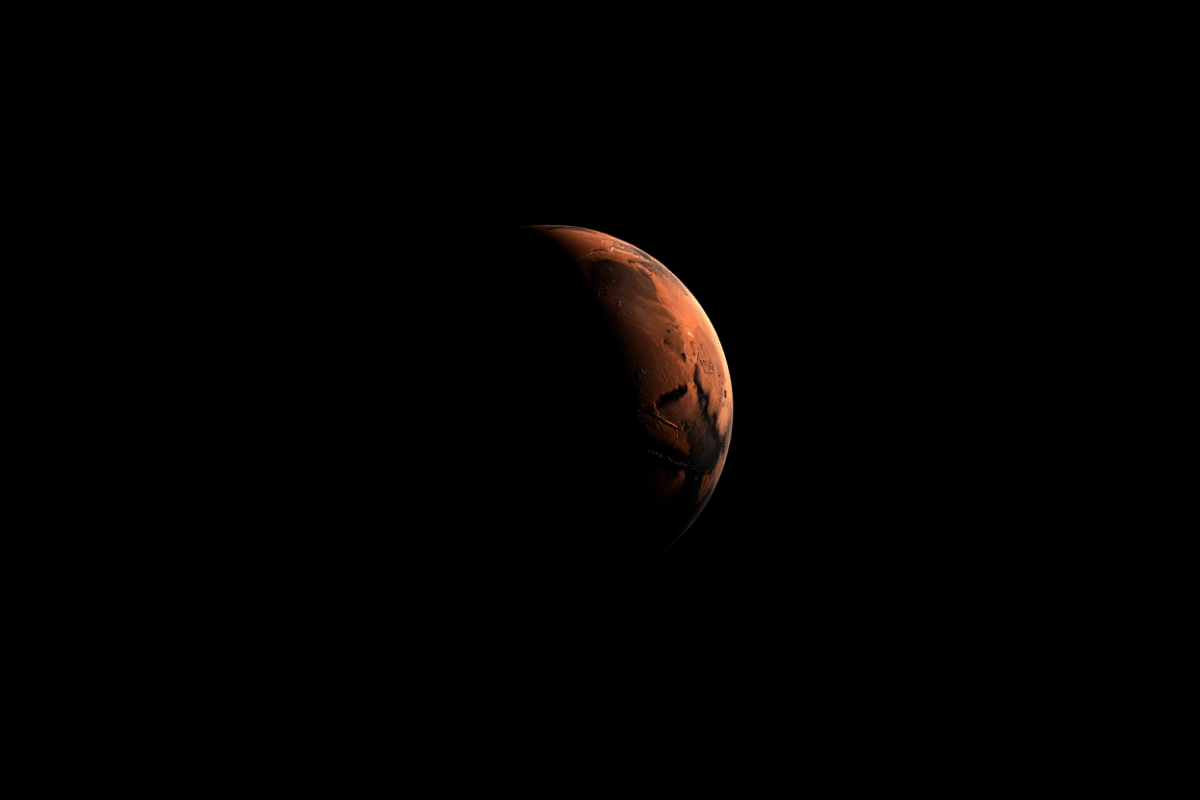
- Crescent Mars images captured during high-speed flyby with natural-color imagery
- Expected asteroid arrival: August 2029 for 817-day orbital science investigation
- Solar-electric propulsion system uses Hall-effect thrusters for precision trajectory control
Understanding Gravity Assist: How Mars Propels Psyche Forward
A gravity-assist maneuver, also called a “slingshot,” harnesses a planet’s gravitational pull to alter a spacecraft’s velocity and trajectory without consuming fuel. During the May 15 approach, Psyche coasted toward Mars with thrusters turned off, relying entirely on the planet’s gravitational field to redirect its path and accelerate it toward the asteroid belt.
This technique proves essential for long-distance missions where fuel consumption must be minimized. By leveraging Mars’s gravity, Psyche gained the precise speed increase needed to reach asteroid 16 Psyche without burning additional propellant. The maneuver also adjusted the spacecraft’s orbital plane—an orientation change that would be prohibitively expensive in terms of fuel if attempted through thruster firing alone. NASA engineers calculated the trajectory to within extraordinary precision, accounting for the spacecraft’s current velocity of approximately 12,333 mph during the approach phase.
The Unprecedented Mars Crescent Images: Science and Artistry Combined
Psyche captured stunning natural-color imagery of Mars as it zipped past, producing views impossible to obtain from Earth-based telescopes or stationary orbital platforms. The crescent images—showing only the illuminated edge of Mars against the darkness of space—represent the spacecraft’s unique vantage point during high-speed transit.
On May 3, 2026, when Psyche was approximately 3 million miles (4.8 million kilometers) away, the spacecraft transmitted a colorized image revealing Mars’s crescent silhouette. As the spacecraft approached closer to May 15, additional images documented the Red Planet’s atmosphere, surface features, and terminator line—the boundary between the illuminated and shadowed hemispheres. These high-resolution frames serve dual purposes: they provide calibration data for Psyche’s imaging instruments and offer scientists a fresh perspective on Martian atmospheric dynamics. Such images are invaluable for validating onboard camera systems before the spacecraft reaches its destination.
Technical Achievements: Precision Navigation and Imaging Performance
| Mission Milestone | Details |
| Launch Date | October 13, 2023 (SpaceX Falcon Heavy) |
| Mars Flyby Distance | 2,864 miles (4,609 km) |
| Flyby Date | May 15, 2026 |
| Spacecraft Velocity (cruise) | Approximately 12,333 mph |
| Propulsion System | Solar-electric Hall-effect thrusters |
| Asteroid Arrival | August 2029 (capture by gravity) |
| Orbital Science Duration | 817 days (through October 2031) |
The May 15 approach demonstrated Psyche’s navigation accuracy. To achieve a flyby distance of 2,864 miles, NASA’s navigation team executed trajectory corrections using minute thruster burns coordinated months in advance. The spacecraft’s solar-powered Hall-effect propulsion system—unlike chemical rockets—provides continuous low-thrust acceleration. This innovation enables precise orbital adjustments while conserving fuel, a critical advantage for a mission spanning seven years from launch to asteroid rendezvous. During the Mars approach, Psyche maintained powered flight minimal, relying instead on the planet’s gravitational gradient that increases exponentially as proximity decreases.
“The Psyche spacecraft completed its close approach of Mars on May 15, coming within 2,864 miles of the planet’s surface. This gravity assist provides a critical boost in speed and adjusts the spacecraft’s orbital plane without consuming additional fuel.”
— NASA Mission Operations, NASA Headquarters
What This Flyby Means for Asteroid Psyche’s Exploration Mission
With the Mars gravity assist successfully executed, Psyche is now locked on course for asteroid 16 Psyche, an unusual metal-rich body orbiting between Mars and Jupiter. Unlike rocky or icy asteroids, 16 Psyche is theorized to be the exposed iron core of a protoplanet—a remnant of the early solar system when planetary cores differentiated from their mantles. This hypothesis makes Psyche one of NASA’s most anticipated asteroid missions, as it offers unprecedented access to a world never before visited by spacecraft.
When Psyche arrives in August 2029, the asteroid’s gravity will capture the spacecraft into orbit. Over the subsequent 817 days, the mission team will deploy eight scientific instruments to map surface topography, measure magnetic fields, and analyze elemental composition. These observations will test whether 16 Psyche truly represents a planetary core, fundamentally advancing planetary formation science. The May 15 flyby was an essential checkpoint: it tested attitude control, imaging system performance, and trajectory management, all critical functions for the asteroid orbit insertion and extended science operations planned for 2029-2031.
Why This Moment Captivated Space Enthusiasts and Scientists Alike?
Psyche’s Mars crescent images represent a rare convergence of engineering precision and raw beauty. Most spacecraft transit silently from point to point, their accomplishments recorded only in telemetry logs. But Psyche’s natural-color imagery made the mission tangible to millions, transforming an intricate orbital mechanics achievement into a visceral reminder of humanity’s spacefaring reach.
The crescent Mars views also illuminate a timeless truth about space exploration: that perspective matters. From Earth, Mars appears as a rust-colored disk. From Psyche’s vantage point, the planet revealed its three-dimensional form, with atmosphere-limb scattering and terminator detail etched in natural hues. For mission teams, imaging system performance during high-speed approach provides confidence in the sophisticated cameras waiting to study asteroid 16 Psyche itself. For the public, the images rekindle wonder at what remains possible when engineering meets ambition.
Sources
- NASA Official – “NASA’s Psyche Mission Aces Mars Flyby, Targets Metal-Rich Asteroid” (May 19, 2026)
- NASA Jet Propulsion Laboratory – “NASA’s Psyche Mission to Fly by Mars for Gravity Assist” (May 8, 2026)
- NASA Science – “NASA’s Psyche Mission Captures Mars During Gravity-Assist Approach” (May 8, 2026)
- Arizona State University News – “NASA’s Psyche Mission Aces Mars Flyby, Targets Metal-Rich Asteroid” (May 20, 2026)










