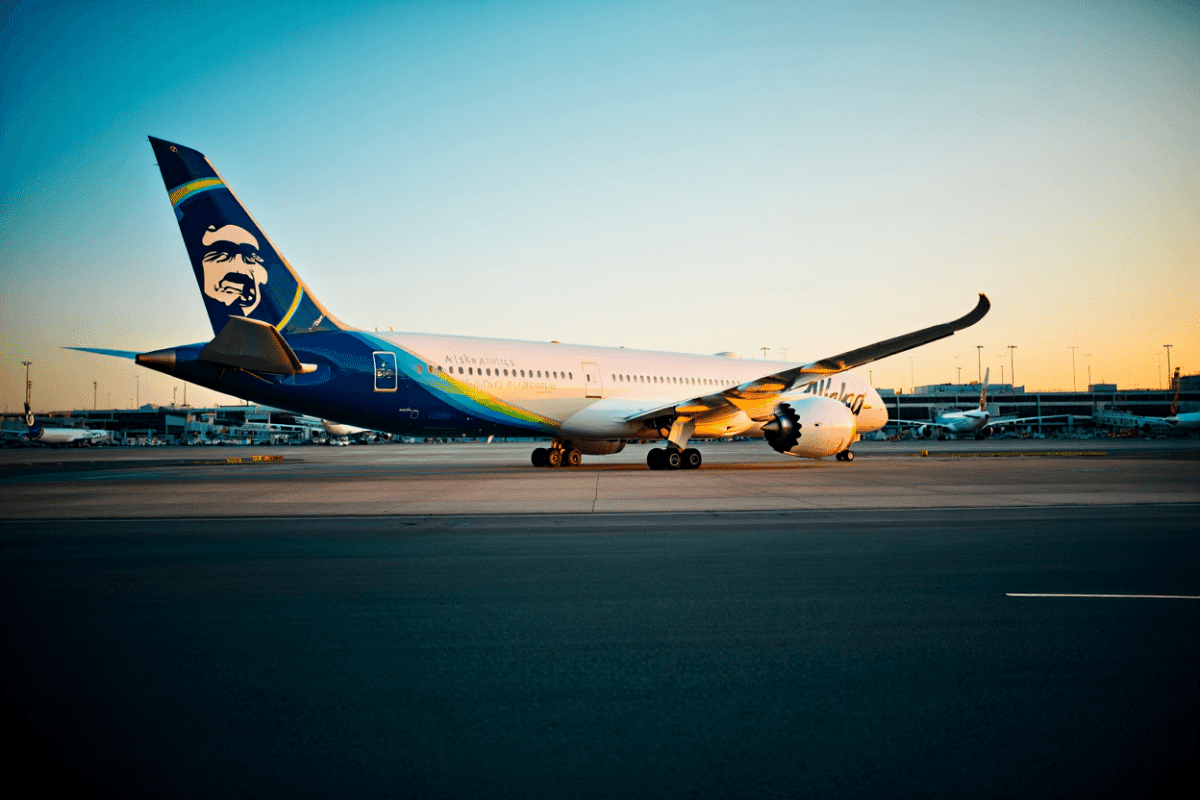
Alaska Airlines launched its first nonstop transatlantic service on May 21, 2026, connecting Seattle-Tacoma International Airport with London Heathrow Airport daily. The route marks a historic expansion for the Seattle-based carrier and positions the airline as a key competitor on the Pacific Northwest-Europe corridor. Flights depart Seattle at 9:40 PM Pacific Standard Time and arrive in London at 3:05 PM British Summer Time the following day, with westbound return flights completing the 10-hour-45-minute journey in slightly longer timeframes.
🔥 Quick Facts
- Service Launch: May 21, 2026 — First day of nonstop Seattle to London Heathrow flights
- Aircraft: Boeing 787-9 Dreamliner — 300-seat configuration with lie-flat business suites
- Frequency: Daily, Year-Round — Positioned out of London Heathrow Terminal 3
- Flight Duration: 10 hours 45 minutes — Outbound; inbound flights approximately 11 hours 20 minutes
- Route Expansion Goal: 12 Intercontinental Destinations — By 2030, across 17 Boeing 787 aircraft
Why This Route Represents Alaska’s Global Pivot
Alaska Airlines has undergone a dramatic transformation since acquiring Hawaiian Airlines, positioning itself no longer as a regional carrier but as a genuine international competitor. The Seattle-London service exemplifies this shift. For decades, the Pacific Northwest lacked consistent daily nonstop transatlantic access—passengers typically routed through hubs like San Francisco, Seattle-Tacoma itself via connections, or accepted longer journeys with connections. Texas and California dominated US-UK routes, but the SEA-LHR nonstop fills a structural gap in the market. Alaska is not the first US carrier on the route—British Airways, United, and American already operate Seattle-London services—but Alaska’s daily year-round commitment signals confidence in regional demand and reflects the carrier’s three-year plan to establish a widebody hub in Seattle with up to 17 Boeing 787 Dreamliners.
Fleet & Aircraft: The Boeing 787-9 Advantage
The Boeing 787-9 Dreamliner underpins Alaska’s long-haul ambitions. The aircraft, powered by Rolls-Royce Trent 1000 engines, delivers a 7,530-nautical-mile range—sufficient for Seattle to Rome, London, Reykjavik, and beyond. Alaska’s configuration optimizes for premium and economy revenue: 34 lie-flat International Business Suites with direct aisle access, 32 premium-economy seats, and 234 standard economy seats fill the 300-seat cabin. The Dreamliner’s advanced features—higher cabin humidity (65% vs. 40% on older aircraft), larger windows, optimized cabin pressure—address traveler fatigue on 10+ hour journeys. Passengers also gain complimentary Starlink satellite connectivity via Alaska’s partnership with T-Mobile, a competitive advantage versus legacy carriers.
| Route & Service Detail | Specification |
| Departure (Seattle/PDT) | 9:40 PM daily |
| Arrival (London/BST) | 3:05 PM +1 day |
| Return Departure (London/BST) | 8:00 PM |
| Return Arrival (Seattle/PDT) | 7:20 PM same day |
| Heathrow Terminal | Terminal 3 |
| Frequency | Daily, year-round |
| Aircraft | Boeing 787-9 Dreamliner (300 seats) |
| Fare Range (Westbound Summer) | From $343 one-way |
The timing of the 9:40 PM departure optimizes overnight transatlantic travel. Passengers depart Seattle in evening, sleep during the ~11-hour flight, and arrive mid-afternoon London time with a full day ahead. This contrasts with daytime departures, which compress sleep into red-eye conditions and limit arrival-day productivity. The Terminal 3 positioning at Heathrow gives Alaska seamless connections to British Airways flights and interline partners, facilitating European onward connections from London’s most congested but best-connected terminal.
“Alaska’s daily service will operate out of London Heathrow’s Terminal 3, offering U.S.-based guests a seamless way to reach one of the world’s most important aviation hubs. This marks the beginning of Alaska’s global expansion, with additional European routes planned in the coming years.”
— Alaska Airlines Global Expansion Statement, May 2026
Broader Strategic Implications: Industry Consolidation & West Coast Dominance
Alaska Airlines’ transatlantic entry reflects broader US aviation trends. Route expansion by low-cost carriers like Allegiant has intensified competition on domestic corridors, pushing legacy and regional players toward premium long-haul markets where margins remain stronger. The Seattle-London route directly engages British Airways, United, and American, but Alaska’s lower cost structure—inherent from Hawaiian Airlines merger synergies and regional operating efficiencies—offers fare competitiveness. Summer 2026 fares beginning at $343 one-way undersell many competitors’ promotional rates for the same route. The airline’s commitment to 12 intercontinental destinations by 2030 signals intent to rival Delta and United in European market share from the Pacific Northwest. Delta Air Lines, responding to this competitive pressure, recently launched Seattle-Rome service (4x weekly) and Seattle-Barcelona (3x weekly) on Airbus A330-900neo aircraft, matching Alaska’s aggressiveness in the SEA market.
What This Means for Travelers & The Transatlantic Landscape
Passengers gain genuine choice: Alaska’s lower fares, newer widebody product, and included Starlink connectivity pressure incumbents to improve value. Business travelers benefit from direct Seattle-London connectivity without multi-hour layovers in San Francisco, Seattle (connecting service), Chicago, or Dallas. Leisure travelers gain year-round daily frequency, reducing schedule conflicts. The route also strengthens Seattle-Tacoma’s competitive position as a major US transatlantic gateway, competing with San Francisco, New York JFK, Boston, and Newark for international passengers.
Operationally, the route tests Alaska’s ability to manage long-haul crew scheduling, maintenance, and fuel economics. The 10-hour-45-minute block time sits at the 787’s operating sweet spot for crew rest and fuel efficiency. Fuel hedging and jet fuel costs—currently elevated post-2022 price spikes—remain a profitability constraint, though Alaska’s Q1 2026 cost-per-available-seat-mile remained competitive versus legacy carriers.
Will Daily Seattle-London Service Prove Sustainable Long-Term?
Alaska’s long-haul commitments hinge on sustained demand and competitive dynamics. COVID-era route launches by United, American, and British Airways provided lessons: transatlantic leisure travel recovered robustly post-2021, but business travel remained structurally lower than pre-pandemic peaks as remote-work adoption persisted. Alaska’s year-round commitment—not seasonal, unlike some competitors’ initiatives—suggests confidence that Seattle business and leisure demand supports daily service year-round. Success depends on load factors (seat-fill rates) exceeding 80% and yield management preventing destructive fare wars. If Alaska achieves 65-70% load factors at competitive fares, the route becomes a template for Rome, Paris, Dublin, and Reykjavik routes. Conversely, capacity oversupply or economic downturn could compress yields, forcing reductions to seasonal or 5-6x weekly service. Historical precedent suggests nonstop transatlantic routes from secondary US hubs typically sustain when anchored by strong home-market demand and competitive cost structures—conditions Alaska appears to possess.
Sources
- Alaska Airlines Official Announcement (December 2025, May 2026) — Service launch details, aircraft specifications, terminal positioning
- Seattle Times — Route overview and operational details, May 21, 2026
- Travel and Tourism World — Global strategic context on Alaska’s transatlantic expansion
- Live and Let’s Fly / Aviation Industry Reports — Boeing 787-9 cabin configuration and Starlink integration
- Port of Seattle — Seattle-Tacoma International Airport transatlantic routes and competitive landscape