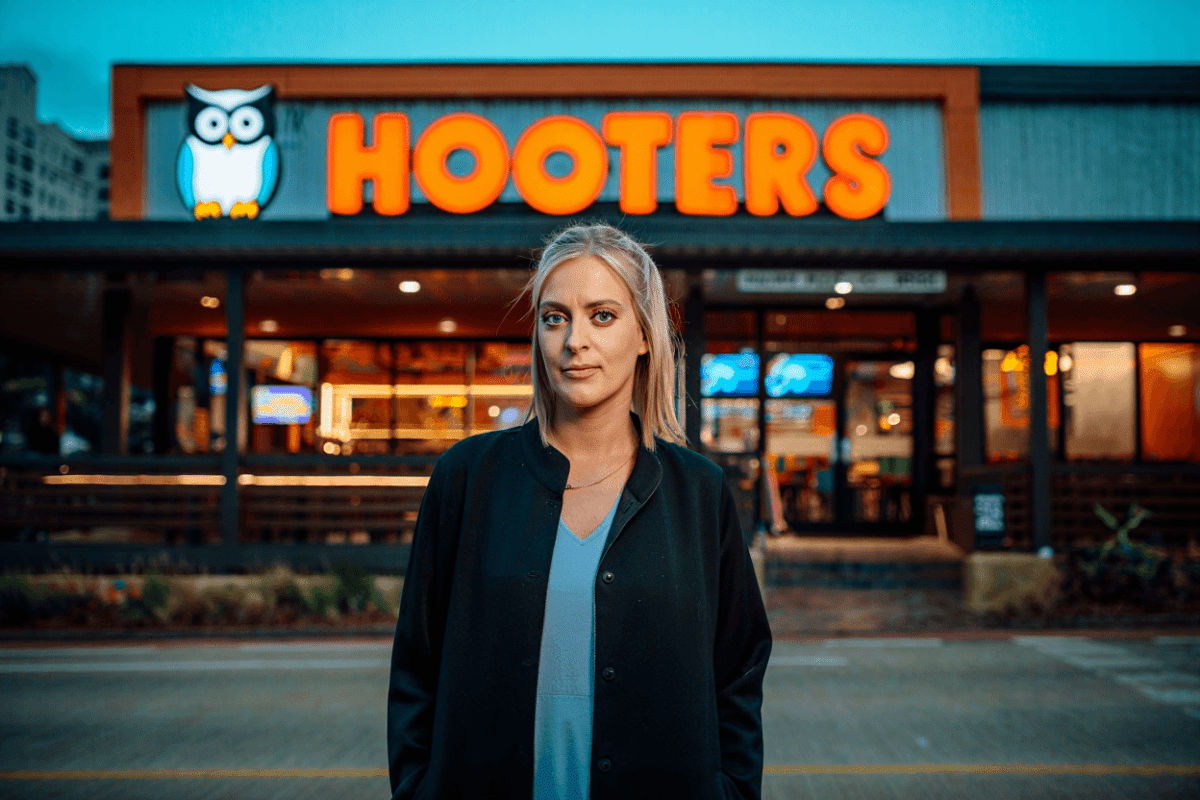
Hooters is undergoing a comprehensive rebrand after the company’s founding group reclaimed ownership from bankruptcy protection in October 2025. The transformation marks a return to the brand’s original family-friendly beach-themed concept, reversing years of private equity-driven expansion. Under founder-led leadership, Hooters is simplifying its menu, restoring classic uniforms, and refocusing on hospitality fundamentals rather than image-driven marketing—a strategic pivot that signals confidence in core business operations over peripherals.
🔥 Quick Facts
- Founders reclaimed Hooters in October 2025 after the chain exited Chapter 11 bankruptcy
- Private equity ownership lasted from 2019 to 2025, accumulating $376 million in debt
- All future Hooters will operate as franchises, eliminating corporate-owned locations
- Rebrand includes menu simplification and return to original uniform designs
- CEO Neil Kiefer leads “Original Hooters” management philosophy: core business excellence over brand spin
How Private Equity Debt Forced a Bankruptcy Crisis
Hooters of America filed for Chapter 11 on March 31, 2025, citing unsustainable debt accumulated during private equity ownership. The chain had been owned by PE firms since 2019, a period marked by aggressive expansion and margin compression. With 151 company-owned restaurants generating $359 million in annual revenue, the debt-to-revenue ratio became untenable when consumer traffic declined and operational costs surged under PE cost-cutting measures.
The bankruptcy filing was strategic, not catastrophic. Hooters operated continuously throughout restructuring with $40 million in debtor-in-possession financing, enabling uninterrupted service to franchisees and customers. By November 3, 2025, the restructuring was complete, and the founding group—the original entrepreneurs who built Hooters—had repurchased the brand.
The Founder Reclamation: Returning to Original Roots
Original Hooters, the founding management group, took back full operational and strategic control. This wasn’t simply a management change; it represented a philosophical reset. According to CEO Neil Kiefer, the approach centers on restoring authentic hospitality rather than relying on brand gimmicks. The “Re-Hooterization” initiative includes physical and operational upgrades: better equipment, streamlined service training, and a simplified menu focused on signature items like wings and comfort food.
The uniform strategy illustrates this philosophy. Rather than maintaining provocative imagery as a marketing hook, Hooters is reintroducing more modest, practical uniforms that align with the original 1983 concept—functional beach-casual attire emphasizing professionalism and approachability. This change acknowledges shifting consumer expectations: diners increasingly choose restaurants based on food quality and service, not aesthetic provocation.
Restructuring the Business Model: 100% Franchise Future
A critical strategic decision emerged during bankruptcy: Hooters will transition all locations to franchisee ownership. This eliminates corporate-owned restaurants entirely, shifting from a mixed corporate-franchise model to a pure franchise system. This change reduces capital requirements for the brand and aligns incentives directly with franchisee profitability.
| Metric | Pre-Bankruptcy (March 2025) | Post-Restructuring (Nov 2025) |
| Debt Burden | $376 million | Restructured / Eliminated |
| Company-Owned Locations | 151 restaurants | 0 (Full franchise conversion) |
| Ownership Structure | Private equity + franchises | Founder-led (Original Hooters) |
| Capital Requirements | High (corporate operations) | Low (franchise licensing model) |
| Strategic Focus | Growth / expansion | Operational excellence / brand authenticity |
The all-franchise model mirrors successful casual-dining franchises that prioritize unit economics over corporate infrastructure. Franchisees retain operational control while adhering to brand standards set by Original Hooters management.
“We’re not just acquiring restaurants—we’re taking back the Hooters name to show the world who we really are. This is about restoring trust with franchisees and customers by focusing on what made Hooters successful: great food, genuine hospitality, and a fun atmosphere.”
— Neil Kiefer, CEO, Original Hooters Management Group
Strategic Implications: What This Means for Restaurant Industry Recovery
Hooters’ founder-led rebrand signals broader industry trends in casual dining. After years of private equity ownership driving short-term financial engineering, founder-led management emphasizes sustainable operations and brand authenticity. The shift away from provocative marketing toward service excellence reflects consumer values: quality, consistency, and inclusivity matter more than shock value.
The success of similar turnarounds matters here. Compare this to recent restaurant chain closures accelerating in 2026—brands that failed to adapt business models faced liquidation. Hooters avoided that fate through bankruptcy-driven restructuring and founder reacquisition. The strategy prioritizes franchisee profitability, which stabilizes the brand ecosystem long-term.
Uniforms, Menu Simplification, and the “Tacky” Rebrand Conversation
One of the most debated aspects of the rebrand involves uniform changes. Hooters is introducing more practical, modest attire as part of its “tacky, family-focused roots” messaging. This terminology—while potentially tone-deaf in communications—reflects founder intent: move the brand away from being defined by server appearance and toward being defined by food quality and restaurant experience.
The menu simplification focuses on signature items: wings, seafood appetizers, comfort-food sandwiches, and beverages. By eliminating lower-performing dishes, Hooters improves kitchen efficiency, reduces waste, and allows servers to confidently recommend favorites. This operational discipline—trimming bloat introduced during PE expansion—is foundational to franchisee profitability.
What Comes Next: Testing the Founder-Led Recovery Model?
The real test of Original Hooters’ strategy begins in 2026. Can a founder-led brand executing focus, simplicity, and genuine hospitality compete in a casual-dining market dominated by established competitors? Hooters has structural advantages: recognizable brand identity, franchisee relationships earned over 40+ years, and elimination of corporate debt.
Expect the company to report franchisee satisfaction metrics, unit-level economics, and new location openings throughout 2026. These indicators will reveal whether the rebrand strategy resonates with restaurant operators and customers. The founder group betting their reputation on operational excellence over brand spectacle represents a contrarian move in an era of marketing-first strategy—and if it works, other brands may follow.
Sources
- Nation’s Restaurant News (NRN) – Hooters founders reclaim company after bankruptcy exit (October 2025)
- PR Week – Inside Hooters’ true return to its roots (January 2026)
- Hooters Corporate – Strategic action announcement and restructuring updates (March 2025)
- Fox Business – Hooters revamps menu and uniforms under original ownership (November 2025)
- Accordion Consulting – Chapter 11 restructuring analysis preserving iconic brand (February 2026)