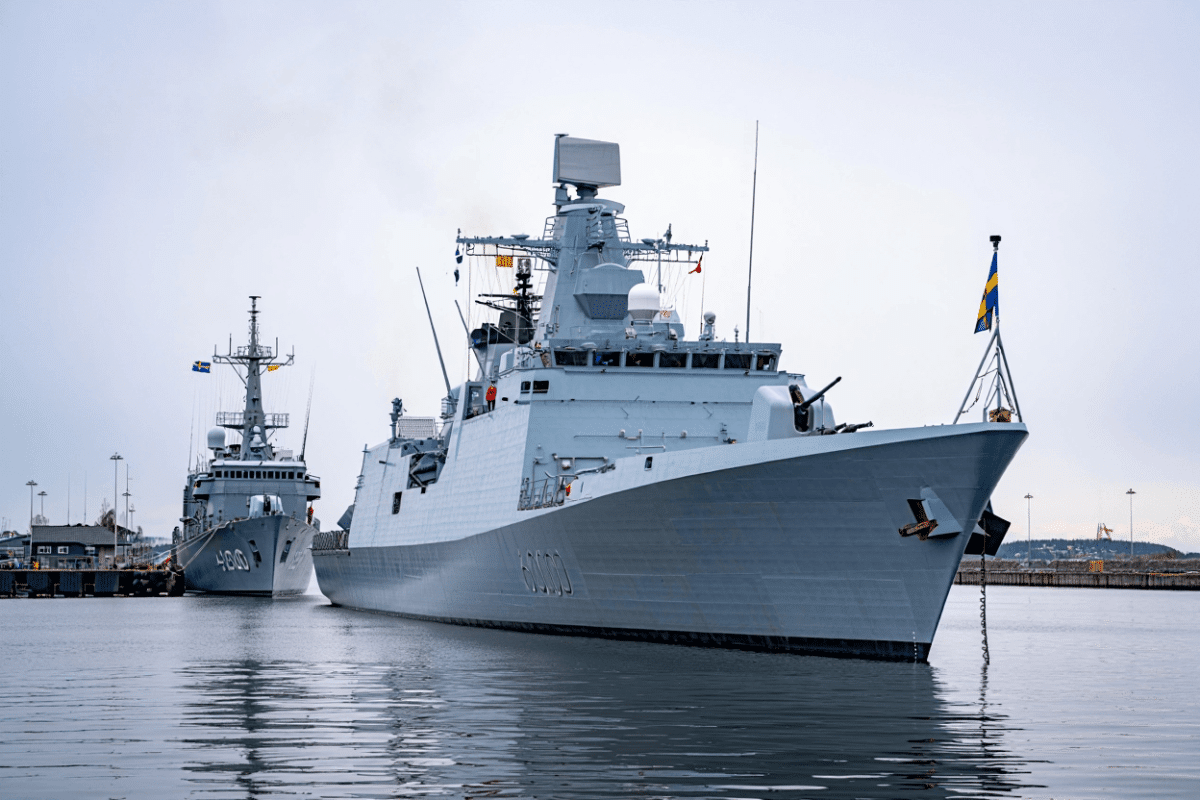
Sweden announced May 19 that it will acquire four FDI-class frigates from France’s Naval Group in a $4.25 billion deal that represents the country’s largest defense investment since the 1980s Gripen fighter jet program. The first vessel will arrive in 2030, with deliveries continuing annually through 2033, fundamentally transforming Sweden’s maritime capabilities as NATO’s newest member faces growing Baltic Sea security challenges.
🔥 Quick Facts
- Contract value: $4.25 billion (approximately 40 billion Swedish kroner)
- Quantity: Four FDI-class frigates called the Luleå class in Swedish service
- First delivery: 2030, with one ship annually thereafter
- Air defense boost: 3x capacity increase over existing Visby-class corvettes
- Primary competitor: UK Type 26 and Spain’s Alfa 4000 designs
Why Sweden Chose French Frigates Over British and Spanish Rivals
Sweden’s Defense Minister Pål Jonson emphasized that delivery speed was the decisive factor in the competition. Naval Group’s FDI design is already in active production—the French Navy commissioned its first FDI frigate, Amiral Ronarc’h, in 2025—while competing designs from UK Babcock International’s Arrowhead 120 and Spain’s Navantia Alfa 4000 were still in development phases. This operational advantage proved critical given Russia’s 2022 invasion of Ukraine and Sweden’s strategic realignment toward NATO’s Nordic defense posture.
Joint production economics also favored the FDI. Sweden identified the potential to share sustainment costs with France and Greece, which already operate the design. Additionally, the integrated air defense system—MBDA’s Aster 30 missiles with long-range capability—was proven and compatible with NATO integrated air defense architecture, eliminating integration risks that plagued some competing proposals.
Technical Specifications and Weapons Integration Strategy
The FDI displaces 4,500 tons and measures 122 meters in length, making it significantly larger than Sweden’s existing Visby-class corvettes (650 tons, 73 meters). The vessel operates at 27 knots maximum speed and features a 45-day operational autonomy, enabling sustained Baltic Sea and NATO-wide operations.
Swedish subsystems will integrate into French hulls. Saab’s RBS-15 anti-ship missiles, Torped 47 lightweight torpedoes, and Giraffe G1X compact radar will complement French systems. The frigates will also mount BAE Systems Bofors 57mm naval guns. The primary air defense suite combines MBDA’s Aster 30 Block 1NT system for long-range engagement with CAMM-ER medium-range missiles, rivaling land-based Patriot air defense in capability according to Swedish Supreme Commander Michael Claesson.
| Specification | FDI Class (Swedish Luleå) | Visby Class (Current) |
| Displacement | 4,500 tons | 650 tons |
| Length | 122 meters | 73 meters |
| Speed | 27 knots | ~25 knots |
| Primary Air Defense | Aster 30 + CAMM-ER | Point defense only |
| Unit Cost (est.) | ~$1.06 billion each | ~$500 million (1990s) |
| Operational Range | 45+ day autonomy | Limited blue-water |
Unit cost averages approximately $1.06 billion per frigate, making the acquisition comparable to modern destroyer programs in terms of per-ship investment. Sweden has allocated additional defense spending increases—18% boost in 2026 to reach 2.8% of GDP—partly to fund this modernization initiative.
“With our corvettes and frigates we are building naval operational control in the Baltic Sea together with our NATO allies. The frigates are important in keeping the Baltic Sea open for civilian and military transport to Finland and the Baltic States in case of an escalated conflict.”
— Johan Norlen, Chief of the Swedish Navy
Strategic Context: Baltic Security and NATO Realignment
Sweden retired its last frigate in the early 1980s, leaving the navy without long-range air defense capabilities for over 40 years. Prime Minister Ulf Kristersson stated the acquisition was essential because “the Baltic Sea has never in the modern era been as exposed, questioned and contested as it is now.” The Russian naval presence in the Baltic, combined with amphibious capability exercises near Swedish territory, accelerated the procurement timeline.
The 2030 delivery schedule aligns with NATO’s capability targets. Swedish defense spending is projected to reach 3.5% of GDP by 2030, significantly exceeding NATO’s traditional 2% baseline. This frigate acquisition represents the centerpiece of Sweden’s maritime modernization alongside ongoing A26 submarine development—vessels Poland has already agreed to purchase.
Implications for US-European Strategic Competition
The French victory over competing bids from UK-Swedish partnership and Spanish designs reaffirms European industrial consolidation in advanced warship production. Naval Group now operates FDI production lines serving France, Greece, and Sweden—three NATO countries—establishing a European frigate standard that reduces dependence on non-European suppliers. The FDI uses fully digital architectures and integrated combat management systems compatible with NATO command structures, enabling rapid interoperability.
For American defense planners, the deal signals Sweden’s confidence in NATO’s collective defense framework. The choice reflects both proven design maturity and Swedish preference for standardized European capabilities over potential US systems, despite American relationships with both Saab and other Swedish defense firms.
What Happens When First Frigate Arrives—And What Sweden Must Do First
Swedish Defence Materiel Administration (FMV) now enters contract negotiations with Naval Group, anticipated to conclude within 12-18 months. Negotiations will focus on final weapon system integration, Swedish subsystem customization timelines, and training crew preparation. The first frigate, tentatively named HMS Luleå, will undergo Swedish Navy acceptance trials in 2030 before formal commissioning.
Sweden must also prepare shore infrastructure. The larger Luleå-class vessels require deeper berthing, expanded ammunition storage, and significantly increased manning compared to existing corvette operations. Existing Visby-class corvettes will receive upgrades with enhanced air defense capability to complement the new frigates, extending their operational relevance into the 2040s.
The acquisition also opens doors for further Sweden-France cooperation on emerging capabilities. France already ordered two Saab GlobalEye airborne early-warning aircraft in December 2025—a reciprocal relationship that demonstrates deepening Nordic-French defense industrial relationships post-Ukraine.
Sources
- Reuters – Swedish frigate selection announcement and strategic context
- Defense News – Technical specifications and competing designs analysis
- Naval Group – FDI frigate technical data and production capacity
- Swedish Government/Defense Ministry – Official statements and budget allocations
- NATO/Swedish Navy statements – Strategic implications and operational doctrine