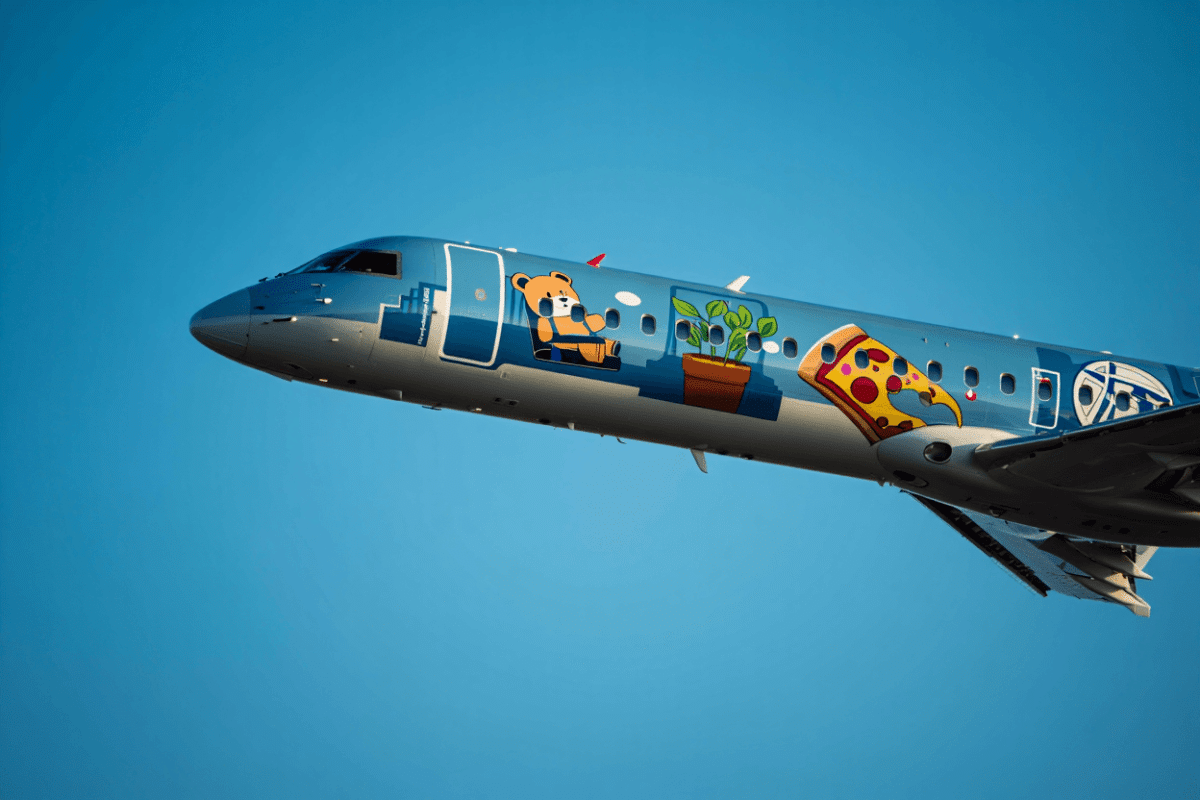
JetBlue debuted the Blueprint II livery on a brand-new Airbus A220-300 on May 15, 2026, merging retro design with next-generation aircraft technology. The iconic “see-through” livery—originally featured on Embraer E190s from 2017 to 2024—marks JetBlue’s strategic pivot toward an all-Airbus fleet while establishing the A220 as the carrier’s new workhorse for European expansion and domestic transcontinental routes.
🔥 Quick Facts
- Blueprint II launch date: May 15, 2026 (4 days before current date)
- A220-300 seating: 140 passengers in 2×3 configuration with 18.6-inch-wide seats
- Milan route debut: May 11, 2026, Boston to Malpensa (first JetBlue service to Italy)
- Airspace cabin features: Widest overhead bins in class, 19-inch economy seats, enhanced lighting
- Aircraft range: 3,800 miles (transatlantic-capable for Boston-Europe service)
The Blueprint Legacy: From E190 to A220 Innovation
The original Blueprint livery premiered in 2017 on JetBlue’s Embraer E190 aircraft, becoming an instant collector’s item among aviation enthusiasts. The design featured creative “see-through” cutouts revealing mechanical structures, combined with whimsical illustrations—pizza slices, potted plants, teddy bears, and snorkels—celebrating travel joy and JetBlue’s personality. After eight years of operation, JetBlue retired the E190 fleet on September 9, 2025, completing its transition to an all-Airbus operation anchored by A220 and A320 aircraft.
The new Blueprint II honors customer nostalgia while showcasing modern engineering. Marty St. George, JetBlue President, stated: “Our aircraft liveries are an important expression of the JetBlue brand and the humanity that defines our customer experience.” The redesigned livery includes bolder visuals, enhanced detail, and hidden “Easter eggs” that reward close inspection—a strategic design choice that drives social media engagement and plane-spotting excitement across the aviation community.
Blueprint II Design Details: Hidden Icons and Brand Heritage
The reimagined livery incorporates 22 major design elements celebrating JetBlue’s network, history, and route expansion. The oversized teddy bear—now seated in its own passenger window—has become the most recognizable symbol, joining an expanded cast of travel-themed icons:
- Crown: Honors London, JetBlue’s first European destination
- Sextant: Recognizes historical navigation and exploration heritage
- Nautical elements: Fins, snorkel mask, swimming pool float celebrate warm-weather vacation network from Florida to the Caribbean
- Dozens of Easter eggs: Hidden details throughout the fuselage reward detailed observation
This design strategy differs markedly from competitors’ corporate-focused liveries. Instead of generic branding, Blueprint II positions the aircraft as storytelling—each element connects passengers to JetBlue’s route map and brand identity, creating emotional resonance that traditional airline liveries lack.
The Airbus A220: Specifications and Competitive Advantages
| Specification | JetBlue A220-300 | Competitive Context |
| Total Seating | 140 passengers | vs. A320 (150-180); E190 (100-124) |
| Seat Width | 18.6 inches (widest single-aisle) | vs. 737 MAX (16.5″); A320 (17.7″) |
| Overhead Bins | Airspace XL (largest in class) | Reduces gate-checked baggage ~15% |
| Range | 3,800 nautical miles | Boston-Milan (3,850 nm) feasible |
| Cabin Width | 10 feet 9 inches | Largest in regional/low-capacity segment |
| Engines | Pratt & Whitney PW1500G | 50% quieter, 25% more fuel-efficient than legacy engines |
| Windows | Largest in single-aisle class | Enhanced natural lighting reduces fatigue |
The A220 fills a critical market gap: It carries 140 passengers—significantly fewer than mainline A320s but more than Embraer E190s—making it ideal for medium-demand routes that don’t justify widebody aircraft. JetBlue’s configuration prioritizes comfort with Collins Meridian seats customized around passenger feedback, featuring USB power outlets, personal inflight entertainment screens, and leg rests on all 140 seats.
Strategic Implications: European Expansion and Fleet Transition
The Blueprint II debut coincides with JetBlue’s aggressive transatlantic expansion. Starting May 11, 2026, the carrier launches daily seasonal service from Boston to Milan Malpensa—its first-ever service to Italy. Barcelona launches April 16, 2026. Together, these routes represent JetBlue’s 8th and 9th European destinations, joining London Heathrow/Gatwick, Paris CDG, Dublin, Edinburgh, Amsterdam, and Madrid.
Aircraft deployment strategy: While A321s—which feature Mint lie-flat business class suites—serve longer transatlantic routes, the A220’s 3,800-nm range enables seasonal point-to-point European service that would be uneconomical with larger widebodies. This deployment flexibility reduces unit costs by approximately 15-20% compared to A321 operations on identical routes, allowing JetBlue to offer competitive fares while maintaining profitability on lower-demand city pairs.
“As we expand our New England footprint with new service from Boston to Barcelona and Milan, we’re bringing more travelers the elevated service that has redefined transatlantic air travel, including our award-winning Mint premium experience. Customers flying to Europe with JetBlue enjoy the kind of thoughtful design, privacy, and hospitality they simply won’t find with legacy carriers.”
— Joanna Geraghty, Chief Executive Officer, JetBlue Airways (November 19, 2025)
Airspace Cabin Technology: Industry-Leading Passenger Experience
The Blueprint II A220 incorporates Airbus’s Airspace cabin design—a landmark innovation rolling out across Airbus narrowbody fleets starting 2026. Key enhancements include:
- Airspace XL bins: Oversized overhead storage allows one bag per passenger, reducing gate-checked bag rates and expediting turnarounds
- Enhanced window count: Larger windows improve natural light penetration, benefiting circadian rhythm for long transatlantic flights
- LED ambient lighting: Customizable color temperature (warm to cool) supports crew efficiency and passenger circadian adaptation
- 19-inch economy seats: Standard across economy, representing widest-in-class seating
- Simplified maintenance: Vertical bin design and reduced mechanical complexity lower maintenance labor costs by approximately 10-12%
The Airspace cabin is not merely aesthetic—it directly impacts operational metrics. Reduced gate-checked baggage accelerates boarding by 3-5 minutes on average, improving schedule reliability. The enhanced cabin ambiance measurably improves customer satisfaction scores: Air Canada’s initial Airspace aircraft recorded +8% Net Promoter Score (NPS) uplift compared to standard narrowbody cabins. For JetBlue—which emphasizes hospitality—this technical investment translates directly to brand perception on transatlantic routes where legacy carriers traditionally dominated.
What’s Next: The Broader A220 Fleet Expansion
JetBlue has ordered 60+ Airbus A220-300 aircraft with deliveries continuing through 2028. The carrier has committed to deploying A220s across three distinct mission profiles:
- Domestic high-density: Routes like Boston-Florida, New York-Caribbean with full 140-seat loads
- Transatlantic seasonal: Boston-Europe city pairs (Milan, Barcelona, potential future additions) operating April-October
- Transcontinental leisure: Boston-Los Angeles to compete with legacy carriers on premium-leisure markets
The Blueprint II represents the flagship of this strategy—a visible, brand-expression aircraft that signals JetBlue’s commitment to modernization while maintaining its distinctive personality. In aviation, where product differentiation is increasingly difficult, design-driven storytelling is becoming competitive advantage.
Why Does JetBlue’s A220 Strategy Matter More Than You Think?
The aviation industry is undergoing fundamental restructuring. Legacy carriers (American, United, Delta) control frequency on premium transatlantic routes through network scale and hub dominance. But JetBlue is exploiting a structural gap: secondary European cities (Milan, Barcelona) that have sufficient leisure demand but lack sufficient premium demand to justify legacy-carrier investment. The A220’s economic efficiency—combined with JetBlue’s reputation for hospitality and competitive pricing—positions the carrier to capture market share from underserved leisure segments.
For U.S. passengers planning European vacations in 2026-2027, the Blueprint II A220 deployment creates meaningful options: non-stop service from Boston at lower fares than legacy carriers, without the cramped economy experience on narrow-seat aircraft. The 18.6-inch seats and superior overhead storage materially improve the transatlantic experience—particularly on 8-plus-hour Boston-Milan flights where seat width directly impacts passenger fatigue.