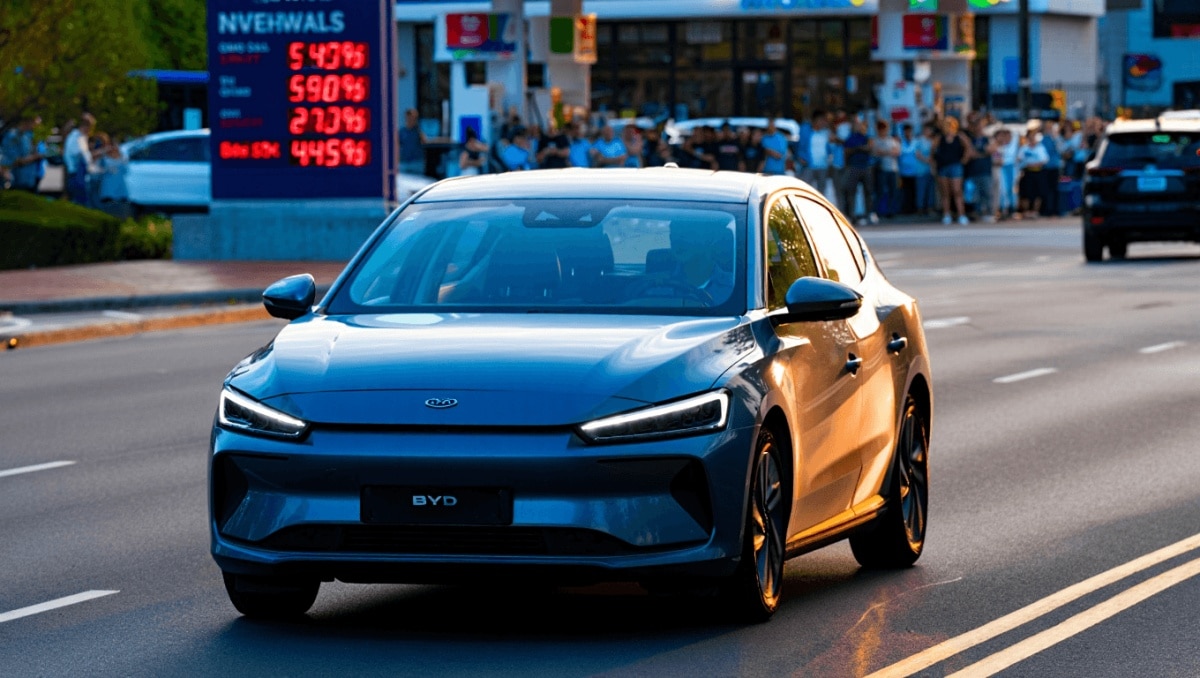
Rising global fuel costs are giving a fresh tailwind to China’s BYD as it pushes deeper into overseas markets. With Brent crude above $100 a barrel and pump prices climbing, the maker of low-cost, tech-heavy electric vehicles says higher fuel bills are accelerating demand for its cars — a shift with immediate consequences for buyers and incumbent automakers.
BYD executives told Reuters they are “highly confident” of meeting or surpassing an overseas sales goal of 1.5 million vehicles this year, and company insiders estimate foreign markets could eventually represent roughly half of its sales. That marks a rapid transition from a domestic champion to a global competitor that is undercutting legacy brands on price and pushing the pace of battery development.
Global push meets high fuel costs
Oil prices have climbed since the outbreak of conflict in Iran, lifting Brent crude more than 40% in the last month and keeping the benchmark above $100 per barrel. The jump has translated into higher retail fuel costs and, in several places, government measures aimed at reducing driving — moves that tend to raise the short-term appeal of electric cars.
While price swings alone do not guarantee sustained EV adoption, industry observers say the current environment creates a clearer window for aggressively priced models to gain market share beyond China.
- Immediate effect: Higher gasoline costs make lower-cost EVs relatively more attractive to shoppers.
- Market reach: BYD is rapidly shipping vehicles to South and Central America, Europe and Australia, with Canada expected to follow.
- US access limited: Tariffs and regulatory barriers continue to impede large-scale entry into the American market.
A broad lineup stretching into new markets
BYD sells a wide range of models, from an entry-level hatchback to luxury vans and high-performance sports cars. Dealers and social posts from early markets show demand often outstripping supply — in Australia, some buyers reported test drives booked more than a week in advance.
Price comparisons are striking in some markets. In Australia, average prices for mainstream ICE and hybrid models from Toyota, Ford and Hyundai sit between about AU$44,000 and AU$62,000, while local offers list BYD’s Atto 1 hatchback for under AU$25,000 — a gap large enough to reshape shopping lists for cost-conscious buyers.
Battery claims and competitive pressure
Technological advances are a key part of BYD’s pitch. This month the company unveiled its new Blade 2.0 battery, which BYD says can charge from 10% to 70% in five minutes and provide more than 620 miles of range. Those figures, presented by the manufacturer, would represent a significant leap over current charging times and ranges in many markets.
Other Chinese automakers — including NIO, Li Auto, XPeng and electronics firms that have entered the vehicle space — are offering similarly aggressive pricing and battery claims, adding to competitive pressure on established global brands.
Industry veterans have noticed. Adam Bernard, founder of AutoPerspectives and a former GM executive, told reporters that many automakers are worried because BYD is developing a full product lineup and expanding its global footprint. Ford CEO Jim Farley has publicly acknowledged that some Chinese EVs appear, in his view, to outpace U.S. offerings. And Toyota’s CEO Koji Sato told suppliers the sector faces an existential commercial test unless incumbents adapt, according to Automotive News.
Limits and longer-term risks
Despite momentum, there are clear constraints. Regulatory hurdles and tariffs keep most Chinese brands from selling widely in the U.S., and concerns remain over long-term profitability, shifting government incentives, and potential consumer pushback in some markets.
“Gas prices move, and behavior follows — but not always for long,” Bernard observed, cautioning that fuel shocks can spur short attention spans rather than sustained shifts.
- Regulatory barriers: The U.S. market remains largely closed to many Chinese-made EVs due to tariffs and rules on software and safety.
- Profitability questions: Rapid expansion and heavy pricing pressure could strain margins over time.
- Demand volatility: Fuel-price-driven interest in EVs may ebb if oil markets stabilize.
For consumers, the near-term consequence is clearer: more affordable, feature-rich electric options arriving faster in many countries — and renewed competition among automakers to respond with lower prices, faster charging and improved vehicle software. For legacy manufacturers, the challenge is adapting product, cost and distribution strategies while regulatory and geopolitical barriers continue to shape where and how competition unfolds.