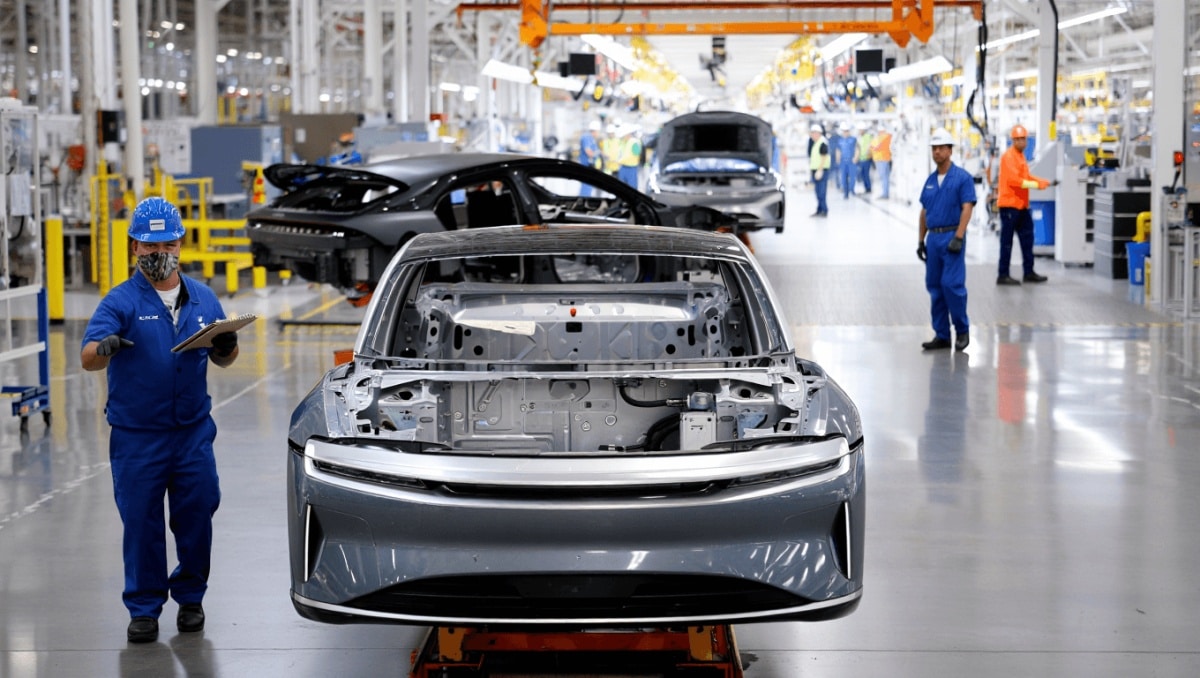
Lucid’s momentum from a stronger 2025 stalled in the first quarter of 2026 after the company delivered far fewer cars than it built, citing a parts-quality problem that interrupted shipments and triggered a recall. The disruption highlights how a single supplier issue can ripple through production targets and customer deliveries at a critical moment for the EV maker.
Production outpaced deliveries
Lucid reported it built roughly 5,500 vehicles in Q1 but only delivered 3,093 — a steep decline from the prior quarter and slightly below year-ago deliveries. The company said the shortfall is not driven by weak demand but by a supplier-related defect that temporarily halted sales of its SUV.
| Metric | Reported figure | Context / comparison |
|---|---|---|
| Q1 deliveries | 3,093 vehicles | Down ~42% from Q4; ~0.5% below Q1 last year |
| Q1 production | ~5,500 vehicles | Significant gap vs. deliveries |
| Recall | >4,000 Gravity SUVs | Second-row seat-belt anchor welding issue |
| 2025 production | 18,378 vehicles | Baseline for 2026 growth targets |
| 2026 guidance | 25,000–27,000 vehicles | Reaffirmed despite Q1 disruption |
What went wrong
Lucid traced the delivery interruption to a supplier that implemented an unapproved change affecting the welding of anchors used in the SUV’s second-row seat belts. That fault prompted a company-wide stop on sales of the affected SUV model for most of February while teams verified vehicle safety and rectified the issue.
The company notified regulators and initiated a recall covering more than 4,000 SUVs to correct the welding problem. A Lucid spokesperson said the pause was intended to preserve quality and that a stronger finish to the quarter — particularly in January and March — nearly offset the year-over-year comparison on their own.
Implications for customers and the company
Short-term, owners waiting for deliveries of the Lucid SUV faced delays and an inconvenience for dealers managing inventory. For Lucid, the episode underscores a vulnerability: even as EV makers scale up production, supplier changes or quality lapses can stall shipments and dent quarterly results.
- Consumers: Potential delays and additional service appointments if recalled vehicles need repair.
- Investors: A cautionary flag on execution risk despite maintained production guidance.
- Supply chain: Greater scrutiny on supplier approvals and incoming quality checks.
- Competition: Lucid’s planned lower-cost model faces a tighter time window to reach market on schedule.
Lucid says the supplier problem has been addressed and confirmed its target to produce between 25,000 and 27,000 vehicles in 2026 — a jump possible from last year’s 18,378 units if the company can sustain steady deliveries. That ramp matters because Lucid is about to start production on a new, lower-priced platform expected to yield a roughly $50,000 model aimed squarely at mainstream rivals such as Rivian’s R2 and established EV entries from Tesla and Chevrolet.
For now, the company’s ability to meet its annual goal will depend on keeping supplier issues contained as it scales. Observers will be watching upcoming monthly delivery updates and any further actions from regulators to see whether the disruption has lasting effects on Lucid’s growth trajectory.